My Socialist Hall of Fame
During this chaotic era of vile rhetoric and manipulative tactics from our so-called bourgeois leaders, I am invigorated by the opportunity to reflect on Socialists, Revolutionaries, Philosophers, Guerrilla Leaders, Partisans, and Critical Theory titans, champions, and martyrs who paved the way for us—my own audacious “Socialism’s Hall of Fame.” These are my heroes and fore-bearers. Not all are perfect, or even fully admirable, but all contributed in some way to our future–either as icons to emulate, or as warnings to avoid in the future.
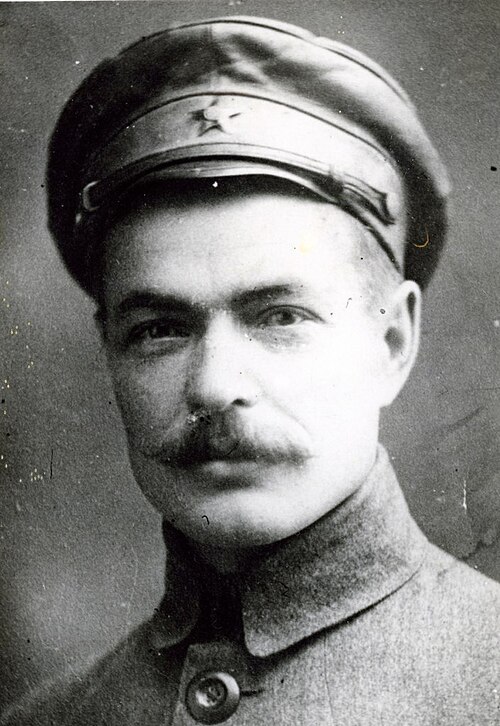
Ivan Petrovich Bakayev occupies a paradoxical place in the history of the Soviet Union. He belonged to the generation of Old Bolsheviks whose revolutionary commitment helped bring the Bolsheviks to power in 1917, participated in the construction of the Soviet state during the Civil War, and held important positions within the Cheka, the revolutionary security apparatus. Yet the same revolutionary state that Bakayev helped consolidate ultimately consumed him during Joseph Stalin’s Great Purge. His career illustrates the transformation of the Bolshevik Party from a revolutionary movement characterized by intense internal debate into a bureaucratized dictatorship that increasingly equated political disagreement with treason.
Born in 1887 into a poor peasant family in Saratov Province, Bakayev experienced firsthand the social inequalities that radicalized many young workers and peasants during the final decades of the Russian Empire. He entered the revolutionary movement during the upheaval of the 1905 Revolution, joining the Russian Social Democratic Labour Party while organizing underground activity in Kamyshin. Although the local organization had not yet divided decisively between Bolsheviks and Mensheviks, Bakayev aligned himself with Lenin’s faction in 1906. His commitment reflected not merely ideological preference but confidence in the disciplined revolutionary organization advocated by the Bolsheviks.
Like many professional revolutionaries of his generation, Bakayev spent years engaged in clandestine work. He organized Bolshevik activities in Baku, Astrakhan, and Saint Petersburg while repeatedly suffering arrest under the tsarist regime. Altogether he spent approximately six years imprisoned before the collapse of the Romanov monarchy in 1917. These experiences forged both his revolutionary credentials and his reputation for organizational discipline, characteristics that later facilitated his rapid advancement after the February Revolution.
Following the overthrow of Nicholas II, Bakayev emerged as an important functionary within the Petrograd Soviet. During the October Revolution he served first as deputy secretary and later as secretary of the Soviet, participating directly in the administrative coordination of Bolshevik power during one of the defining moments of twentieth century history. Unlike many revolutionary leaders remembered primarily for military command or theoretical contributions, Bakayev’s strengths lay in organization, administration, and party discipline.
During the Russian Civil War, Bakayev served as a political commissar on both the Ural and Petrograd fronts before assuming one of the most controversial positions of his career. Between September 1919 and August 1920 he chaired the Petrograd Cheka, the regional branch of the Soviet political police established under Felix Dzerzhinsky. The Cheka operated amid the extraordinary circumstances of civil war, foreign intervention, economic collapse, and widespread armed resistance to Bolshevik rule. Within this environment it exercised sweeping authority to suppress counterrevolutionary activity through arrests, imprisonment, and executions. The institution became inseparable from the Red Terror, a policy that remains one of the most contested aspects of the revolutionary period.
Bakayev’s tenure within the security apparatus illustrates the moral and political contradictions confronting many early Bolsheviks. Revolutionary leaders frequently justified extraordinary repression as a temporary necessity required to defend the workers’ state against military encirclement and domestic insurrection. Historians continue to debate both the extent of this necessity and the degree to which emergency institutions established during the Civil War became permanent instruments of authoritarian rule. Bakayev himself would later become a victim of the coercive state whose foundations he had helped administer.
After the Civil War, Bakayev remained a trusted party administrator. Following service directing Cheka operations in southeastern Russia, he returned to Petrograd in 1922. There he supervised government efforts to compel Metropolitan Benjamin and the Russian Orthodox Church to recognize the pro-Soviet Renovationist movement. When Benjamin refused, he was arrested, tried, and executed. This episode reflected the broader Bolshevik campaign to subordinate religious institutions to Soviet authority while simultaneously revealing the increasingly coercive methods employed by the postwar state.
Bakayev’s political trajectory shifted dramatically after Lenin’s death. During the factional struggles of the mid 1920s he aligned himself with Grigory Zinoviev and Lev Kamenev against Stalin. As chairman of the Communist Party Control Commission for the Leningrad region between 1924 and 1926, he occupied a significant organizational position, yet he ultimately chose loyalty to the Leningrad Opposition over accommodation with Stalin’s consolidating leadership. This decision proved decisive for his future.
In 1927 Bakayev was expelled from the Central Control Commission and from the Communist Party itself for supporting the United Opposition. Like Zinoviev and Kamenev, he eventually capitulated and acknowledged the party leadership’s authority. Readmitted in 1928, he occupied comparatively minor economic posts thereafter. His political rehabilitation, however, proved superficial. Under Stalin, former oppositionists remained permanently suspect regardless of subsequent professions of loyalty.
The assassination of Sergei Kirov in December 1934 marked the beginning of the final phase of Bakayev’s life. Security forces searched his apartment, discovered old opposition materials, and arrested him. Initially sentenced to imprisonment after a closed trial in January 1935, he was later returned to Moscow as one of the principal defendants in the First Moscow Trial of August 1936. During the proceedings he confessed to participation in an alleged terrorist conspiracy organized by Zinoviev and Kamenev. Modern scholarship overwhelmingly regards these confessions as products of coercion rather than reliable historical evidence. Following conviction, Bakayev was executed on 25 August 1936. His wife, Anna Kostina Bakayeva, was likewise arrested and executed later that year.
Bakayev’s historical significance extends beyond his personal biography. His career embodies several central contradictions of Soviet history. First, he represented the revolutionary generation whose commitment and sacrifice enabled the Bolshevik seizure and consolidation of power. Second, his service within the Cheka demonstrates the central role played by coercive institutions in defending the Soviet state during its formative years. Third, his later association with the Left Opposition reveals that many experienced revolutionaries rejected Stalin’s growing bureaucratic centralization. Finally, his execution during the Moscow Trials exposed the fundamentally self destructive character of Stalin’s political terror, which systematically eliminated many of the very individuals who had built the Soviet regime.
Bakayev was posthumously rehabilitated by the Soviet Supreme Court in 1988 during the era of glasnost. His rehabilitation reflected the broader reassessment of the Moscow Trials as judicial fabrications that had criminalized legitimate political disagreement within the Communist Party.
From a historical perspective, Ivan Bakayev should neither be reduced solely to his role as a Cheka official nor remembered exclusively as a victim of Stalinism. Rather, he represents the tragic complexity of the revolutionary generation itself. He participated in constructing institutions of extraordinary political repression while later falling victim to an even more expansive machinery of terror. His life illustrates how revolutions often transform their own architects into casualties of the political systems they helped create.
Bibliography
Getty, J. Arch, and Oleg V. Naumov. The Road to Terror: Stalin and the Self Destruction of the Bolsheviks, 1932–1939. Yale University Press, 2010.
Leggett, George. The Cheka: Lenin’s Political Police. Oxford University Press, 1981.
Montefiore, Simon Sebag. Stalin: The Court of the Red Tsar. Vintage Books, 2005.
Service, Robert. Stalin: A Biography. Belknap Press of Harvard University Press, 2005.
Service, Robert. The Russian Revolution, 1900–1927. Palgrave Macmillan, 2009.
Tucker, Robert C. Stalin as Revolutionary, 1879–1929. W. W. Norton, 1973.
Volkogonov, Dmitri. Lenin: A New Biography. Free Press, 1994.


Leave a Reply