My Socialist Hall of Fame
During this chaotic era of vile rhetoric and manipulative tactics from our so-called bourgeois leaders, I am invigorated by the opportunity to reflect on Socialists, Revolutionaries, Philosophers, Guerrilla Leaders, Partisans, and Critical Theory titans, champions, and martyrs who paved the way for us—my own audacious “Socialism’s Hall of Fame.” These are my heroes and fore-bearers. Not all are perfect, or even fully admirable, but all contributed in some way to our future–either as icons to emulate, or as warnings to avoid in the future.
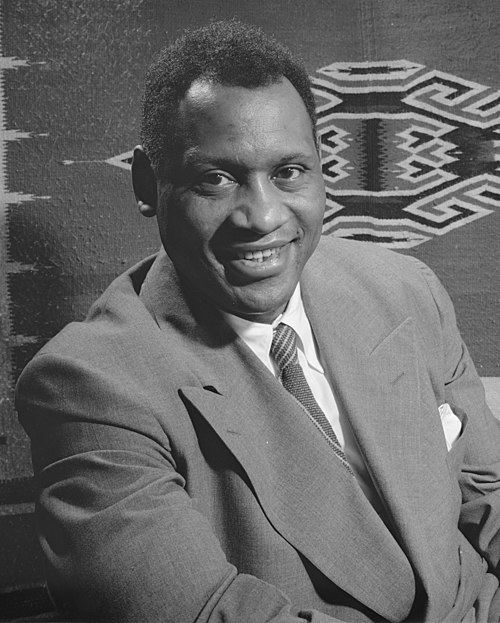
Any biography of Paul Robeson must account for the unusual breadth of his intellectual formation, artistic achievement, and political commitment. Few twentieth century figures moved so fluidly across domains of culture, law, and international politics while sustaining a coherent critique of racial capitalism and imperial power. Robeson’s life, spanning from 1898 to 1976, offers a singular case study in the convergence of Black radical thought, performance, and global anti fascist struggle.
Paul Leroy Robeson was born on April 9, 1898 in Princeton, New Jersey, the son of William Drew Robeson, a formerly enslaved man who became a minister, and Maria Louisa Bustill, a teacher from a prominent Black Quaker family. This dual inheritance of clerical discipline and intellectual ambition shaped Robeson’s early life. At Rutgers University, he emerged as one of the most accomplished students of his generation. He was valedictorian of the class of 1919, a Phi Beta Kappa inductee, and a standout athlete who earned All American honors in football. Robeson’s collegiate experience, however, was also marked by intense racial hostility, including violent hazing, which sharpened his awareness of structural racism within American institutions.
After Rutgers, Robeson attended Columbia Law School, supporting himself through professional football and early theatrical work. He briefly practiced law but abandoned the profession after confronting overt racism in the legal field. This turning point redirected him toward the stage, where he began to cultivate the voice and presence that would make him an international figure.
Robeson’s artistic career took shape in the 1920s and 1930s, particularly through his collaborations in theater and film. His performance in Othello became one of the most celebrated interpretations of the role, notable for its psychological depth and refusal of minstrel conventions. He also starred in Eugene O’Neill’s plays, including The Emperor Jones and All God’s Chillun Got Wings, where his performances interrogated the racialized structures embedded within American drama. As a singer, Robeson achieved global acclaim for his renditions of spirituals, folk songs, and labor anthems, treating them not as relics but as living expressions of collective struggle. His interpretation of “Ol’ Man River,” for example, evolved over time into an explicitly political statement, transforming the song’s fatalism into defiance.
By the mid 1930s, Robeson’s intellectual and political commitments deepened significantly. His travels in Europe and the Soviet Union brought him into contact with socialist and anti colonial movements, leading him to embrace a broadly Marxist analysis of race and class. During the Spanish Civil War, he supported the Republican cause, performing for troops and articulating the struggle against fascism as inseparable from the fight against racial oppression. Robeson’s politics were not ancillary to his art; rather, they constituted its organizing principle. He viewed culture as a weapon in the broader struggle for human emancipation.
In the United States, Robeson became a leading voice in labor activism and civil rights, aligning himself with organizations such as the Congress of Industrial Organizations and advocating for Black workers’ rights. His outspoken criticism of American racism and his refusal to repudiate the Soviet Union during the early Cold War placed him at odds with the political establishment. The postwar period saw Robeson subjected to intense repression. During the era commonly associated with McCarthyism, he was blacklisted, his concerts were canceled or violently disrupted, and in 1950 the U.S. government revoked his passport, effectively silencing his international career for nearly a decade.
Robeson’s 1956 appearance before the House Un-American Activities Committee remains one of the most significant moments in the history of American political dissent. Refusing to recant his beliefs, he asserted both his dignity and his critique of systemic injustice, famously declaring that his father had been a slave and that he would not be intimidated into silence. This confrontation underscored the extent to which Robeson’s life had become inseparable from the broader struggles over democracy, dissent, and ideological conformity in the United States.
Despite the partial restoration of his passport in 1958, Robeson’s later years were marked by declining health and reduced public activity. Nevertheless, his legacy endured as a foundational influence on subsequent generations of artists and activists. Figures in the Civil Rights and Black Power movements drew upon his example of internationalism and cultural resistance, while scholars have continued to reassess his contributions within frameworks of diaspora studies, performance theory, and political history.
In assessing Robeson’s life, it is essential to recognize the unity of his endeavors. He was not merely an artist who held political views, nor a political figure who happened to perform. Rather, his work exemplifies a dialectical relationship between culture and politics, in which artistic expression becomes both a site of struggle and a means of articulating alternative futures. His career challenges conventional disciplinary boundaries and demands an interpretive approach attentive to the intersections of race, class, nation, and performance.
Bibliography
Duberman, Martin B. Paul Robeson: A Biography. New York: Knopf, 1988.
Foner, Philip S., ed. Paul Robeson Speaks: Writings, Speeches, Interviews, 1918–1974. New York: Citadel Press, 1978.
Horne, Gerald. Paul Robeson: The Artist as Revolutionary. London: Pluto Press, 2016.
Naison, Mark. “Paul Robeson and the American Labor Movement.” Science & Society 38, no. 1 (1974): 67–86.
Robeson, Paul. Here I Stand. Boston: Beacon Press, 1958.
Von Eschen, Penny M. Race against Empire: Black Americans and Anticolonialism, 1937–1957. Ithaca: Cornell University Press, 1997.


Leave a Reply