Understanding Aristophanes’ Assemblywomen: A Political Comedy
Book Review
Aristophanes. Assemblywomen. Translated by Jeffrey Henderson, Harvard University Press, 2002. Loeb Classical Library, vol. 4.
Aristophanes’s Assemblywomen (Greek: Ecclesiazusae), first produced in the early fourth century BCE, represents a late-phase experiment in Old Comedy that is at once formally transitional and ideologically provocative. While earlier plays such as Lysistrata stage women’s political agency through spectacular disruptions of male institutions (sex strike, seizure of the Acropolis), Assemblywomen pushes the conceit further: women do not merely pressure the polis from outside—they infiltrate it, appropriate its mechanisms, and reconstitute civic life through legislation. Yet Aristophanes does not offer a feminist utopia; rather, the play operates as an unstable satire in which egalitarian rhetoric and communal provision become inseparable from anxieties about class redistribution, the erosion of household authority, and the replacement of democratic deliberation with managerial decree. In this regard, Assemblywomen becomes a crucial text for understanding late Classical Athens’s political fatigue—its disenchantment with assembly politics, its post-war economic strain, and its susceptibility to “solutions” framed as administrative rationality.
Historical and Political Context: Post-War Athens and the Crisis of the Polis
Assemblywomen belongs to a wounded Athens. The Peloponnesian War had ended disastrously; oligarchic coups and restorations had shaken institutional confidence; the citizen body faced economic insecurity and ideological fragmentation. Aristophanes’s comic imagination responds not only with nostalgia for the earlier democratic vigor of Periclean Athens but with an increasingly bitter awareness that politics had become a contest of self-interest, demagoguery, and scarce resources. The play’s central strategy—women disguised as men commandeering the Assembly—functions less as a simple inversion of gender hierarchy than as an allegory of civic illegibility: the institutions remain, but their capacity to express collective reason has decayed. If the Assembly can be captured by disguised outsiders, then its legitimacy is already hollowed out.
This also explains the play’s structural emphasis on policy rather than war, diplomacy, or heroic conflict. Aristophanes treats the polis as a distributive machine: who eats, who owns, who works, who has sexual access to whom. The comic horizon here is economic and administrative—an Athens in which politics no longer dreams of glory but struggles to manage decline.
Praxagora and the Comic Logic of Reform
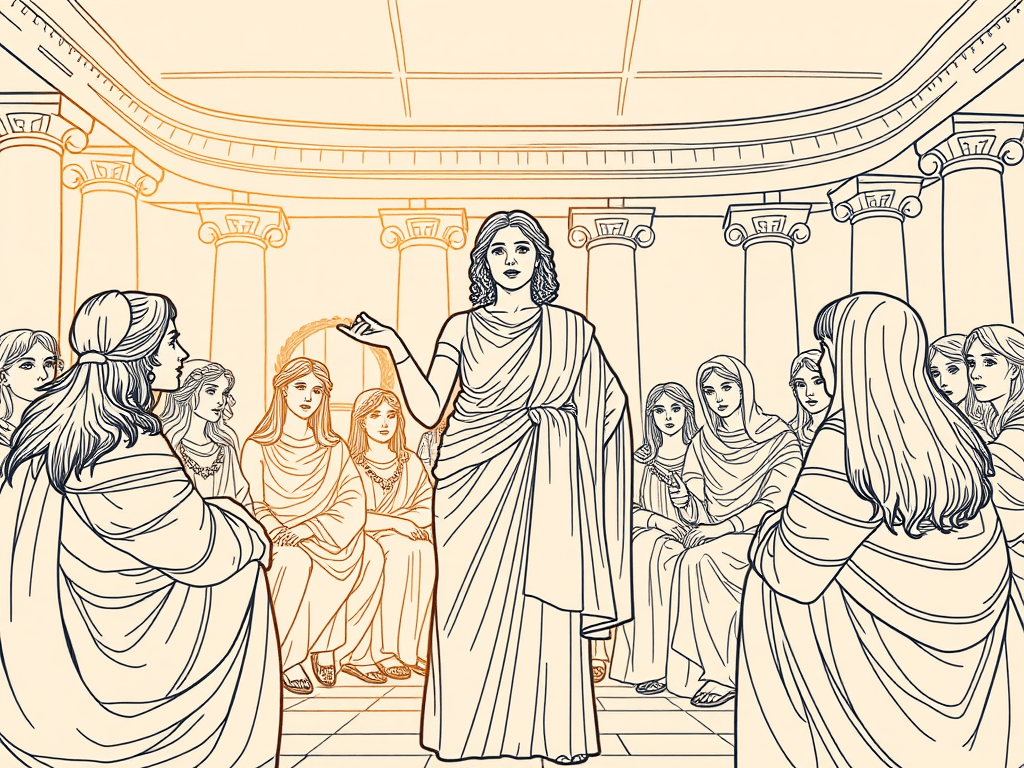
The play’s engine is Praxagora, Aristophanes’s most politically articulate female protagonist. Unlike the heroines of earlier comedies who employ domestic cunning or erotic leverage, Praxagora speaks in the idiom of civic reform. She frames the women’s takeover as a correction of male incompetence: men have governed badly; therefore women, presumed more prudent household managers, will govern well. Aristophanes crafts her rhetoric with a seriousness that intensifies the satire. Praxagora’s logic resembles real Athenian political argumentation—appeals to practicality, precedents of failure, and the promise of orderly distribution.
Yet the comedy exposes the latent authoritarianism within rational administration. Praxagora’s reforms abolish private property and institute communal dining—policies that appear egalitarian but effectively transfer control from household to state apparatus. This is not democracy expanded but democracy overwritten by a “benevolent” program that eliminates individual autonomy and civic contestation. Aristophanes thus anticipates a recurring critique of utopian politics: the promise of universal provision can require coercive standardization, and the abolition of scarcity narratives may conceal new forms of domination.
Utopian Communism, Sexual Economy, and Social Anxiety
What most distinguishes Assemblywomen is the radicalism of its imagined reforms. The women propose:
1. abolition of private property and wealth inequality
2. communal ownership of resources
3. communal meals and public provisioning
4. regulated sexual access, including compulsory satisfaction of older, less desirable citizens prior to the young
Scholars have often noted how these measures caricature philosophical discourse—especially the “community of women and property” proposed in Plato’s Republic (a text likely later than Aristophanes but reflective of circulating elite debates). Whether Aristophanes targets philosophical utopianism directly or the general Athenian anxiety about radical reform, the satire is unmistakable: communalization becomes indistinguishable from a reversal of erotic privilege and class advantage.
Significantly, the play ties political economy to sexuality. Redistribution is not limited to wealth; it extends to bodies. Erotic access becomes social policy. In Old Comedy, sex is always political, but here it is literally legislated, shifting desire from private pursuit into a public entitlement. Aristophanes leverages this to provoke disgust and laughter: the “new order” levels not only property but sexual hierarchy, compelling the attractive young man to service older women first. The joke is not simply misogynistic (though misogyny is certainly present); it is also a conservative defense of eros as hierarchy—youth, beauty, and male autonomy as privileges that politics should not touch. That is, Aristophanes makes the audience confront the implications of egalitarianism when applied to desire itself.
Genre and Form: From Old Comedy Toward Middle Comedy
Formally, Assemblywomen displays Aristophanes at the edge of Old Comedy’s decline. The chorus is less central than in earlier works, and the play’s movement is less episodic in the classic parabatic sense. There remains, however, the familiar structure of comic transformation: a scheme is proposed, enacted, and then tested through consequences more chaotic than intended.
This shift matters. Old Comedy thrived on direct political invective—named targets, explicit contemporary references, choral address to the audience. By the early fourth century, this mode was less viable (politically and aesthetically). Assemblywomen reflects that change by transforming political satire into a broader socio-economic thought experiment. Instead of attacking specific leaders, Aristophanes attacks the logic of reform as such, staging the polis as a laboratory whose results are monstrous.
Ethical Ambivalence: Does Aristophanes Endorse Any Alternative?
A key tension in Assemblywomen is whether the play offers any stable alternative to its satirized “communism.” The men are incompetent, selfish, and inconsistent; the women are rational but coercive; the new system promises justice but produces grotesque obligations and collapses private life. Aristophanes seems to argue not that one faction should rule but that the political imagination itself has become exhausted. Reform becomes parody because no credible path remains—only increasingly extreme proposals.
Seen this way, Assemblywomen is less a conservative defense of the status quo than a diagnosis of late democratic malaise. When civic life is reduced to private interest, even “good ideas” become laughable, and the only imaginable future is a comedy of forced equalization. The play’s laughter is therefore defensive and despairing at once.
Conclusion
Assemblywomen is among Aristophanes’s sharpest late works precisely because it destabilizes the audience’s pleasure. The premise is absurd, but the anxieties are real: scarcity, class resentment, political corruption, and the fear that democracy’s mechanisms can be hijacked by disciplined blocs. Praxagora’s utopia is not merely ridiculed; it is made thinkable, and that thinkability threatens the norms of property, household, and erotic privilege at the heart of the Athenian social order. Aristophanes uses comedy not to propose policy but to dramatize the costs of imagining politics as distribution alone. The play thus becomes a transitional artifact—between Old Comedy’s direct civic aggression and later comedy’s domestic preoccupations—and a profound example of how laughter can register the trauma of a polis that no longer knows how to govern itself.


Leave a comment