My Socialist Hall of Fame
During this chaotic era of vile rhetoric and manipulative tactics from our so-called bourgeois leaders, I am invigorated by the opportunity to reflect on Socialists, Revolutionaries, Philosophers, Guerrilla Leaders, Partisans, and Critical Theory titans, champions, and martyrs who paved the way for us—my own audacious “Socialism’s Hall of Fame.” These are my heroes and fore-bearers. Not all are perfect, or even fully admirable, but all contributed in some way to our future–either as icons to emulate, or as warnings to avoid in the future.
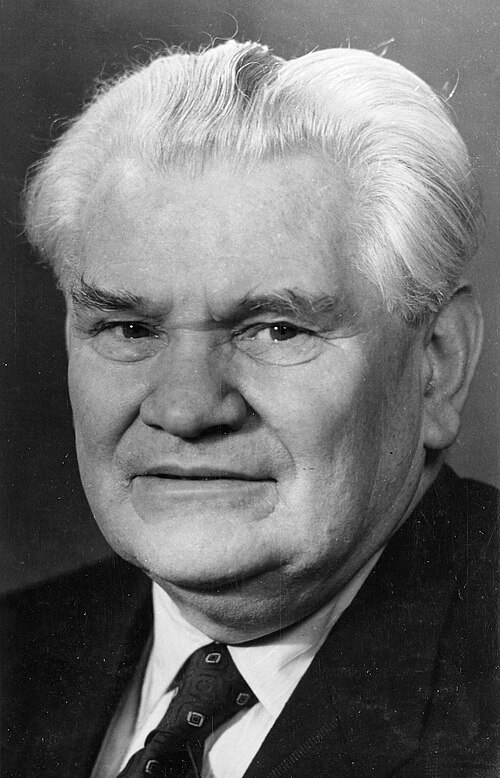
Max Seydewitz occupies a distinctive place in the history of the German socialist movement. A prominent figure of the left wing of German Social Democracy during the Weimar Republic, he later became a founder of the Socialist Workers’ Party of Germany (SAPD), an anti-Stalinist and anti-reformist socialist organization that sought a revolutionary alternative to both the Social Democratic Party (SPD) and the Communist Party (KPD). After years of exile under National Socialism, Seydewitz returned to Germany and emerged as one of the leading political figures in the Soviet occupation zone and the German Democratic Republic (GDR), serving as Minister-President of Saxony from 1947 to 1952. His political career thus spanned the major upheavals of twentieth century Germany, from imperial rule and the First World War to the collapse of the Weimar Republic, Nazi dictatorship, and the establishment of East Germany.
Born on 19 December 1892 in Forst, in the Province of Brandenburg, Seydewitz came from a working class family. His father was a tanner, and after completing elementary education he trained as a book printer. The printing trade exposed him early to socialist ideas and labor politics. He joined the socialist youth movement in 1907 and became a member of the SPD in 1910. By the years before the First World War he was already active in party organization and trade union affairs, representing a generation of socialist militants shaped by industrial labor and the rapid growth of German Social Democracy.
Military service during the First World War proved brief. Seydewitz served in the German Army between 1914 and 1915 before being discharged on grounds of physical unsuitability. Returning to civilian life, he entered socialist journalism, first working for the Volksstimme in Halle and later becoming editor and eventually editor in chief of the Sächsisches Volksblatt in Zwickau. Journalism became his principal political instrument during the interwar period. Through newspapers and theoretical journals he established himself as one of the most articulate representatives of the SPD’s Marxist left wing.
Seydewitz rose steadily within the SPD during the turbulent years of the Weimar Republic. He chaired the party district organization in Zwickau Plauen, joined the party executive apparatus, and in 1924 entered the Reichstag. His parliamentary career coincided with intense debates over the future direction of German socialism. Unlike the reformist leadership that increasingly emphasized coalition government and parliamentary compromise, Seydewitz advocated a more class conscious and militant socialist strategy. He contributed to Marxist publications such as Der Klassenkampf and became associated with critics of the party’s moderate course.
The decisive break came in 1931. Amid fierce controversy over military spending and the SPD leadership’s support for state policies that many leftists regarded as concessions to capitalism, Seydewitz and other dissidents departed the party. Together with Kurt Rosenfeld and Heinrich Ströbel, he helped found the Socialist Workers’ Party of Germany (SAPD). The new organization sought to unite revolutionary socialists who rejected both Social Democratic reformism and Communist sectarianism. The SAPD attracted a number of left intellectuals and activists but remained politically marginal in a period marked by economic crisis and the rapid advance of National Socialism. Seydewitz served among its principal leaders until the Nazi seizure of power in 1933.
Following Hitler’s rise to power, Seydewitz entered exile. Like many socialist opponents of the Nazi regime, he spent years moving between countries while participating in émigré political activity. Exile deepened his commitment to antifascism and reinforced his belief that the fragmentation of the German workers’ movement had contributed significantly to the destruction of the Weimar Republic. During these years he continued political and journalistic work among German socialist émigrés.
The defeat of Nazi Germany in 1945 transformed Seydewitz’s political fortunes. Returning to Germany, he settled in the Soviet occupation zone and joined the newly formed Socialist Unity Party (SED), created through the controversial merger of the SPD and KPD in eastern Germany. He served as editor of the SED theoretical journal Einheit and later directed Berlin Radio, becoming a prominent public advocate of socialist reconstruction under Soviet auspices.
In 1947 Seydewitz succeeded Rudolf Friedrichs as Minister-President of Saxony. His tenure coincided with the consolidation of communist rule in eastern Germany and the gradual transformation of regional governments into instruments of centralized party authority. When the German Democratic Republic was formally established in 1949, Seydewitz retained his position and became one of the most visible state leaders in East Germany. Nevertheless, his earlier association with the independent socialist tradition of the SAPD later became a political liability. During internal SED campaigns against former SAPD members in the early 1950s, Seydewitz was subjected to criticism and compelled to engage in public self criticism. The abolition of the Länder in 1952 brought an end to his premiership.
Although removed from executive political leadership, Seydewitz remained an important public figure. He continued to serve in the Volkskammer, East Germany’s parliament, for the remainder of his life. Between 1955 and 1968 he served as General Director of the Dresden State Art Collections, overseeing one of the most significant museum complexes in the German Democratic Republic. This cultural role reflected both his intellectual interests and the regime’s partial rehabilitation of a veteran socialist whose political reliability had once been questioned.
Max Seydewitz died in Dresden on 8 February 1987 at the age of ninety four. His life illustrates the complex trajectory of many German socialists who moved from the revolutionary hopes of the early twentieth century through the disasters of fascism and exile to positions of authority within the East German state. Historians continue to regard him as an important representative of the socialist left that stood between reformist Social Democracy and Soviet Communism during the final years of the Weimar Republic. His career offers valuable insight into the ideological struggles that shaped modern German socialism and the political culture of the GDR.
Bibliography
Bessel, Richard. Germany after the First World War. Oxford University Press, 1993.
Broué, Pierre. The German Revolution, 1917–1923. Haymarket Books, 2006.
LaPorte, Norman. The German Communist Party in Saxony, 1924–1933. University of Stirling, 1998.
Seydewitz, Max. Mein Weg zur Einheit. Dietz Verlag, 1950.
Seydewitz, Max. Der Zusammenbruch der Weimarer Republik. Dietz Verlag, 1955.
Winkler, Heinrich August. Germany: The Long Road West. Vol. 2, Oxford University Press, 2007.
Wer war wer in der DDR? Ein biographisches Handbuch. Ch. Links Verlag.


Leave a Reply