My Socialist Hall of Fame
During this chaotic era of vile rhetoric and manipulative tactics from our so-called bourgeois leaders, I am invigorated by the opportunity to reflect on Socialists, Revolutionaries, Philosophers, Guerrilla Leaders, Partisans, and Critical Theory titans, champions, and martyrs who paved the way for us—my own audacious “Socialism’s Hall of Fame.” These are my heroes and fore-bearers. Not all are perfect, or even fully admirable, but all contributed in some way to our future–either as icons to emulate, or as warnings to avoid in the future.
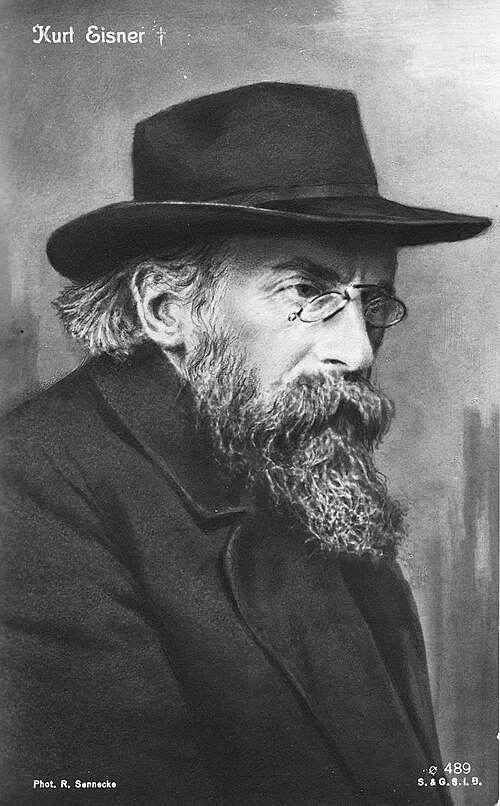
Kurt Eisner was a German socialist intellectual, journalist, and revolutionary statesman whose political life embodied the moral and ideological fractures of European socialism in the age of imperialism, war, and revolution. Best known as the leading figure of the Bavarian Revolution of 1918 and the first Minister-President of the Free State of Bavaria, Eisner represented a distinctive current of ethical, anti-authoritarian socialism rooted in Kantian moral philosophy, Marxist critique, and radical pacifism. Though his tenure in power was brief and violently terminated, Eisner’s political thought and actions left a lasting imprint on the German Left and on debates surrounding democracy, revolution, and socialist ethics.
Early Life and Intellectual Formation
Born in Berlin in 1867 into a middle-class Jewish family, Eisner was educated in philosophy, literature, and political economy at the universities of Marburg and Berlin. His early intellectual influences included Immanuel Kant, German idealism, and the ethical socialism associated with thinkers such as Hermann Cohen. Unlike orthodox Marxists who emphasized historical determinism and economic laws, Eisner placed strong emphasis on moral agency, human responsibility, and democratic values.
Eisner pursued a career in journalism, writing for socialist and liberal newspapers, and developed a reputation as a sharp critic of authoritarianism and militarism. His entry into organized socialism came through the Social Democratic Party of Germany (SPD), which by the late nineteenth century had become the largest socialist party in Europe. However, Eisner remained uneasy with the SPD’s growing bureaucratization and its increasing accommodation to parliamentary routine.
Social Democracy and Anti-Militarism
By the early twentieth century, Eisner had become a prominent voice on the left wing of German social democracy. He was particularly outspoken in his opposition to militarism and imperial expansion, viewing war as both a moral catastrophe and a betrayal of socialist internationalism. These convictions placed him at odds with the SPD leadership, especially during the First World War.
The SPD’s decision in August 1914 to support war credits in the Reichstag marked a decisive rupture in Eisner’s political life. Like other anti-war socialists, he regarded this vote as a capitulation to nationalism and bourgeois state power. Eisner became active in the anti-war opposition, contributing to the formation of the Independent Social Democratic Party of Germany (USPD) in 1917, which brought together pacifists, left socialists, and revolutionaries disillusioned with the SPD’s wartime stance.
The Bavarian Revolution of 1918
The collapse of the German Empire in November 1918 created an opening for revolutionary change, particularly in Bavaria, where socialist and anarchist traditions were strong. Eisner emerged as the central political figure in Munich during this period of upheaval. On 7 November 1918, amid mass demonstrations and soldiers’ mutinies, he proclaimed the overthrow of the Wittelsbach monarchy and the establishment of the Free State of Bavaria.
As Minister-President, Eisner envisioned Bavaria as a democratic socialist republic grounded in civil liberties, workers’ participation, and moral renewal rather than coercive dictatorship. He rejected both the Bolshevik model of one-party rule and the conservative restoration sought by the old elites. His government emphasized transparency, freedom of expression, and social reform, though it faced immense obstacles, including economic collapse, administrative inexperience, and hostility from both the Right and sections of the Left.
One of Eisner’s most controversial actions was his publication of diplomatic documents intended to demonstrate German responsibility for the outbreak of the First World War. This act, consistent with his ethical commitment to truth and accountability, provoked outrage among nationalists and further isolated his government.
Assassination and Aftermath
On 21 February 1919, Eisner was assassinated in Munich by Anton Graf von Arco-Valley, a right-wing nationalist motivated by antisemitism and counterrevolutionary fervor. Eisner’s murder triggered a wave of political violence and radicalization, culminating in the short-lived Bavarian Soviet Republic and its brutal suppression by Freikorps units.
Eisner’s death symbolized both the promise and the vulnerability of democratic socialism in postwar Germany. His commitment to moral politics and democratic procedure left him exposed in an environment increasingly dominated by armed force and ideological polarization.
Political Thought and Historical Significance
Kurt Eisner occupies a distinctive place in the history of socialism as a theorist and practitioner of ethical socialism. He rejected economic reductionism and authoritarianism alike, insisting that socialism must be grounded in human dignity, moral responsibility, and democratic participation. His vision stood in sharp contrast to both the reformist pragmatism of the SPD leadership and the centralized revolutionary model advanced by Bolshevism.
Although often overshadowed by figures such as Rosa Luxemburg and Karl Liebknecht, Eisner’s legacy is crucial for understanding the pluralism of socialist thought in early twentieth-century Europe. His life highlights the tragic dilemmas faced by socialist intellectuals attempting to reconcile revolutionary change with democratic ethics under conditions of extreme social crisis.
Bibliography
Primary Sources
• Eisner, Kurt. Gesammelte Schriften. Edited by Hans Beyer. Berlin: Dietz Verlag, 1920–1924.
• Eisner, Kurt. Der Krieg und die Arbeiterklasse. Munich: Verlag der Jugendinternationale, 1919.
Secondary Sources
• Broué, Pierre. The German Revolution, 1917–1923. Leiden: Brill, 2005.
• Evans, Richard J. The Coming of the Third Reich. New York: Penguin, 2003.
• Hett, Benjamin Carter. Burning the Reichstag: An Investigation into the Third Reich’s Enduring Mystery. Oxford: Oxford University Press, 2014.
• Morgan, David W. The Socialist Left and the German Revolution. Ithaca: Cornell University Press, 1975.
• Sperber, Jonathan. The Kaiser’s Voters: Electors and Elections in Imperial Germany. Cambridge: Cambridge University Press, 1997.


Leave a Reply