Aristophanes. Birds. Edited and translated by Stephen Halliwell, Oxford University Press, 2008.
Aristophanes’ Birds (414 BCE) occupies a peculiar place within the corpus of Old Comedy: it is neither the direct, agonistic intervention in Athenian politics found in Knights nor the explicit antiwar pamphleteering of Acharnians or Peace. Instead, Birds offers a phantasmagorical departure from the polis that, paradoxically, deepens its political resonance. From a revolutionary perspective, the play stages an imaginative interrogation of sovereignty, ideology, and class power in late-fifth-century Athens, while simultaneously revealing the fundamental contradictions that thwart emancipatory transformation within the ideological horizon of classical comedy.
Utopian Flight as Class Resignation and Class Critique
At the center of Birds is the flight of Peisetairos and Euelpides—two disaffected Athenian citizens—who seek escape from a polis ravaged by juridical litigiousness, imperial overstretch, and civic exhaustion. Their exodus corresponds to what Marxist theorist Ernst Bloch would later identify as the “utopian impulse”: a desire that has not yet become political consciousness but gestures toward it. The protagonists’ desire to abandon Athenian social relations constitutes, in embryonic form, a critique of the democratic-imperial structure of the city, especially its bureaucratic parasitism and ideological exhaustion.
Yet their solution—creating a utopia above the clouds—represents a displacement rather than a confrontation with Athenian class antagonisms. The revolutionary reading must therefore recognize in Birds both a recognition of alienation and a failure to resolve that alienation through collective praxis. The flight of the demos into the sky is an ideological refuge rather than a basis for overturning material relations. In this sense, Aristophanes anticipates the petit-bourgeois fantasy of “exit” from a decaying social order, rather than articulating a proletarian or popular revolutionary project.
Cloudcuckooland and the Reproduction of Power
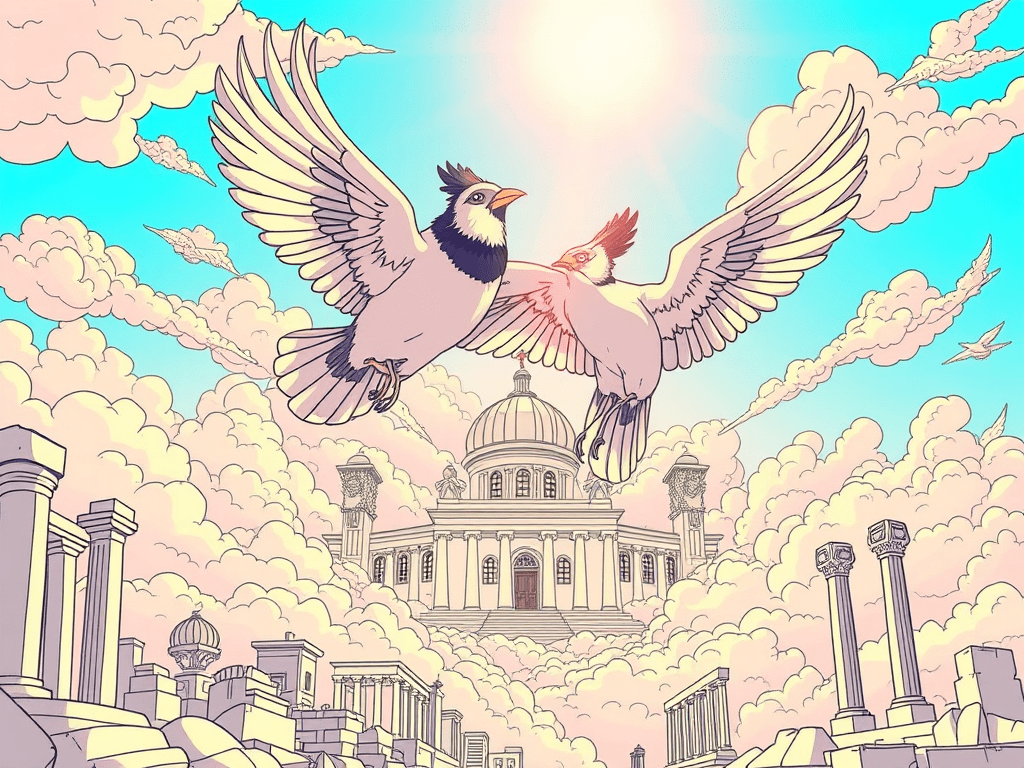
The construction of Cloudcuckooland constitutes the play’s central political allegory. Ostensibly a realm free from the constraints of the Athenian state, it quickly reveals itself to be a laboratory for new forms of domination. Peisetairos—whose name means “Persuader of the People”—rapidly transforms from a vagabond into a sovereign, subjugating gods and mortals alike. This transformation reflects a core insight of historical materialism: without structural change to the relations of production, utopian fantasies merely replicate existing hierarchies.
The birds themselves, who might be seen as a revolutionary class oppressed by both gods and men, are co-opted into a new ideological order in which their collective labor and military power serve Peisetairos’ personal consolidation. Aristophanes, intentionally or otherwise, demonstrates how charismatic leadership can contain and redirect revolutionary energy toward authoritarian ends. Cloudcuckooland becomes not a commune but a state, and ultimately an imperial one, closing the play by affirming Peisetairos as a new Zeus rather than dissolving divine or aristocratic authority.
The spectacle of revolutionary transformation thus collapses into the reproduction of hegemony. From a Marxist perspective, Birds exposes the dangers inherent in revolution conceived as escape, as well as the ease with which popular discontent can become raw material for vertical power.
Athenian Imperialism and the Material Basis of Satire
Written during the nadir of the Sicilian Expedition, Birds is saturated with the contradictions of Athenian imperialism. Aristophanes constructs Cloudcuckooland’s blockade of Olympus as a parody of imperial siege warfare, while Peisetairos’ diplomatic manipulation echoes Athenian bullying of subject states. The revolutionary reading identifies here not merely satire but a structural critique: Athenian democracy had fused citizenship with imperial expropriation, a contradiction that would ultimately tear the polis apart.
Birds, far from advocating political quietism or escapism, dramatizes the ideological absurdity of maintaining imperial logics while rejecting their social costs. The impossible middle ground the protagonists seek—imperial power without Athenian corruption—exposes the impossibility of reform within a system predicated on coercion. In this sense, Aristophanes unintentionally affirms a revolutionary insight: meaningful transformation requires the abolition, not the aesthetic reconfiguration, of the structures of domination.
Saturnalia Without Revolution
Aristophanes’ comic form is essential to the revolutionary critique. Old Comedy’s dramaturgy of inversion—role reversals, mock trials, parody of institutions—appears superficially radical but is functionally restorative. The carnivalesque freedoms of comedy temporarily suspend hierarchy but ultimately reaffirm it. The revolutionary reading acknowledges the limits imposed by genre: Birds can only gesture toward systemic critique through the language of fantasy, and the reinstitution of order at the end is structurally predetermined.
However, within these constraints, Aristophanes nevertheless registers the anxieties of a society confronting political collapse. The failure of Cloudcuckooland to transcend the polis reveals not the conservative instincts of the playwright but the historical inability of the Athenian democratic-imperial system to imagine a world free of exploitation. The play’s concluding apotheosis of Peisetairos is thus tragicomic: a bourgeois fantasy of personal sovereignty in place of collective liberation.
Conclusion
From a revolutionary perspective, Birds emerges as both a critique and a symptom of its age. It identifies alienation, imperial exhaustion, and ideological decay but resolves them through mythical transposition rather than political transformation. Aristophanes exposes the mechanisms through which potential revolutionary energies are redirected into charismatic authoritarianism, highlighting a dynamic recognizable across history: without structural analysis and collective praxis, utopian desires become instruments of domination.
In the end, Birds offers an invaluable, if ambivalent, resource for revolutionary theory: a demonstration of the ways political imagination operates under conditions of crisis, and a reminder that liberation requires not flight but struggle.


Leave a Reply