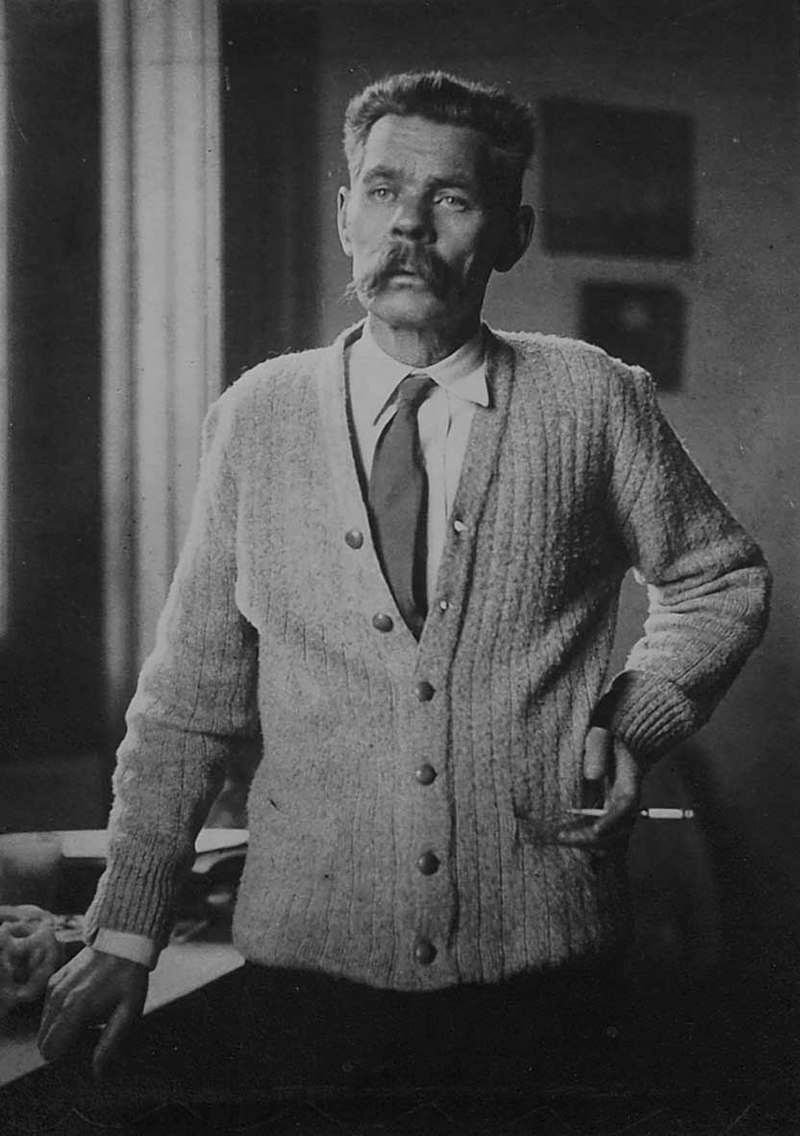
My Socialist Hall of Fame
During this chaotic era of vile rhetoric and manipulative tactics from our so-called bourgeois leaders, I am invigorated by the opportunity to reflect on Socialists, Revolutionaries, Philosophers, Guerrilla Leaders, Partisans, and Critical Theory titans, champions, and martyrs who paved the way for us—my own audacious “Socialism’s Hall of Fame.” These are my heroes and fore-bearers. Not all are perfect, or even fully admirable, but all contributed in some way to our future–either as icons to emulate, or as warnings to avoid in the future.
Maxim Gorky (1868–1936) was one of Russia’s most prominent literary figures, a writer whose works significantly influenced early 20th-century Russian literature and political thought. Born Aleksei Maksimovich Peshkov in Nizhny Novgorod, Russia, he adopted the pseudonym “Gorky,” meaning “bitter,” to reflect the harsh realities of his early life marked by poverty and hardship.
Gorky’s childhood was characterized by extreme adversity, losing both parents at an early age and subsequently raised by his grandparents. These experiences profoundly shaped his worldview and literary themes. From his teenage years, Gorky traveled extensively across Russia, working odd jobs and immersing himself in the plight of the proletariat and marginalized communities. This deep exposure to the struggles of the working class became central to his literary voice and political orientation.
His first significant literary breakthrough came with the publication of “Chelkash” in 1895, which highlighted the struggles and dignity of impoverished Russians. Soon after, works such as “The Lower Depths” (1902), a starkly realistic depiction of urban poverty, firmly established his reputation. Gorky’s narratives and plays vividly articulated the suffering, resilience, and potential revolutionary spirit of the Russian proletariat, aligning him closely with revolutionary intellectual circles.
Politically active, Gorky openly supported the Bolshevik revolutionaries, forming a complex and often tumultuous relationship with the movement. Although initially a fervent supporter of Lenin and the Bolshevik cause, Gorky later expressed concerns about the direction of the revolution, particularly regarding the suppression of individual freedoms, particularly censorship and the treatment of intellectuals. This nuanced stance led to tensions, culminating in a self-imposed exile in Italy from 1921 to 1928.
During exile, Gorky produced a substantial body of work that critically examined both capitalist societies and emerging Soviet power structures. His trilogy, comprising “My Childhood,” “In the World,” and “My Universities,” is semi-autobiographical, providing insightful perspectives on Russian society’s transformation.
Returning to the Soviet Union at Stalin’s behest in 1932, Gorky was widely celebrated but soon became entangled in the complexities and moral compromises of Stalinist politics. Until his death in 1936, his writings subtly criticized authoritarian excesses while publicly endorsing Soviet ideology. His death, officially due to pneumonia, remains controversial, with some scholars suggesting foul play orchestrated by Stalin’s regime.
Maxim Gorky’s legacy endures not only in his literary accomplishments but also in his complex representation of revolutionary ideals, individual freedoms, and the stark realities of early Soviet life. His works remain fundamental texts for understanding Russian literature, revolutionary movements, and the interplay between political power and cultural expression.
Bibliography:
1. Clark, Katerina, and Evgeny Dobrenko, eds. “Soviet Culture and Power: A History in Documents, 1917-1953.” New Haven: Yale University Press, 2007.
2. Levin, Dan. “Stormy Petrel: The Life and Work of Maxim Gorky.” New York: Appleton-Century-Crofts, 1965.
3. Tovah Yedlin, “Maxim Gorky: A Political Biography.” Westport, CT: Praeger Publishers, 1999.
4. Weil, Irwin. “Gorky: His Literary Development and Influence on Soviet Intellectual Life.” New York: Random House, 1966.
5. Wolfe, Bertram D. “The Bridge and the Abyss: The Troubled Friendship of Maxim Gorky and V.I. Lenin.” New York: Frederick A. Praeger, 1967.
 Letters from Tomis
Leave a comment