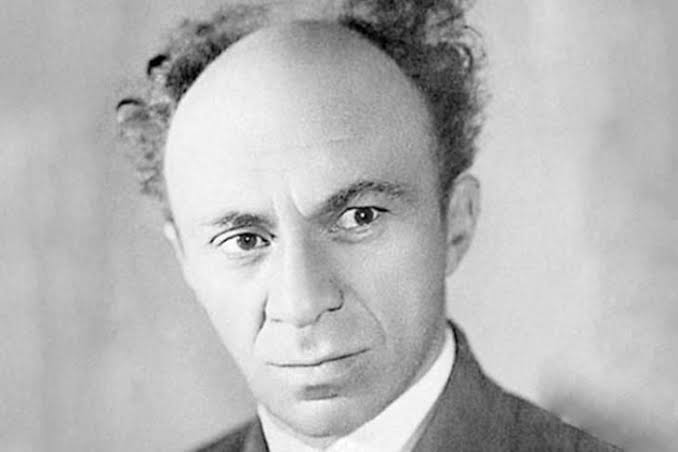
My Socialist Hall of Fame
During this chaotic era of vile rhetoric and manipulative tactics from our so-called bourgeois leaders, I am invigorated by the opportunity to reflect on Socialists, Revolutionaries, Philosophers, Guerrilla Leaders, Partisans, and Critical Theory titans, champions, and martyrs who paved the way for us—my own audacious “Socialism’s Hall of Fame.” These are my heroes and fore-bearers. Not all are perfect, or even fully admirable, but all contributed in some way to our future–either as icons to emulate, or as warnings to avoid in the future.
Solomon Mikhoels (1890–1948), born Shloyme Vovsi in Dvinsk, Russian Empire (present day Daugavpils, Latvia), stands among the most significant figures in twentieth century Jewish theater and Soviet cultural history. An actor, director, public intellectual, and political representative, Mikhoels became the foremost interpreter of Yiddish dramatic art within the Soviet Union while simultaneously embodying the contradictions of Stalinist nationality policy. His career reflected the early Soviet commitment to fostering minority cultures within a socialist framework, whereas his assassination in 1948 marked the beginning of the systematic destruction of Soviet Jewish cultural life during Stalin’s final years. Mikhoels therefore occupies a unique position as both the greatest artistic representative of Soviet Yiddish theater and one of the earliest prominent victims of postwar state antisemitism.
Born into an Orthodox Jewish family, Mikhoels initially pursued legal studies at Saint Petersburg University. The revolutionary upheavals of 1917 redirected his ambitions toward the performing arts, where he joined Aleksei Granovsky’s Jewish Theater Workshop. This institution eventually evolved into the Moscow State Jewish Theater, commonly known by its Russian acronym GOSET. The early Soviet government’s policy of korenizatsiya, or indigenization, encouraged the flourishing of minority languages and cultures, providing unprecedented opportunities for Yiddish literature and drama. Mikhoels emerged as the theater’s leading actor following Granovsky’s departure from the Soviet Union in 1928 and soon assumed artistic leadership of the institution.
Mikhoels revolutionized Yiddish theatrical performance by blending Jewish folk traditions with avant garde stagecraft. Rather than treating Yiddish theater as a provincial ethnic institution, he sought to elevate it to the highest standards of international dramatic art. Influenced by the innovations of Konstantin Stanislavski, Vsevolod Meyerhold, and European expressionism, Mikhoels emphasized psychological depth while preserving the linguistic and cultural richness of Jewish life. His productions demonstrated that Yiddish theater could stand alongside the greatest achievements of Russian and European drama without sacrificing its distinct identity.
Among Mikhoels’s greatest artistic accomplishments was his portrayal of King Lear. Shakespeare’s tragedy became, under his interpretation, an exploration of universal suffering and moral responsibility while resonating deeply with Jewish historical experience. Critics frequently ranked his performance among the finest interpretations of the twentieth century. His portrayals of Tevye in Sholem Aleichem’s Tevye the Dairyman and Zayvl Ovadis in Peretz Markish’s Family Ovadis likewise established enduring standards for Yiddish dramatic performance. These productions demonstrated his remarkable ability to unite realism, symbolism, and emotional intensity within a coherent theatrical vision.
The German invasion of the Soviet Union in 1941 transformed Mikhoels from a theatrical leader into an important political figure. Stalin’s government established the Jewish Anti Fascist Committee to mobilize international Jewish support for the Soviet war effort. Mikhoels became its chairman, lending both artistic prestige and personal credibility to the organization. Alongside the poet Itzik Feffer, he traveled extensively throughout the United States, Canada, Mexico, and Great Britain during 1943, addressing enormous public gatherings and raising substantial financial and political support for the Soviet Union’s struggle against Nazi Germany. His appearances attracted leading intellectuals, politicians, and representatives of Jewish organizations, making him one of the most internationally recognized Soviet cultural figures of the wartime period.
This international prominence, however, ultimately contributed to his downfall. Following the Allied victory, Stalin’s regime became increasingly suspicious of all independent Jewish institutions and viewed international Jewish connections as potential channels for espionage and political dissent. Mikhoels’s position as both a celebrated artist and an internationally respected Jewish leader rendered him politically vulnerable. Although he remained publicly loyal to the Soviet government, the changing ideological climate transformed his visibility into a liability.
On 13 January 1948, while traveling in Minsk on official theatrical business, Mikhoels was murdered by agents of the Soviet Ministry of State Security acting under Stalin’s orders. His death was carefully disguised as a traffic accident involving a truck, and the official explanation remained unchanged for years. Subsequent archival evidence released after Stalin’s death confirmed that the killing had been a state sponsored assassination. The operation represented the opening phase of a broader campaign against Soviet Jewish intellectuals that culminated in the liquidation of the Jewish Anti Fascist Committee, the execution of leading Yiddish writers during the so called Night of the Murdered Poets in 1952, and the antisemitic hysteria surrounding the Doctors’ Plot.
Mikhoels’s assassination symbolized a decisive turning point in Soviet nationality policy. During the 1920s and early 1930s, the Soviet state had encouraged the institutional development of Yiddish schools, publishing houses, and theaters. By the late 1940s, however, official policy increasingly identified expressions of Jewish cultural autonomy with bourgeois nationalism and foreign influence. The destruction of GOSET and the suppression of Yiddish cultural institutions represented not merely an attack upon individual intellectuals but the dismantling of an entire cultural infrastructure that had flourished during the early decades of Soviet rule.
From a broader historical perspective, Mikhoels illustrates the paradoxes of Soviet cultural politics. He sincerely believed that socialism offered unprecedented opportunities for Jewish cultural development and devoted his career to realizing that vision through artistic excellence rather than religious revival or political nationalism. His achievements demonstrated the extraordinary creative possibilities that briefly emerged within Soviet nationality policy. Yet his fate also revealed the inherent vulnerability of cultural institutions entirely dependent upon an authoritarian state. The same government that celebrated him as a People’s Artist of the USSR and awarded him the Order of Lenin ultimately orchestrated his murder when political priorities shifted.
Today, Solomon Mikhoels is remembered not only as the greatest actor in the history of Soviet Yiddish theater but also as a symbol of artistic integrity confronting political repression. His performances continue to influence scholarship on Jewish theater, while his life serves as a cautionary example of the complex relationship between culture and state power under totalitarian regimes. Historians increasingly regard his assassination as the beginning of Stalin’s final antisemitic campaign, underscoring Mikhoels’s enduring importance within both Jewish history and the history of Soviet authoritarianism.
Bibliography
Eliav, Binyamin, and Joseph Leftwich. “Mikhoels, Solomon.” Encyclopaedia Judaica. 2nd ed., Macmillan Reference USA, 2007.
Geizer, Matvei. Solomon Mikhoels. Moscow, Sovetskii Pisatel’, 1990.
Rubenstein, Joshua. Stalin’s Secret Pogrom: The Postwar Inquisition of the Jewish Anti Fascist Committee. Yale University Press, 2001.
Veidlinger, Jeffrey. The Moscow State Yiddish Theater: Jewish Culture on the Soviet Stage. Indiana University Press, 2000.
Veidlinger, Jeffrey. “Mikhoels, Solomon Mikhailovich.” YIVO Encyclopedia of Jews in Eastern Europe, 2010.
Vovsi Mikhoels, Natalia. My Father Solomon Mikhoels. Raduga Publishers, 1984.
Wasserstein, Bernard. On the Eve: The Jews of Europe Before the Second World War. Simon and Schuster, 2012.


Leave a Reply