My Socialist Hall of Fame
During this chaotic era of vile rhetoric and manipulative tactics from our so-called bourgeois leaders, I am invigorated by the opportunity to reflect on Socialists, Revolutionaries, Philosophers, Guerrilla Leaders, Partisans, and Critical Theory titans, champions, and martyrs who paved the way for us—my own audacious “Socialism’s Hall of Fame.” These are my heroes and fore-bearers. Not all are perfect, or even fully admirable, but all contributed in some way to our future–either as icons to emulate, or as warnings to avoid in the future.
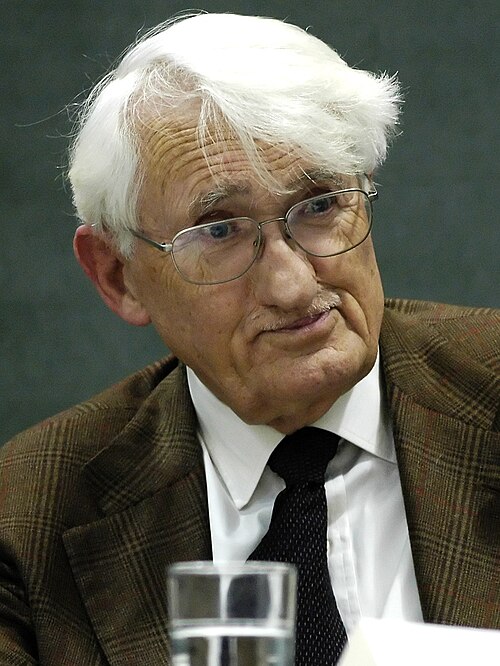
Jürgen Habermas stands as one of the most influential philosophers and social theorists of the twentieth and twenty first centuries. His work represents both the culmination and transformation of the Frankfurt School tradition of Critical Theory. Drawing upon philosophy, sociology, political science, linguistics, psychology, and jurisprudence, Habermas developed a comprehensive theory of communicative rationality that sought to defend the emancipatory potential of reason against both postmodern skepticism and technocratic domination. While deeply indebted to Karl Marx, Max Weber, Georg Lukács, and the first generation of Frankfurt School theorists, especially Max Horkheimer and Theodor W. Adorno, Habermas departed from their pessimism by arguing that democratic communication remains a viable foundation for human freedom and social transformation.
Early Life and Intellectual Formation
Jürgen Habermas was born on June 18, 1929, in Düsseldorf, Germany. He spent his childhood during the collapse of the Weimar Republic, the rise of National Socialism, and the devastation of the Second World War. Like many members of his generation, his philosophical development was profoundly shaped by Germany’s confrontation with fascism and the moral catastrophe of Auschwitz.
Habermas was born with a cleft palate, requiring several surgeries during childhood. This condition has often been cited as contributing to his lifelong concern with language, communication, and participation in public discourse. Following the war, he studied philosophy, psychology, German literature, economics, and history at the universities of Göttingen, Zurich, and Bonn. In 1954 he completed his doctoral dissertation on Friedrich Schelling.
His intellectual trajectory changed decisively during the 1950s when he became associated with the Institute for Social Research in Frankfurt under Max Horkheimer and Theodor Adorno. Although welcomed into the Frankfurt School, Habermas soon began developing criticisms of its increasingly pessimistic assessment of modern society. Whereas Horkheimer and Adorno emphasized domination through instrumental reason, Habermas sought to identify forms of rationality capable of sustaining democratic life.
The Frankfurt School and Critical Theory
Habermas is widely regarded as the leading representative of the second generation of the Frankfurt School. Critical Theory emerged during the interwar period as an attempt to explain why Marx’s prediction of proletarian revolution had not materialized in advanced capitalist societies. Instead of emphasizing economic contradictions alone, thinkers such as Horkheimer, Adorno, Herbert Marcuse, and Erich Fromm explored the cultural, psychological, and ideological mechanisms through which capitalist domination reproduced itself.
Habermas inherited this project but believed that the first generation had underestimated the democratic and communicative capacities embedded within modern institutions. Rather than abandoning Enlightenment rationality after fascism, he argued that the solution lay in recovering a richer conception of reason centered upon dialogue rather than domination.
The Public Sphere
Habermas first achieved international prominence with The Structural Transformation of the Public Sphere (1962). In this landmark study, he traced the historical emergence of the bourgeois public sphere during the eighteenth century.
According to Habermas, coffeehouses, salons, literary societies, and newspapers created spaces where private citizens could debate matters of common concern independently of both state authority and economic power. Public opinion, ideally formed through rational discussion among equals, became a cornerstone of democratic legitimacy.
Habermas also argued that advanced capitalism gradually undermined this public sphere through commercialization, mass media concentration, public relations, and state bureaucratization. Rational debate increasingly gave way to consumer culture and political spectacle.
The concept of the public sphere has since become foundational across political theory, communication studies, sociology, media studies, and democratic theory.
Communicative Action
Habermas’s mature philosophical project culminated in The Theory of Communicative Action (1981), generally regarded as his greatest work.
At its center lies the distinction between two forms of rationality.
Instrumental rationality concerns the efficient achievement of predetermined goals. It governs technology, administration, markets, and bureaucracies.
Communicative rationality concerns mutual understanding among individuals engaged in dialogue. Participants seek agreement through reasons rather than coercion.
Habermas argued that human language contains implicit norms requiring speakers to justify their claims regarding truth, sincerity, and moral rightness. Genuine communication therefore possesses an inherent democratic structure.
Through communicative action, individuals coordinate social life not by force or economic exchange but through reasoned agreement. This insight allowed Habermas to relocate the emancipatory potential previously attributed primarily to labor within the structures of language itself.
System and Lifeworld
A central concept in Habermas’s sociology is the distinction between the system and the lifeworld.
The system consists of institutions governed primarily by money and administrative power, including markets, corporations, and state bureaucracies.
The lifeworld encompasses everyday social interaction, families, communities, cultural traditions, and democratic discussion.
Modern capitalist societies require both spheres, but crises emerge when systemic imperatives colonize the lifeworld. Economic competition and bureaucratic administration increasingly penetrate education, family life, healthcare, and political discourse, replacing genuine communication with strategic calculation.
This concept of the “colonization of the lifeworld” remains one of Habermas’s most influential contributions to contemporary social theory.
Discourse Ethics
Habermas extended his theory of communication into moral philosophy through discourse ethics.
Rather than grounding morality in divine authority or fixed metaphysical principles, he argued that moral norms gain legitimacy only if they could receive the rational assent of everyone affected under conditions of free and equal discussion.
His ethical theory builds upon Immanuel Kant’s concern with universal morality while replacing the solitary rational subject with collective democratic deliberation.
Discourse ethics has had substantial influence in legal theory, political philosophy, bioethics, and democratic constitutionalism.
Democracy and Constitutional Patriotism
Habermas has consistently defended liberal constitutional democracy while arguing that democratic institutions require active citizen participation rather than passive electoral consent.
His concept of constitutional patriotism proposes that modern political communities should be united not primarily through ethnicity, religion, or nationalism, but through shared commitment to democratic constitutional principles.
This position gained particular importance during debates surrounding German reunification and later European integration. Habermas has been among Europe’s most prominent advocates of supranational democracy within the European Union.
Relationship to Marxism
Habermas occupies an unusual position within Marxist thought.
He accepted Marx’s critique of capitalism, commodification, alienation, and ideological domination while rejecting economic determinism and revolutionary inevitability.
For Habermas, class struggle remains important but no longer exhausts the sources of domination. Modern societies are also structured by communication, administration, culture, and law.
He argued that Marx privileged labor as humanity’s defining activity while neglecting communication as an equally fundamental dimension of social life.
From a revolutionary Marxist perspective, this represents both Habermas’s greatest innovation and his principal limitation.
Marxists such as Georg Lukács, Antonio Gramsci, and later Alex Callinicos have argued that Habermas underestimates the structural constraints imposed by capitalist property relations. They contend that ideal communication cannot overcome inequalities rooted in class ownership and state power. Revolutionary theorists further criticize his emphasis upon democratic consensus over class struggle and revolutionary transformation.
Nevertheless, Habermas remains one of the most sophisticated interpreters of Marx’s philosophical legacy and has significantly expanded debates concerning democracy, ideology, and social emancipation.
Major Works
Among Habermas’s most significant publications are:
- The Structural Transformation of the Public Sphere (1962)
- Knowledge and Human Interests (1968)
- Theory and Practice (1971)
- Communication and the Evolution of Society (1976)
- The Theory of Communicative Action, Volumes I and II (1981)
- Moral Consciousness and Communicative Action (1983)
- Between Facts and Norms (1992)
- The Inclusion of the Other (1996)
- The Future of Human Nature (2001)
- Between Naturalism and Religion (2005)
- Also a History of Philosophy (2019)
Legacy
Few living philosophers have exerted as broad an influence as Jürgen Habermas. His work bridges analytic and continental philosophy while profoundly shaping sociology, political theory, constitutional law, communication studies, ethics, and democratic theory. Concepts such as the public sphere, communicative rationality, discourse ethics, and the colonization of the lifeworld have become indispensable tools across the social sciences and humanities.
Habermas’s optimistic defense of rational discourse distinguishes him from both the cultural pessimism of early Frankfurt School theorists and the relativism associated with postmodern thinkers such as Michel Foucault and Jacques Derrida. Although critics question whether ideal communication can overcome entrenched economic inequality and political power, Habermas remains perhaps the foremost contemporary advocate of Enlightenment ideals grounded in democratic participation.
From a Marxist standpoint, his work represents both an extension and revision of Critical Theory. While many revolutionaries reject his reformist orientation, few dispute the significance of his analyses of capitalism’s effects upon democratic communication and civil society. His enduring contribution lies in demonstrating that struggles for emancipation occur not only in production but also in language, public debate, and the institutions of democratic life.
Selected Bibliography
Adorno, Theodor W., and Max Horkheimer. Dialectic of Enlightenment. Translated by Edmund Jephcott, Stanford University Press, 2002.
Baxter, Hugh. Habermas: The Discourse Theory of Law and Democracy. Stanford University Press, 2011.
Finlayson, James Gordon. Habermas: A Very Short Introduction. Oxford University Press, 2005.
Habermas, Jürgen. Between Facts and Norms. Translated by William Rehg, MIT Press, 1996.
Habermas, Jürgen. Communication and the Evolution of Society. Beacon Press, 1979.
Habermas, Jürgen. Knowledge and Human Interests. Translated by Jeremy J. Shapiro, Beacon Press, 1971.
Habermas, Jürgen. Moral Consciousness and Communicative Action. MIT Press, 1990.
Habermas, Jürgen. The Structural Transformation of the Public Sphere. Translated by Thomas Burger, MIT Press, 1989.
Habermas, Jürgen. The Theory of Communicative Action. Vols. 1 and 2, translated by Thomas McCarthy, Beacon Press, 1984–1987.
McCarthy, Thomas. The Critical Theory of Jürgen Habermas. MIT Press, 1978.
Outhwaite, William. Habermas: A Critical Introduction. 2nd ed., Polity Press, 2009.
Pensky, Max, editor. The Habermas Handbook. Columbia University Press, 2011.
White, Stephen K. The Cambridge Companion to Habermas. Cambridge University Press, 1995.


Leave a Reply