Book Review
Malraux, André. Man’s Fate. Translated by Haakon M. Chevalier, Vintage International, 1990.
Few novels of the twentieth century unite revolutionary politics and existential philosophy as successfully as André Malraux’s Man’s Fate (La Condition humaine). First published in 1933 and awarded the Prix Goncourt, the novel is set during the failed Communist uprising in Shanghai in 1927. Through a diverse cast of revolutionaries, intellectuals, adventurers, and capitalists, Malraux transforms a specific historical event into a meditation on human freedom, mortality, and political commitment. The Vintage International edition of 1990, translated by Haakon M. Chevalier, remains the standard English language version and preserves much of the urgency and intellectual intensity that made the novel a landmark of modern European literature.
At the center of the novel lies a profound question: how should individuals create meaning in a world marked by suffering, violence, and death? Malraux approaches this question through characters whose political commitments are inseparable from their personal struggles. Kyo Gisors, the revolutionary organizer, seeks dignity through collective action. Katov, the veteran Bolshevik, discovers humanity through self sacrifice. Ch’en, the assassin, pursues a darker path in which violence becomes an existential act. These figures are not merely representatives of ideological positions. Rather, they embody competing responses to the human condition itself. Their choices reveal Malraux’s conviction that meaning is not discovered but created through action.
The novel’s greatest strength is its ability to depict revolution without romanticism. Unlike much political fiction of the period, Man’s Fate neither glorifies nor condemns revolutionary struggle outright. The Communist insurgents are portrayed with sympathy, yet Malraux remains acutely aware of the tragedy inherent in political commitment. The revolutionaries fight for liberation while confronting betrayal, defeat, and death. In this sense, the novel anticipates later existentialist concerns associated with Albert Camus and Jean Paul Sartre. Political action becomes meaningful not because it guarantees success but because it affirms human agency in the face of inevitable failure.
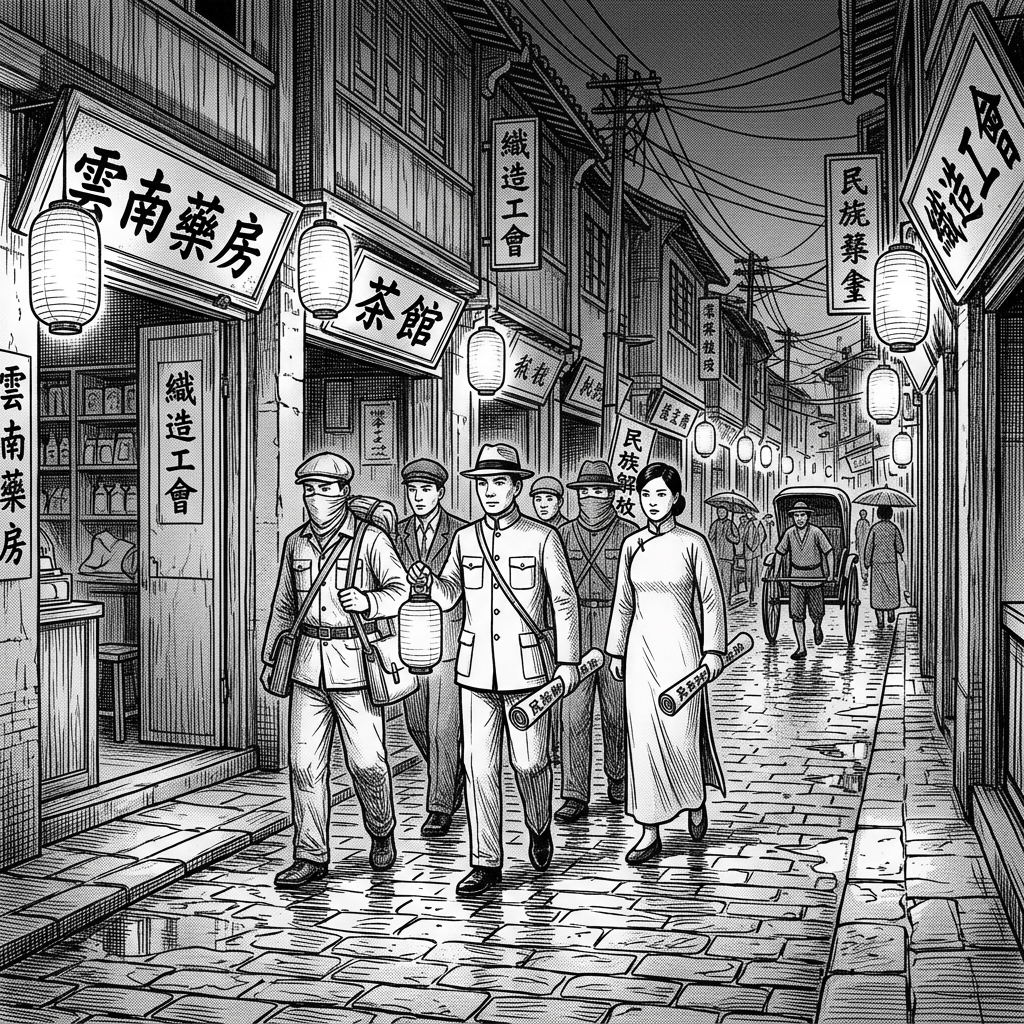
Malraux’s Shanghai is likewise remarkable. Although critics have noted that his knowledge of China was limited and filtered through European assumptions, the city functions less as a realistic setting than as a symbolic landscape of modernity. Financial interests, colonial powers, criminal networks, and revolutionary organizations collide in an atmosphere of uncertainty and impending catastrophe. The result is a world where historical forces appear immense yet individual choices remain decisive.
Stylistically, Man’s Fate combines the pace of a political thriller with philosophical reflection. The opening assassination scene remains one of the most memorable introductions in modern fiction. Malraux writes with cinematic intensity, shifting rapidly between action and introspection. At times the philosophical dialogue can feel overly programmatic, and some secondary characters function more as vehicles for ideas than fully realized individuals. Yet these weaknesses are outweighed by the novel’s extraordinary intellectual ambition and emotional power.
Man’s Fate occupies an intriguing position. The novel demonstrates genuine admiration for revolutionary commitment and collective struggle, yet it ultimately places greater emphasis on existential courage than on historical materialism. Class conflict drives the narrative, but the deepest concerns are ethical and metaphysical. Malraux is interested less in the mechanics of revolution than in the experience of individuals confronting history. Consequently, the novel offers a humanistic rather than strictly Marxist interpretation of revolutionary politics.
Nearly a century after its publication, Man’s Fate remains a powerful exploration of political idealism, sacrifice, and human dignity. It is both a revolutionary novel and a philosophical tragedy. Malraux’s achievement lies in demonstrating that the struggle for social transformation cannot be separated from the larger question of what it means to live and die as a human being. The novel endures because it recognizes that history is made not only by classes and movements but also by individuals who choose action despite uncertainty and defeat.


Leave a Reply