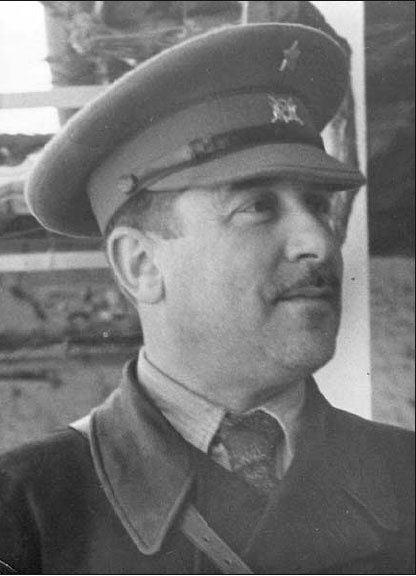
My Socialist Hall of Fame
During this chaotic era of vile rhetoric and manipulative tactics from our so-called bourgeois leaders, I am invigorated by the opportunity to reflect on Socialists, Revolutionaries, Philosophers, Guerrilla Leaders, Partisans, and Critical Theory titans, champions, and martyrs who paved the way for us—my own audacious “Socialism’s Hall of Fame.” These are my heroes and fore-bearers. Not all are perfect, or even fully admirable, but all contributed in some way to our future–either as icons to emulate, or as warnings to avoid in the future.
Máté Zalka occupies a significant position within the intertwined histories of revolutionary socialism, anti fascism, and twentieth century international warfare. Soldier, communist intellectual, novelist, and military commander, Zalka became one of the most celebrated Hungarian participants in the global revolutionary movements that emerged from the collapse of the old European order after the First World War. Although best remembered for his role in the Spanish Civil War under the nom de guerre “General Lukács,” Zalka’s life reflected the broader political trajectory of many Central European radicals who passed through imperial war, revolution, exile, and transnational communist militancy. His career reveals the extent to which the interwar communist movement functioned not merely as a political ideology but as a global network of military, cultural, and revolutionary commitment.
Máté Zalka was born Béla Frankl on April 23, 1896, in Matolcs, then part of the Austro Hungarian Empire, in present day Hungary. He was born into a Jewish family of modest means in a region marked by profound social inequality, ethnic diversity, and agrarian poverty. Like many young men of his generation, Zalka came of age in a multinational imperial society already strained by nationalism, industrial transformation, and political unrest. His early experiences exposed him both to the marginalization of Jewish communities and to the wider instability of late Habsburg society.
Zalka received a relatively broad education for someone of his social background and displayed literary interests from an early age. Yet the outbreak of the First World War fundamentally altered the course of his life. Drafted into the Austro Hungarian Army, he served on the Eastern Front against Imperial Russia. The war proved transformative politically and psychologically. Like countless soldiers across Europe, Zalka encountered the collapse of traditional authority amid mechanized violence, mass death, and military disintegration.
During the war he was captured by Russian forces and became a prisoner of war. This experience proved decisive for his political radicalization. The Russian Empire during the final years of the war and the revolutionary upheavals of 1917 became fertile ground for ideological transformation among prisoners, workers, and soldiers alike. Zalka encountered Bolshevik ideas within the volatile political environment created by the Russian Revolution and subsequent Civil War. He eventually joined the Bolsheviks and participated in revolutionary military activity on behalf of the emerging Soviet state.
The experience of the Russian Civil War shaped Zalka’s worldview permanently. He embraced communism not simply as an economic theory but as a total political and moral commitment rooted in international solidarity and armed struggle. He became part of the generation of revolutionary veterans for whom military organization and political ideology became inseparable. This fusion later characterized many communist movements during the interwar years.
Following the collapse of the short lived Hungarian Soviet Republic in 1919, Hungary entered a period of fierce counterrevolution under Admiral Miklós Horthy. Radical leftists, Jews, and former revolutionaries faced violent repression during the so called White Terror. Like many communist exiles, Zalka remained tied to Soviet institutions rather than returning permanently to Hungary. The Soviet Union increasingly became both refuge and political homeland for displaced revolutionaries from across Europe.
During the 1920s and early 1930s, Zalka developed a parallel identity as both military figure and writer. He became associated with Soviet literary circles and published works drawing heavily upon his wartime experiences. His fiction reflected the influence of socialist realism before the doctrine’s formal consolidation under Stalin. At the same time, his writing retained traces of the brutal immediacy associated with war literature of the interwar era. Zalka’s prose emphasized hardship, sacrifice, comradeship, and revolutionary transformation.
Among his most notable literary works was Doberdó, a novel based upon the experiences of Austro Hungarian soldiers during the First World War. The work examined the suffering and absurdity of imperial warfare while simultaneously framing revolutionary consciousness as the moral response to capitalist and aristocratic catastrophe. Like many communist writers of the period, Zalka interpreted the First World War not merely as geopolitical conflict but as evidence of systemic social collapse produced by imperial capitalism.
Zalka’s literary reputation in the Soviet Union grew steadily, though he never achieved the international stature of figures such as Isaac Babel or Mikhail Sholokhov. Nevertheless, he occupied an important place within the Soviet cultural apparatus as an example of the revolutionary intellectual forged through combat and ideological commitment. His identity as both soldier and writer mirrored broader Soviet ideals concerning the unity of political consciousness and practical action.
The defining chapter of Zalka’s life began with the outbreak of the Spanish Civil War in 1936. The conflict quickly became the central ideological battleground of interwar Europe, drawing fascists, liberals, socialists, and communists into a struggle widely understood as a precursor to a broader continental war. The Soviet Union provided military assistance to the Spanish Republic, while communist parties throughout the world organized volunteers through the International Brigades.
Zalka traveled to Spain as part of this international mobilization and adopted the name “General Lukács.” He soon became one of the most respected commanders within the International Brigades. His military experience, personal courage, and ability to inspire multinational volunteers contributed to his reputation among anti fascist fighters. Unlike some political commissars whose authority rested primarily on ideology, Zalka possessed genuine battlefield experience dating back to the First World War and Russian Civil War.
As commander of the Twelfth International Brigade, Zalka participated in several major engagements during the Spanish conflict. The International Brigades themselves represented one of the most extraordinary experiments in transnational political militancy during the twentieth century. Volunteers from dozens of countries fought together under explicitly anti fascist and often communist banners. Zalka’s leadership symbolized the ideal of proletarian internationalism promoted by the Communist International.
Contemporary accounts frequently described Zalka as charismatic, disciplined, and personally fearless. He reportedly maintained close relationships with ordinary soldiers and shared the harsh conditions of front line combat. His command style contrasted with the bureaucratic rigidity often associated with Stalinist military culture. Nevertheless, Zalka remained firmly integrated into Soviet aligned military structures operating within Republican Spain.
The Spanish Civil War exposed the severe contradictions within the international communist movement. While volunteers like Zalka fought sincerely against fascism, Soviet involvement was also shaped by internal political purges and geopolitical calculations. Historians continue to debate the extent to which commanders such as Zalka understood or accepted the repressive dimensions of Stalinism during this period. What remains clear is that many international volunteers viewed Spain as the decisive front in the struggle against fascist expansion.
Zalka was killed on June 11, 1937, near Huesca in Aragón after his vehicle came under enemy artillery fire. His death transformed him into a martyr figure within communist memory culture. Soviet and Hungarian communist institutions commemorated him extensively after the Second World War. Streets, schools, and military units bore his name throughout the Eastern Bloc, particularly in postwar Hungary.
During the Cold War, official communist historiography portrayed Zalka as an exemplary revolutionary hero whose life embodied anti fascist sacrifice and proletarian internationalism. These portrayals often simplified the ideological complexities of his life and ignored the ambiguities surrounding Soviet politics during the 1930s. Following the collapse of communist regimes in Eastern Europe, scholarly reassessments became more critical and nuanced. Historians began situating Zalka within the broader tensions between revolutionary idealism and authoritarian communist structures.
Nevertheless, Zalka remains an important figure in the history of twentieth century radicalism. His life illustrates how warfare, exile, and ideology reshaped political identities during the age of extremes. He belonged to a generation for whom national boundaries increasingly appeared subordinate to ideological allegiance. The trajectory from Austro Hungarian soldier to Bolshevik revolutionary, Soviet writer, and commander in Spain reflects the transnational character of interwar revolutionary politics.
Moreover, Zalka’s literary contributions provide valuable insight into the psychological and ideological transformations produced by total war and revolution. His works belong to a broader corpus of communist war literature that sought to reinterpret suffering through the lens of collective struggle and historical necessity. Although later overshadowed by larger political narratives, his writings remain significant documents of revolutionary culture.
Ultimately, Máté Zalka’s historical importance lies not only in his military role but also in his embodiment of twentieth century revolutionary internationalism. His life traversed empire, revolution, civil war, exile, and ideological conflict across multiple continents and political systems. In doing so, he became representative of a generation that sought to remake the modern world through armed political commitment, often at immense personal cost.
Works Cited
Bolloten, Burnett. The Spanish Civil War: Revolution and Counterrevolution. University of North Carolina Press, 1991.
Graham, Helen. The Spanish Civil War: A Very Short Introduction. Oxford University Press, 2005.
Preston, Paul. The Spanish Civil War: Reaction, Revolution and Revenge. W. W. Norton, 2007.
Thomas, Hugh. The Spanish Civil War. Modern Library, 2001.
Volgyes, Ivan, editor. Hungary in Revolution, 1918–19: Nine Essays. University of Nebraska Press, 1971.
Zalka, Máté. Doberdó. Corvina Press, 1978.


Leave a comment