Book Review
Plautus. The Little Carthaginian. Pseudolus. The Rope. The Two Menaechmuses. Translated by Wolfgang de Melo, Loeb Classical Library, Harvard University Press, 2011.
Plautus’s Menaechmi (often rendered in English as The Two Menaechmuses) occupies a foundational place in the history of Western comedy, not merely as an exemplar of Roman New Comedy but as a durable narrative engine whose structure has echoed from antiquity through Renaissance drama and into modern farce. The 2011 Loeb Classical Library edition, which presents the Latin text alongside an English translation, invites renewed scholarly attention to Plautus’s dramaturgy, linguistic play, and cultural adaptation of Greek originals. Far from a simple comedy of mistaken identity, Menaechmi reveals a sophisticated engagement with Roman social anxieties, mercantile culture, and the instability of personal identity in an increasingly interconnected Mediterranean world.
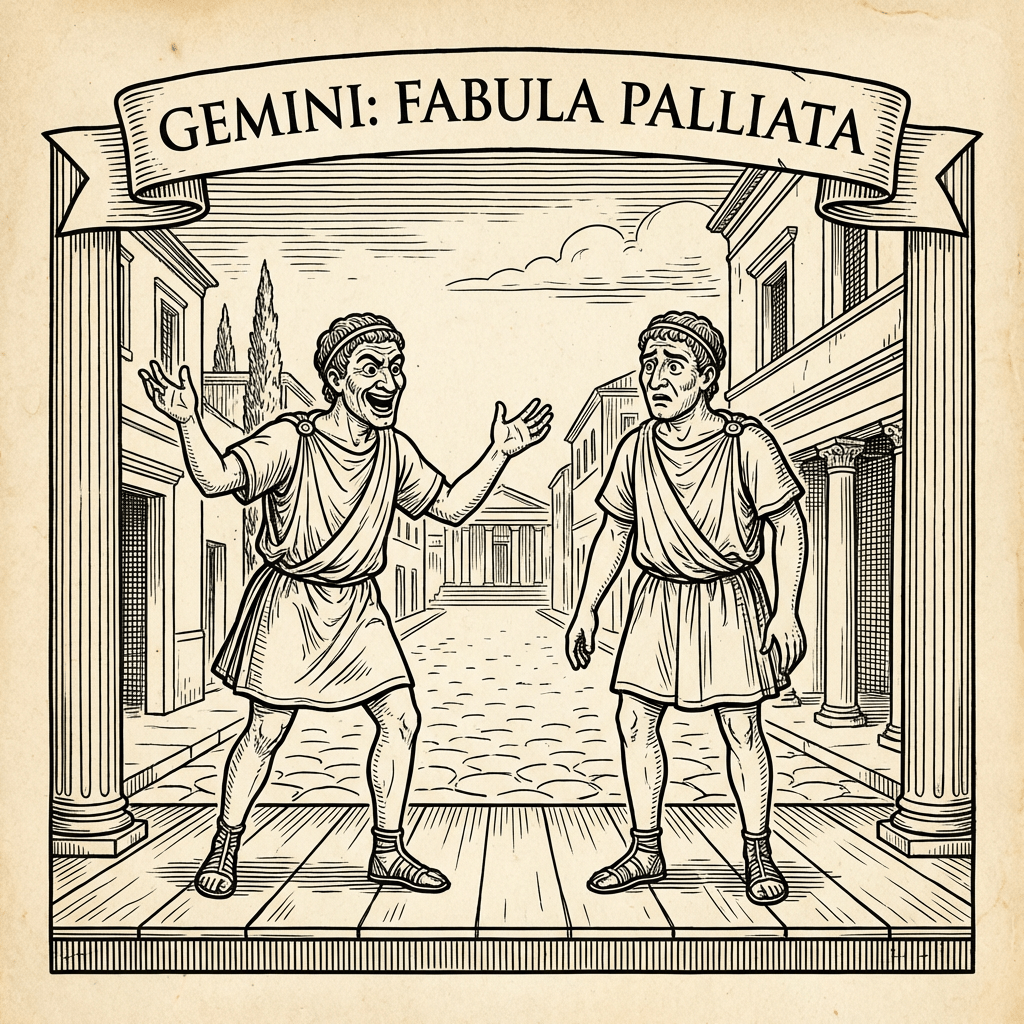
At its core, the play exploits the device of identical twins separated in childhood and unknowingly reunited as adults in the city of Epidamnus. This narrative conceit, inherited from Greek New Comedy, is transformed by Plautus into a vehicle for escalating confusion and comic inversion. The twin Menaechmi, indistinguishable in name and appearance, generate a cascade of misunderstandings involving wives, courtesans, parasites, and merchants. Yet what distinguishes Plautus’s handling of the material is his relentless amplification of coincidence into theatrical excess. Scenes are structured not merely to resolve confusion but to intensify it, creating a rhythm of recognition deferred that sustains audience engagement through anticipation rather than resolution.
The Loeb edition’s bilingual format underscores the density of Plautine language, which resists reduction to plot summary. Plautus’s Latin is exuberantly performative, characterized by puns, alliteration, metrical variation, and abrupt tonal shifts. The translator’s task, as evidenced in this edition, is not only to render meaning but to approximate the sonic and rhetorical vitality of the original. While no translation can fully capture the interplay of colloquial Latin idiom and metrical ingenuity, the Loeb text succeeds in preserving the rapidity and wit that define Plautine comedy. For the scholar, the facing-page format enables close philological comparison, revealing how humor often emerges from linguistic ambiguity that is difficult to replicate in English.
Beyond its linguistic features, Menaechmi offers insight into Roman social relations, particularly the dynamics of household authority and economic exchange. The play’s domestic tensions, especially the antagonistic portrayal of Menaechmus I’s wife, reflect anxieties about marriage, property, and male autonomy. At the same time, the figure of the parasite Peniculus embodies the precariousness of patronage systems in Roman urban life. His dependence on the generosity of his host, combined with his sharp opportunism, exposes the transactional nature of social bonds. Plautus does not merely depict these relationships; he subjects them to comic distortion, revealing their underlying instability.
The setting of Epidamnus, a port city associated in Roman imagination with moral looseness and commercial opportunism, further amplifies themes of dislocation and identity. Characters navigate a space where recognition is unreliable and social roles are fluid. In this sense, the comedy gestures toward broader questions about Roman identity in a cosmopolitan world shaped by trade and conquest. The mistaken identity of the twins becomes a metaphor for the permeability of social and personal boundaries, a theme that resonates with the historical context of Rome’s expanding influence during the third and second centuries BCE.
The play’s afterlife attests to its structural ingenuity. Its influence on William Shakespeare’s The Comedy of Errors is particularly notable, where Plautine elements are adapted and expanded within an Elizabethan framework. Yet even beyond direct adaptation, the twin-based farce has become a staple of comedic tradition, from commedia dell’arte to modern film. The endurance of Menaechmi lies in its capacity to generate humor from a fundamental human concern: the fear and fascination of being mistaken for another.
Critically, however, the play also invites interrogation of its limitations. Female characters, while central to the plot’s complications, are often rendered in reductive terms, functioning as obstacles or objects within male-centered narratives. The courtesan Erotium, though more sympathetically portrayed, remains confined within the economic logic of exchange that governs the play’s world. Modern scholarship has increasingly sought to read against these constraints, examining how Plautus’s comedy both reflects and reinforces patriarchal structures.
The 2011 Loeb edition is particularly valuable for situating Menaechmi within the broader corpus of Plautus’s work and for providing a reliable text for both students and scholars. Its editorial apparatus, while concise, supports engagement with textual variants and interpretive challenges. As such, it serves as both an प्रवेश point for newcomers and a resource for advanced study.
In conclusion, Plautus’s The Two Menaechmuses endures not simply as a precursor to later comedic forms but as a richly layered work that rewards sustained critical attention. Its interplay of linguistic virtuosity, social commentary, and theatrical innovation marks it as a cornerstone of classical literature. The Loeb edition of 2011, by preserving the integrity of the Latin alongside an accessible translation, ensures that this seminal text remains available for rigorous academic inquiry.


Leave a Reply