My Socialist Hall of Fame
During this chaotic era of vile rhetoric and manipulative tactics from our so-called bourgeois leaders, I am invigorated by the opportunity to reflect on Socialists, Revolutionaries, Philosophers, Guerrilla Leaders, Partisans, and Critical Theory titans, champions, and martyrs who paved the way for us—my own audacious “Socialism’s Hall of Fame.” These are my heroes and fore-bearers. Not all are perfect, or even fully admirable, but all contributed in some way to our future–either as icons to emulate, or as warnings to avoid in the future.
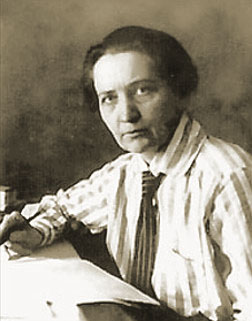
Yevgenia Bosch occupies a distinctive, if often underexamined, place in the history of the Russian Revolution and the early Soviet state. A Bolshevik militant of formidable discipline and ideological commitment, she stands among the first generation of female revolutionary leaders to assume executive authority during the revolutionary upheavals of 1917–1919. Her career, however, also reveals the contradictions of Bolshevik governance in Ukraine, the strains of civil war administration, and the psychological toll of revolutionary absolutism.
Born Yevgenia Bogdanovna Meisch in 1879 in Ochakiv, in the Kherson Governorate of the Russian Empire, Bosch came from a family of mixed German and Moldovan background. Her upbringing in a relatively privileged, though politically unremarkable household, did not initially predispose her to radicalism. Yet, like many members of the late imperial intelligentsia, she was drawn into revolutionary politics through exposure to the social injustices of autocratic rule and the ferment of Marxist thought in the early twentieth century. By the turn of the century, she had joined the Russian Social Democratic Labor Party and soon aligned herself with the Bolshevik faction led by Vladimir Lenin.
Bosch’s early political career was marked by clandestine organizing, arrests, and periods of exile. Her partnership, both political and personal, with the Bolshevik Georgy Pyatakov proved decisive. Together they formed part of a radical current within the party that often pushed for more immediate and uncompromising revolutionary action. Bosch distinguished herself as a capable organizer and agitator, particularly in Ukraine, where national, social, and imperial tensions intersected with unusual intensity.
The February Revolution of 1917 and the subsequent collapse of tsarist authority created the conditions for Bosch’s rapid ascent. She emerged as a key Bolshevik figure in Ukraine, advocating for the extension of Soviet power and opposing both Ukrainian nationalist movements and more moderate socialist factions. Following the October Revolution, Bosch became one of the principal architects of Bolshevik authority in Kyiv and the surrounding regions.
Her most significant role came in late 1917 and early 1918, when she served as head of the Soviet government in Ukraine, often described as the chair of the People’s Secretariat. In this capacity, Bosch functioned as one of the first female heads of government in modern history. Her administration operated under extraordinarily precarious conditions, facing not only internal opposition from Ukrainian nationalists and rival socialist groups, but also the advancing forces of the Central Powers following the Treaty of Brest Litovsk.
Bosch’s tenure illustrates the central dilemma of Bolshevik policy in Ukraine: the tension between the formal recognition of national self determination and the practical imperative of maintaining centralized revolutionary control. Bosch aligned firmly with the latter. She rejected Ukrainian independence as a bourgeois nationalist project and sought to integrate Ukraine into a broader Soviet framework. This position placed her in direct conflict with the Ukrainian Central Rada and contributed to the escalation of armed conflict in the region.
Her governance style was uncompromising. Bosch endorsed the use of coercion to suppress counterrevolutionary forces and to enforce Bolshevik authority. While such measures were consistent with broader Bolshevik practice during the Civil War, they also contributed to the alienation of segments of the local population and intensified the cycle of violence. The collapse of Bolshevik control in Ukraine in early 1918, under pressure from German backed forces, marked a significant setback for Bosch and her allies.
Bosch continued to serve the Soviet state in various administrative and party roles. However, the cumulative strain of political exile, and chronic illness, particularly severe spinal problems, took a profound toll on her physical and mental health. Unlike some of her contemporaries, Bosch did not transition successfully into the more bureaucratized structures of the post Civil War Soviet state. She became increasingly marginalized within the party, especially as internal debates hardened and the leadership consolidated under Lenin and, later, Stalin.
Bosch died in 1925, reportedly by suicide, after a prolonged period of illness and political disillusionment. Her death underscores the tragic dimension of many early Bolshevik lives, shaped by intense ideological commitment, relentless संघर्ष, and eventual estrangement from the revolutionary project they helped to build.
Historiographically, Bosch has often been overshadowed by more prominent figures of the Russian Revolution. Yet recent scholarship has begun to reassess her significance, particularly in the context of gender and revolutionary leadership. Bosch’s career challenges simplistic narratives of women’s roles in the Bolshevik movement by demonstrating that female revolutionaries could and did exercise direct political power at the highest levels. At the same time, her experience reveals the limits of such empowerment within a system increasingly characterized by centralization and authoritarian discipline.
From a broader analytical perspective, Bosch’s life exemplifies the dialectic between revolutionary idealism and state formation. Her unwavering commitment to proletarian internationalism led her to dismiss national aspirations in Ukraine, a position that, while ideologically consistent, proved politically destabilizing. In this sense, Bosch’s trajectory illuminates the broader contradictions of Bolshevik nationality policy and the difficulties of implementing Marxist principles in a multiethnic imperial context.
In sum, Yevgenia Bosch stands as a figure of both pioneering achievement and historical tragedy. Her leadership during a formative moment of Soviet power, her role as one of the first female heads of government, and her ultimate marginalization and demise together offer a compelling lens through which to examine the promises and perils of revolutionary transformation.
Bibliography
Bosch, Yevgenia. God bor’by: Bor’ba za vlast’ na Ukraine s aprelya 1917 goda do nemetskoi okkupatsii [A Year of Struggle: The Struggle for Power in Ukraine from April 1917 to the German Occupation]. Moscow: Gosizdat, 1925.
Figes, Orlando. A People’s Tragedy: The Russian Revolution 1891–1924. New York: Viking, 1996.
Kollontai, Alexandra. Selected Writings. London: Allison and Busby, 1977.
Lenin, Vladimir Ilyich. Collected Works. Moscow: Progress Publishers, various editions.
Pipes, Richard. The Russian Revolution. New York: Knopf, 1990.
Rabow Edling, Susanne. “Yevgenia Bosch and the Ukrainian Revolution.” Journal of Ukrainian Studies 35, no. 1 (2010): 45–68.
Smith, S. A. Russia in Revolution: An Empire in Crisis, 1890–1928. Oxford: Oxford University Press, 2017.
Stites, Richard. The Women’s Liberation Movement in Russia: Feminism, Nihilism, and Bolshevism, 1860–1930. Princeton: Princeton University Press, 1978.
 Letters from Tomis
Leave a comment