Himes, Chester. The Crazy Kill. Vintage Crime/Black Lizard, 1993.
Chester Himes’s The Crazy Kill (1957) is among the earliest and most corrosively intelligent entries in his Harlem cycle, a work that fuses the mechanics of detective fiction with a savage critique of American racial capitalism, Northern hypocrisy, and the violent contradictions of postwar urban modernity. While often read primarily as crime entertainment—and it is undeniably propulsive—The Crazy Kill operates most powerfully as a social anatomy: Harlem becomes less a setting than a political condition, and the “crazy kill” itself becomes a metaphor for the irrational but systematized violence underwriting American life.
Himes’s achievement in this novel lies not in offering a comforting restoration of order (the classical promise of detective fiction), but in exposing the very concept of “order” as ideological—an arrangement maintained through police power, racial containment, and the disciplined suffering of the poor. The Crazy Kill is therefore best approached as noir in its purest sense: a literature of institutional rot in which the individual crime is only the surface symptom of a deeper, chronic sickness.
Harlem as System, Not Locale
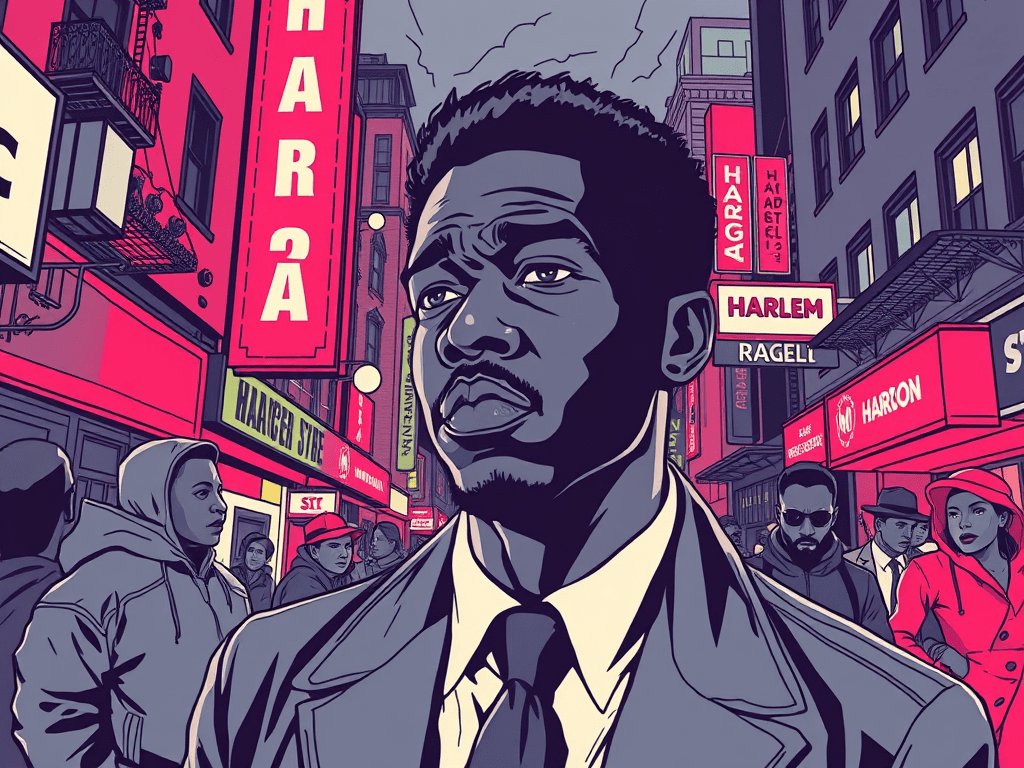
One of Himes’s defining innovations is his portrayal of Harlem not as a colorful neighborhood but as a structurally produced environment—an urban zone shaped by enclosure, exploitation, and surveillance. Harlem in The Crazy Kill is simultaneously over-policed and under-protected, heavily mythologized and brutally neglected. The novel repeatedly emphasizes how racialized poverty warps every human transaction: intimacy, aspiration, sexuality, and even hope become strained commodities.
Harlem thus functions like a political economy. Himes renders the street as a marketplace of hustles where money determines not simply class position but bodily vulnerability: who can buy safety, who must barter dignity, who is exposed to arbitrary assault. This is noir’s traditional interest in corruption, but radicalized: corruption is not an exception to the system; it is the system’s operating logic.
In that regard, The Crazy Kill reads as an implicit rebuttal to the liberal myth of Northern racial progress. It insists that segregation and domination were not merely Southern problems; they were embedded in the labor and housing markets of Northern cities, policed through spatial containment and legalized violence. Harlem becomes the concentrated expression of American inequality—an “internal colony” whose resources (labor, culture, sex, entertainment) are extracted while its population is treated as disposable.
Violence as Social Logic
The novel’s title is not simply sensational: it offers a theory of violence. Himes presents violence as both ubiquitous and culturally “misrecognized.” That is, the public tends to treat murder in Harlem as irrational pathology—random, savage, “crazy.” But Himes shows that the violence has social intelligibility. It is the predictable outcome of structural constraints, the psychic pressure of humiliation, and the constant threat of police intervention.
Himes’s tonal brilliance is that he does not romanticize this violence as revolutionary authenticity, nor does he reduce it to moral failure. Instead, it is treated as historically produced brutality. People are cornered into roles and behaviors through economic desperation and the contempt of state power.
From a critical perspective, The Crazy Kill is therefore aligned with what we might call a materialist noir: the book rejects metaphysical evil as an explanation and insists on the concreteness of social causation. Crime is not individual deviance from normality; it is a symptom of normality under conditions of racial capitalism.
Coffin Ed Johnson and Grave Digger Jones: Law as Performance
Himes’s detective duo—Coffin Ed Johnson and Grave Digger Jones—are among the most original creations in American crime literature. Unlike the solitary private eye who embodies liberal individualism (Chandler’s Marlowe, for instance), Himes’s detectives are agents of the state, but in a state that is itself contradictory. They function simultaneously as protectors of Harlem’s residents and as enforcers of the racist order that contains Harlem.
This contradiction makes them deeply modern figures. Their work is not simply detection but containment: keeping Harlem from “spilling over,” preventing disorder from becoming political. They mediate between white institutions (police hierarchy, courts) and Black urban life, knowing that both sides interpret them instrumentally.
Importantly, their authority is performed through intimidation and spectacle. Violence becomes their language—sometimes punitive, sometimes strategic. Their very nicknames evoke mortality and burial, suggesting that policing in Harlem is inseparable from death management: the state does not merely govern life; it governs who may die, and with what level of public concern.
Himes thus anticipates later critical theories of policing: the police appear less as neutral arbiters and more as the armed edge of social control.
Genre as Ideology: Subverting the Detective Novel
Classic detective fiction is structurally conservative: it begins with a rupture (the crime) and ends with restoration (truth, closure, justice). Himes uses this structure only to poison it. The investigation proceeds, but closure feels partial, tainted, unstable. Even if the immediate crime is clarified, the social conditions that produced it remain intact and will continue to produce future crimes.
In effect, Himes turns detective fiction into a dialectical form:
• the crime reveals the system
• the investigation maps the system
• the solution fails to heal the system
This is not a defect of plotting. It is the novel’s ideological method. Himes insists that if you want clean resolution, you must accept a lie about society.
Style: Excess, Speed, and the Political Use of Shock
Himes’s prose is frequently described as “hardboiled,” but that label understates its experimental volatility. His style accelerates, erupts, veers into grotesquerie, and uses shock not merely for sensation but for political estrangement. Readers are forced to confront the obscene normality of cruelty. The novel can feel exaggerated, yet that exaggeration functions as a realism of social pressure—the realism of living within a violent contradiction.
This is why Himes is often better understood not as merely a genre writer but as a satirist in the tradition of Swift and a social critic in the tradition of Wright and Ellison. He deploys caricature as critique. He makes the social order look monstrous because, under inspection, it is monstrous.
Conclusion: The Crazy Kill as Political Noir
The Crazy Kill should be read as a key text in twentieth-century American literature precisely because it weaponizes genre against American innocence. Its Harlem is not a detective playground but a pressure chamber. Its detectives are not heroes of justice but complicated functionaries of containment. Its violence is not pathology but political logic. And its narrative pleasures—the chase, the interrogations, the reveals—are inseparable from its deeper argument: that the American city produces “crazy” outcomes because the system itself is crazy.
Ultimately, Himes offers not a moral lesson but a diagnosis. The “crazy kill” is what happens when human beings are made to live inside an arrangement that denies their humanity while extracting their labor, disciplining their bodies, and ridiculing their pain. The novel remains urgent because it refuses the consolations that still dominate mainstream crime storytelling: the fantasy that evil is exceptional, justice is attainable, and law is a moral instrument rather than a class weapon.


Leave a Reply