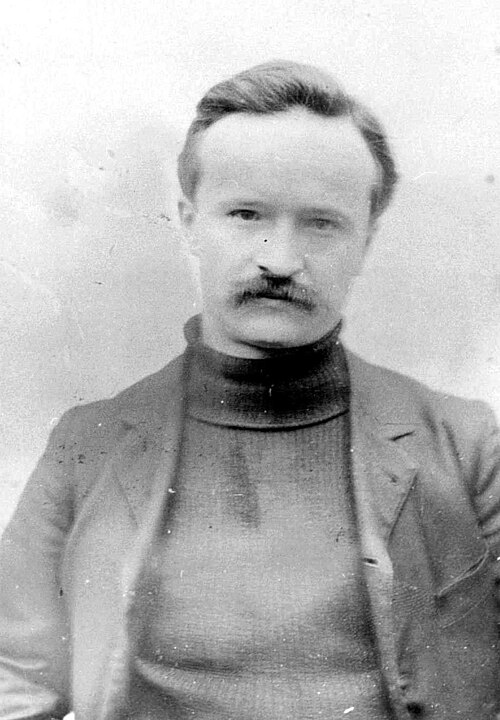
Pierre Monatte: Pioneer of Revolutionary Syndicalism
My Socialist Hall of Fame
During this chaotic era of vile rhetoric and manipulative tactics from our so-called bourgeois leaders, I am invigorated by the opportunity to reflect on Socialists, Revolutionaries, Philosophers, Guerrilla Leaders, Partisans, and Critical Theory titans, champions, and martyrs who paved the way for us—my own audacious “Socialism’s Hall of Fame.” These are my heroes and fore-bearers. Not all are perfect, or even fully admirable, but all contributed in some way to our future–either as icons to emulate, or as warnings to avoid in the future.
Introduction
Pierre Monatte stands as one of the most principled and intellectually rigorous figures of the French revolutionary labor movement in the first half of the twentieth century. A central theorist of revolutionary syndicalism, a founding member of the French Communist Party (PCF), and later one of its most principled critics, Monatte embodied a distinctive current of Marxist humanism rooted in worker autonomy, ethical clarity, and internationalism. Unlike many of his contemporaries who oscillated between reformism and authoritarian party discipline, Monatte remained steadfast in his belief that socialism could only be achieved through the self-emancipation of the working class.
Though less well known than figures such as Georges Sorel or Léon Trotsky, Monatte exerted a profound influence on French labor militancy, particularly through his editorial leadership of La Vie Ouvrière, which became both a practical organizing tool and a theoretical forum for syndicalist Marxism. His life illuminates the tensions between revolutionary ideals and political institutions in the age of world wars, Bolshevism, and the rise of Stalinism.
Early Life and Intellectual Formation (1881–1909)
Pierre Monatte was born on January 15, 1881, in Monlet, Haute-Loire, into a modest rural family. He trained as a typesetter—an occupation historically associated with political radicalism due to its literacy and access to print culture. Like many militants of his generation, Monatte was shaped by the Dreyfus Affair, which radicalized a cohort of French intellectuals and workers against militarism, clericalism, and state injustice.
By the early 1900s, Monatte had become active in the Confédération Générale du Travail (CGT) and gravitated toward revolutionary syndicalism. Unlike reformist socialists, syndicalists rejected parliamentary politics in favor of direct action, mass strikes, and workers’ self-organization. For Monatte, syndicalism was not merely tactical but ethical: it cultivated independence, solidarity, and class consciousness.
In 1909, he founded La Vie Ouvrière, a journal that would become one of the most important organs of French working-class intellectual life. Unlike many labor publications, it emphasized empirical reporting, internationalism, and worker education rather than agitational rhetoric.
Revolutionary Syndicalism and World War I (1909–1918)
Monatte emerged as one of the clearest voices defending syndicalist autonomy against both parliamentary socialism and nationalist compromise. He was a fierce opponent of union bureaucratization and warned early against the erosion of working-class independence through alliances with the bourgeois state.
The outbreak of World War I marked a decisive rupture. While much of the European socialist movement collapsed into patriotic support for their national governments—the Union sacrée in France—Monatte remained staunchly internationalist. He opposed the war as an imperialist conflict fought at the expense of workers and resigned from the CGT leadership in protest against its support for the war effort.
This moral stand marginalized him politically but secured his long-term reputation as a principled internationalist. During the war years, Monatte maintained contact with antiwar socialists and followed the emerging revolutionary movement in Russia with cautious optimism.
Communism and Disillusionment (1919–1924)
The Russian Revolution initially appeared to Monatte as the vindication of revolutionary syndicalism’s central insights. In 1920, he joined the newly formed French Communist Party (PCF), believing it could serve as a vehicle for international working-class unity.
However, Monatte soon grew disillusioned with the authoritarian centralism imposed by the Communist International under Bolshevik leadership. He opposed the subordination of trade unions to party discipline and criticized the growing bureaucratization of the Soviet state. His dissent culminated in his expulsion from the PCF in 1924.
This break marked a decisive moment in his intellectual development. Unlike many former communists who turned toward liberalism or anti-communism, Monatte remained a revolutionary socialist while rejecting both reformism and Stalinism.
La Révolution Prolétarienne and Independent Marxism (1925–1939)
In 1925, Monatte co-founded La Révolution prolétarienne, which became a central forum for anti-Stalinist Marxist thought in France. The journal published workers’ testimonies, international labor reports, and critical analyses of Soviet policy, while maintaining solidarity with genuine revolutionary movements.
Monatte’s Marxism during this period was distinctive for its ethical clarity and empirical grounding. He rejected historical determinism and emphasized human agency, class consciousness, and moral responsibility. His approach resonated with figures such as Alfred Rosmer and later influenced dissident Marxists including Simone Weil and, indirectly, Cornelius Castoriadis.
During the 1930s, Monatte remained skeptical of both the Popular Front and Soviet foreign policy, warning that alliances with bourgeois forces would ultimately disarm the working class. His warnings, largely ignored at the time, would later appear prescient.
War, Postwar Years, and Legacy (1939–1960)
During World War II, Monatte lived in relative political isolation but remained intellectually active. After the war, he continued to write and mentor younger militants, emphasizing historical memory and ethical consistency over ideological fashion.
He died in 1960, largely outside the mainstream of French political life, yet his influence endured—particularly among independent Marxists, libertarian socialists, and labor historians who sought alternatives to both social democracy and Stalinism.
Monatte’s enduring contribution lies in his insistence that socialism must remain inseparable from workers’ self-activity, moral clarity, and democratic practice. In an era marked by ideological betrayals, he represents a rare continuity of revolutionary integrity.
Historical Significance
Pierre Monatte occupies a crucial position in the history of European socialism as a bridge between pre-1914 revolutionary syndicalism and post-1917 anti-Stalinist Marxism. His life challenges simplistic narratives of leftist evolution by demonstrating that fidelity to revolutionary ideals often required resistance to revolutionary institutions themselves.
For contemporary scholars, Monatte offers a model of political ethics grounded not in abstraction, but in lived struggle—a reminder that the means of emancipation must embody the ends they seek.
Selected Bibliography
Primary Sources
Monatte, Pierre. La Vie Ouvrière: 1909–1914. Paris: Maspero, 1963.
—. La Révolution Prolétarienne. Paris: Éditions Spartacus, selected issues 1925–1939.
—. Syndicalisme Révolutionnaire et Communisme. Paris: Librairie du Travail, 1923.
Secondary Sources
Draper, Hal. Karl Marx’s Theory of Revolution, Vol. IV: Critique of Other Socialisms. Monthly Review Press, 1990.
Jennings, Jeremy. Syndicalism in France: A Study of Ideas. St. Martin’s Press, 1990.
Magraw, Roger. A History of the French Working Class, Vol. 2: Workers and the Bourgeois Republic. Blackwell, 1992.
Rosmer, Alfred. Moscow under Lenin. Monthly Review Press, 1972.
Stearns, Peter N. Revolutionary Syndicalism and French Labor. Rutgers University Press, 1971.
Thorpe, Wayne. The Workers Themselves: Revolutionary Syndicalism and International Labour, 1913–1923. Kluwer Academic, 1989.
Weil, Simone. Oppression and Liberty. Translated by Arthur Wills and John Petrie, Routledge, 1958.


Leave a comment