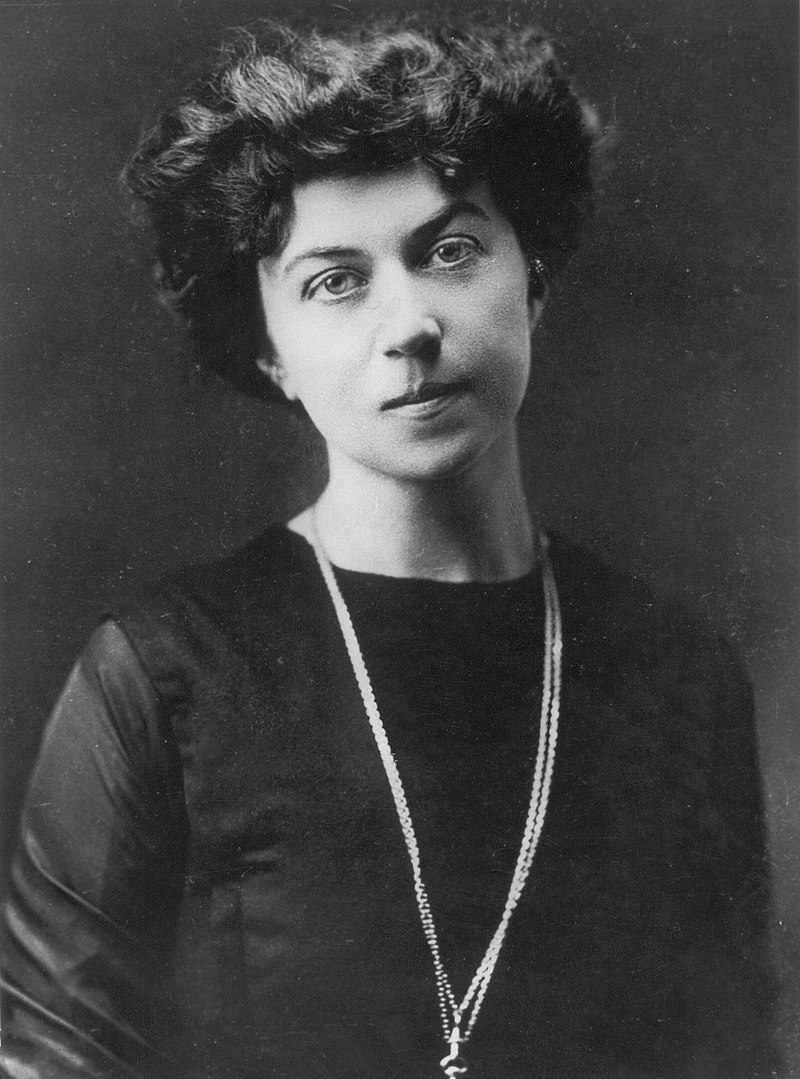
My Socialist Hall of Fame
During this chaotic era of vile rhetoric and manipulative tactics from our so-called bourgeois leaders, I am invigorated by the opportunity to reflect on Socialists, Revolutionaries, Philosophers, Guerrilla Leaders, Partisans, and Critical Theory titans, champions, and martyrs who paved the way for us—my own audacious “Socialism’s Hall of Fame.” These are my heroes and fore-bearers. Not all are perfect, or even fully admirable, but all contributed in some way to our future–either as icons to emulate, or as warnings to avoid in the future.
Early Life and Formation
Alexandra Mikhailovna Kollontai (1872–1952) was born in St. Petersburg into a wealthy and aristocratic but liberal household. Her father, a tsarist general of Ukrainian origin, and her Finnish-born mother provided her with an education steeped in European culture, foreign languages, and music. Yet the contradictions of privilege and the glaring inequalities of late Imperial Russia fostered in Kollontai a critical sensibility. Rejecting the conventional path of marriage and domesticity expected of noble women, she pursued independent study in political economy, attending lectures at Zurich and immersing herself in Marxist literature.
Her intellectual awakening coincided with a growing dissatisfaction with tsarist autocracy and the plight of Russian workers and peasants. By the turn of the century, she had become a committed socialist, linking questions of class exploitation to women’s subjugation.
Revolutionary Career
Kollontai entered the Russian Social Democratic Labor Party (RSDLP) in 1899, initially aligning with the Mensheviks. Her early writings, such as The Social Basis of the Woman Question (1909), demonstrated her conviction that women’s emancipation could only be achieved through proletarian revolution, not through bourgeois feminism. In this, she advanced a distinctly Marxist critique of the “woman question,” situating gender oppression within the structures of capitalism.
Her opposition to the First World War brought her closer to Lenin and the Bolsheviks, whose revolutionary defeatism aligned with her internationalist outlook. By 1915 she was in exile in Switzerland and Scandinavia, writing and organizing among socialist women and advocating proletarian internationalism.
The October Revolution and People’s Commissariat
The October Revolution of 1917 catapulted Kollontai into the Bolshevik government. As People’s Commissar for Social Welfare, she became the first woman in history to hold a ministerial post. Her tenure was marked by ambitious reforms: the legalization of divorce and abortion, the decriminalization of homosexuality, the promotion of communal kitchens, childcare facilities, and maternity benefits. These measures sought to liberate women from the confines of patriarchal family structures and enable their participation in socialist construction.
Kollontai also played a central role in the Zhenotdel (Women’s Department), founded in 1919 to mobilize women workers and peasants. Through literacy campaigns, political education, and the establishment of social services, Zhenotdel was instrumental in integrating women into Soviet society.
The Workers’ Opposition
By 1920, disillusionment with bureaucratization and the centralization of power within the Bolshevik Party led Kollontai to join the Workers’ Opposition, alongside Alexander Shlyapnikov. This faction criticized the suppression of rank-and-file democracy and called for greater control of industry by trade unions. Kollontai’s The Workers’ Opposition (1921) became a manifesto for internal party democracy and a critique of what she saw as creeping authoritarianism. Lenin, while respecting her integrity, denounced the group’s positions, and at the 10th Party Congress the Workers’ Opposition was effectively suppressed.
Diplomatic Career
Following the defeat of her faction, Kollontai was reassigned to the Soviet diplomatic service. From 1922 onward she served in Norway, Mexico, and Sweden, becoming one of the first female diplomats in modern history. In Sweden she played a crucial role in Soviet–Scandinavian relations, including the negotiation of the Soviet–Finnish armistice during the Second World War. Her diplomacy was pragmatic, but her exile from domestic politics also reflected the Party leadership’s mistrust of her oppositional past.
Theoretical Contributions and Legacy
Kollontai’s writings on sexuality, love, and social relations remain some of the most radical contributions to Marxist feminist thought. Works such as Communism and the Family (1920) and essays on the “new woman” envisioned the transformation of human relationships under socialism—where sexual freedom, comradeship, and collective responsibility would replace bourgeois morality and patriarchal marriage.
While many of her reforms were rolled back under Stalin’s conservative “family values” policies of the 1930s, Kollontai’s theoretical legacy endured, influencing second-wave feminism and contemporary socialist feminist scholarship. She exemplified the tensions of revolutionary commitment: a figure simultaneously pioneering in her vision of women’s liberation and marginalized within the structures of a patriarchal and authoritarian party-state.
Kollontai died in Moscow in 1952, largely forgotten by official Soviet historiography, yet her ideas have since been reclaimed as central to Marxist feminist traditions worldwide.
Bibliography
Primary Works by Alexandra Kollontai
• Kollontai, Alexandra. The Social Basis of the Woman Question. 1909.
• ———. Communism and the Family. Moscow: Kommunist, 1920.
• ———. The Workers’ Opposition. 1921.
• ———. Autobiography of a Sexually Emancipated Communist Woman. Berlin: Verlag für Sexualpolitik, 1926.
• ———. Selected Writings of Alexandra Kollontai. Edited and translated by Alix Holt. New York: W. W. Norton, 1977.
Secondary Sources
• Clements, Barbara Evans. Bolshevik Feminist: The Life of Alexandra Kollontai. Bloomington: Indiana University Press, 1979.
• Farnsworth, Beatrice. Alexandra Kollontai: Socialism, Feminism, and the Bolshevik Revolution. Stanford: Stanford University Press, 1980.
• Holt, Alix. Introduction to Selected Writings of Alexandra Kollontai. New York: W. W. Norton, 1977.
• Porter, Cathy. Alexandra Kollontai: A Biography. London: Virago, 1980.
• Stites, Richard. The Women’s Liberation Movement in Russia: Feminism, Nihilism, and Bolshevism, 1860–1930. Princeton: Princeton University Press, 1978.
• Wood, Elizabeth A. The Baba and the Comrade: Gender and Politics in Revolutionary Russia. Bloomington: Indiana University Press, 1997.
 Letters from Tomis
Leave a comment