Book Review
Marx, Karl, and Friedrich Engels. The Civil War in the United States. Edited by Andrew Zimmerman, International Publishers, 2016.
The Civil War in the United States (first published in 1937 by International Publishers and reissued many times since) is a foundational Marxist analysis of the American Civil War, gathering the correspondence, journalism, and commentary of Karl Marx and Friedrich Engels from 1861 to 1865. It stands as one of the clearest expressions of historical materialism applied to a major capitalist society in crisis and is a brilliant example of internationalist solidarity with a progressive bourgeois revolution from a proletarian standpoint.
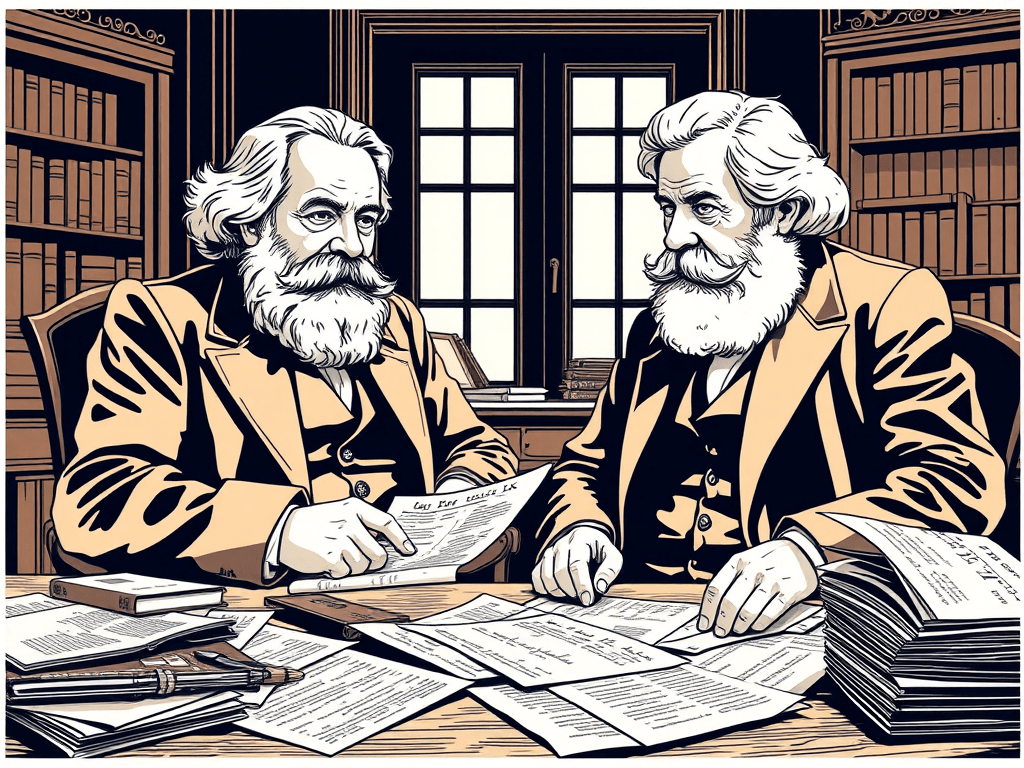
This volume contains Marx’s dispatches to the New York Daily Tribune, as well as his correspondence with Engels and other revolutionaries, illuminating how the leading figures of the First International interpreted the war between North and South. Marx and Engels consistently framed the conflict not simply as a sectional dispute, nor merely a constitutional crisis, but as a decisive battle between two antagonistic modes of production: slavery and capitalism. Their analysis prefigures many insights of modern historiography but is ultimately rooted in Marxist theory’s central proposition—that the motor force of history is class struggle.
Marx’s unwavering support for the Union cause, qualified by his sharp critique of Northern timidity and bourgeois hypocrisy, reveals a dialectical understanding of revolutionary potential within contradictory circumstances. He recognized that the war, though led by capitalists, had the unintended consequence of smashing the Southern slavocracy and accelerating the conditions for proletarian struggle. The Emancipation Proclamation is analyzed not as a gift from Lincoln, but as a forced concession to the needs of war and the rising demands of the enslaved and the working class—an example of how historical necessity and class agency intersect.
Equally valuable is Engels’ military analysis of the war, in which he applied his vast knowledge of military science to the tactics and strategies of the conflict. His letters provide not just detailed critiques of battlefield maneuvers but also emphasize the broader political stakes of military developments. Engels was particularly prescient in noting that the war could not be won without transforming it into a revolutionary war against slavery.
A notable strength of the collection is the insistence that the struggle against slavery in the United States was of international consequence. Marx and Engels argued that a Union victory would deal a blow not just to the Southern planter class, but to the global reactionary order. Their correspondence links the war to broader struggles in Europe and beyond—especially the workers’ movements in Britain and the fight against aristocratic and colonial rule. The workers’ address to Abraham Lincoln from the International Working Men’s Association, included in the volume, is a powerful document of proletarian internationalism and an expression of solidarity rooted not in sentimentality but in strategic clarity.
The book also demonstrates Marx and Engels’ confidence in the working class of Britain and Europe to oppose their own governments’ sympathies for the Confederacy. Despite the material dependence of British industry on Southern cotton, Marx correctly predicted that the British proletariat would support the anti-slavery cause. This affirmation of working-class moral and political independence—despite economic coercion—offers a key lesson for revolutionary strategy today.
Critically, The Civil War in the United States models how communists should engage with bourgeois-democratic struggles: not with sectarian aloofness, but with concrete analysis and support for those aspects that advance the historic interests of the working class and oppressed. Marx and Engels championed the Union war effort not because they were blind to the limitations of bourgeois democracy, but because they understood that the destruction of slavery was a historical precondition for any future class-conscious workers’ movement in the United States.
In today’s context—where the legacy of slavery still shapes capitalist social relations, from systemic racism to economic exploitation—this text remains a vital contribution to revolutionary thought. It compels modern communists to consider the dialectic between bourgeois progress and proletarian revolution, the necessity of concrete solidarity across borders, and the primacy of historical conditions over idealist abstractions.
In sum, The Civil War in the United States is not merely a collection of period journalism—it is a masterpiece of Marxist analysis, alive with revolutionary urgency and strategic insight. It serves as both a theoretical weapon and a historical compass, reminding communists that no revolutionary movement can ignore the concrete struggles for liberation waged within and across class societies. Its place in the canon of communist literature is not ancillary—it is essential.
 Letters from Tomis
Leave a comment