Introduction
The German Communist Party (Kommunistische Partei Deutschlands, KPD) was founded amid the revolutionary ferment of late 1918, and it remained a pivotal force on the German left until its organizational end in 1990 with its successors’ merger into the Party of Democratic Socialism (PDS). This essay traces the KPD’s entire trajectory from its birth in the German Revolution to its dissolution, examining its major ideological currents and historical role from a pro-communist perspective. Luxemburgism – the libertarian Marxist ethos associated with co-founder Rosa Luxemburg – and Marxism-Leninism – the Bolshevik model that later came to dominate the party – are emphasized as critical currents shaping KPD theory and practice. Primary sources, including speeches and writings by Luxemburg, Ernst Thälmann, and Wilhelm Pieck, are analyzed alongside secondary scholarship to critically assess the KPD’s revolutionary strategy, its fraught relationship with social democracy, its responses to fascism, its Cold War alignments, and its experience of repression (both as victim and perpetrator). Comparisons are drawn with other European communist parties (notably in France, Italy, and the Soviet Union) to contextualize the KPD’s strategic and theoretical choices. The essay is structured in chronological and thematic sections, beginning with the KPD’s revolutionary origins and concluding with its post-war metamorphosis, and ends with reflections on its legacy.
Origins: Revolution and the Birth of the KPD (1918–1919)
The KPD emerged directly from the turmoil of World War I and the German Revolution of 1918–19. Before World War I, Germany’s Social Democratic Party (SPD) was the world’s strongest socialist party, but by 1914 it had embraced reformism and supported the war, betraying its Marxist roots. In response, left-wing SPD dissidents led by Rosa Luxemburg and Karl Liebknecht split off, forming the Spartacus League and subsequently the KPD. At the KPD’s founding congress in Berlin from December 30, 1918 to January 1, 1919, Luxemburg – initially hesitant about breaking from the SPD – joined Liebknecht and other revolutionaries to launch a new party committed to socialist revolution. The founding congress featured programmatic speeches by Luxemburg (“Our Program”) and Liebknecht (“The Crisis of the USPD”), underscoring the KPD’s immediate revolutionary aims. Under Luxemburg and Liebknecht’s leadership, the nascent KPD called for overthrowing the bourgeois interim government and establishing a proletarian socialist republic, in solidarity with the recent Bolshevik Revolution in Russia. The party’s platform rejected gradual parliamentary reformism in favor of mass action. As Luxemburg proclaimed in the Spartacus League manifesto of December 1918: “This transformation and this overthrow cannot be decreed by any bureau, committee, or parliament. It can be begun and carried out only by the masses of people themselves,” since socialism can be achieved “only by the great majority of the working people themselves.” This Luxemburgist principle of revolutionary mass democracy – emphasizing spontaneous proletarian action via workers’ and soldiers’ councils – set the tone for the KPD’s early ideological identity.
Despite its theoretical fervor, the KPD’s birth came in a chaotic revolutionary situation. In January 1919, radicalized workers rose in the Spartacist Uprising in Berlin against the SPD-led government. Luxemburg and Liebknecht, though not initiators of the revolt, joined it once underway. The uprising was brutally crushed by paramilitary Freikorps units unleashed by SPD defense minister Gustav Noske; in the aftermath, Luxemburg and Liebknecht were captured and murdered by Freikorps troops on January 15, 1919. This violent repression by the social-democratic government – essentially a “counter-revolutionary” alliance with right-wing forces – cemented an abiding hostility between the KPD and SPD. From a communist perspective, the SPD’s role in suppressing the revolution confirmed its betrayal of the working class, explaining the KPD’s subsequent refusal to trust the social democrats. The martyrdom of Luxemburg and Liebknecht deprived the KPD of its founding leaders within weeks of its creation, a tragic blow to the Luxemburgist current. Nonetheless, the party survived and grew. By 1920, thanks in part to an influx of former Independent Social Democrats (USPD) who defected to the communists, the KPD swelled to as many as 350,000–400,000 members – a mass base that made it a significant force in Weimar politics from the start.
The KPD in the Weimar Republic (1919–1933)
Early Years and Luxemburgist Influence (1919–1923): In its first years, the KPD grappled with how to pursue revolution in the fledgling Weimar Republic. After the abortive Spartacist revolt, the party initially adopted a somewhat flexible approach under leaders like Paul Levi (who succeeded Luxemburg as KPD chair). Levi, a close associate of Luxemburg, steered the KPD away from adventurism and “putschism” and attempted to win over socialist workers by cooperating with the larger labor movement. In 1920, this approach paid off when a left-wing split of the USPD (which itself had broken from the SPD during the war) merged into the KPD, instantly making it a mass party rather than a small vanguard. The KPD’s membership and influence in the early 1920s thus expanded, and it participated in legal elections and trade-union struggles even as it officially remained committed to an ultimate revolutionary overthrow of capitalism. During this period, Luxemburgism still influenced KPD strategy: the party supported workers’ council movements and strikes, and many rank-and-file members believed in democratic mass action rather than “dictatorial” methods. In line with Luxemburg’s critique of authoritarian tactics, the KPD at its Halle Congress (1920) endorsed the principle of working through democratic workers’ councils (Räte) and rejected participation in the bourgeois National Assembly. However, the KPD’s revolutionary impatience also led to missteps: in March 1921, radical elements launched the ill-fated “March Action,” an armed uprising in central Germany, against Levi’s counsel. The failure of this putsch led to Levi’s expulsion (for publicly criticizing the action) and marked the beginning of Comintern (Communist International) intervention in KPD affairs. Levi’s ouster illustrated a broader trend – a tension between the KPD’s indigenous, Luxemburgist tendency favoring united-front, bottom-up struggle and the more militant Bolshevik line advocated by Moscow.
Stalinization and the “Third Period” (1924–1933): By the mid-1920s, the KPD underwent “Bolshevization” under the influence of the Soviet-led Comintern. Internal factional strife wracked the party, mirroring power struggles in Moscow. After a series of leadership changes, a pivotal shift came in 1925 when Soviet leader Joseph Stalin intervened to install Ernst Thälmann as KPD chairman. Thälmann was a devoted Marxist-Leninist who aligned the KPD tightly with Stalin’s line. Under Thälmann’s leadership (1925–1933), the party was “Stalinized” – disciplined under democratic centralism, funded by and loyal to the Comintern, and purged of dissenting factions. Prominent members who supported alternative ideas were expelled, including supporters of the “Right Opposition” like Heinrich Brandler and August Thalheimer (who favored a more moderate united-front approach). Thälmann himself was described as “the driving force behind Stalinization” of the KPD. This transformation meant that Marxism-Leninism, as interpreted by Stalin, supplanted Luxemburgism within the KPD’s ideology. While Luxemburg had been revered as a martyr, by 1931–32 Thälmann and the Comintern line explicitly repudiated Luxemburg’s theoretical “errors.” After Stalin issued a scathing critique of Luxemburg in 1931, Thälmann dutifully responded with an essay that echoed Moscow’s verdict – claiming Luxemburg had been “mistaken on every single point” where she had differed from Lenin. Thus, by the early 1930s the KPD officially canonized Marxism-Leninism (in its Stalinist form) as the only correct doctrine, painting Luxemburgism as a deviant, semi-Menshevik tendency. The ideological homogenization under Thälmann had profound strategic consequences.
In the late 1920s, the Comintern initially encouraged a “united front” policy – urging communists to work with other working-class parties including the SPD. The KPD did briefly cooperate with the Social Democrats on issues like a 1926 referendum to expropriate the former nobility (where they jointly mobilized millions of voters). In October 1923, the KPD even joined short-lived regional coalition governments with the SPD in Saxony and Thuringia (attempting to use these as bases for a revolutionary uprising). However, these united-front experiments were ephemeral: the central army crushed the leftist Saxony/Thuringia governments and foiled communist uprisings. By 1928–1929, the Comintern’s line shifted dramatically to the ultra-left “Third Period”, and the KPD correspondingly adopted a policy of open confrontation with the SPD. The Comintern now theorized that social democracy was “social fascism,” a socialist in name but fascist in essence, for shoring up capitalism and blocking revolution. Thälmann’s KPD embraced this stance zealously. Viewing itself as the “only anti-fascist party” and the true vanguard of the proletariat, the KPD declared that all other parties – including the SPD and moderate liberals – were varieties of “fascist” enemies. In practice, this meant the KPD directed almost as much vitriol (or more) at the Social Democrats as against the emergent Nazi Party. Thälmann notoriously asserted in 1932 that “some Nazi trees must not be allowed to overshadow a forest of social democrats,” implying that the SPD was the more obstructive foe. This sectarian line led the KPD to routinely refuse joint actions with the SPD against the Nazis, even though fascism’s threat was growing.
From a critical perspective, the “social fascism” policy was a grave strategic error – one that many communists (including exiled Bolshevik Leon Trotsky and even some within the KPD like Thalheimer) harshly criticized. Trotsky called for a united front of KPD and SPD to stop Hitler, warning that splitting the working class would be fatal. However, Thälmann and the Comintern majority rebuffed these appeals. In their view, the SPD leadership – epitomized by figures like Hermann Müller and Otto Braun – was so complicit in bourgeois repression (e.g. the “Bloody May” 1929 massacre of communist demonstrators by SPD-led Berlin police) that unity was impossible. The “Blutmai” events indeed deepened animosity: when SPD authorities banned May Day marches in 1929, the KPD defied the ban and clashes ensued in which police killed 33 civilians. To communists, this confirmed SPD’s role as strike-breaker and accomplice of capitalist violence. Thälmann thus maintained that cooperation could only occur if the SPD rank-and-file broke from their “reactionary” leaders – essentially demanding the SPD’s political surrender. By 1932, despite enormous pressures, the KPD and SPD remained bitterly divided, which tragically undercut the German left’s ability to present a united front against Nazism.
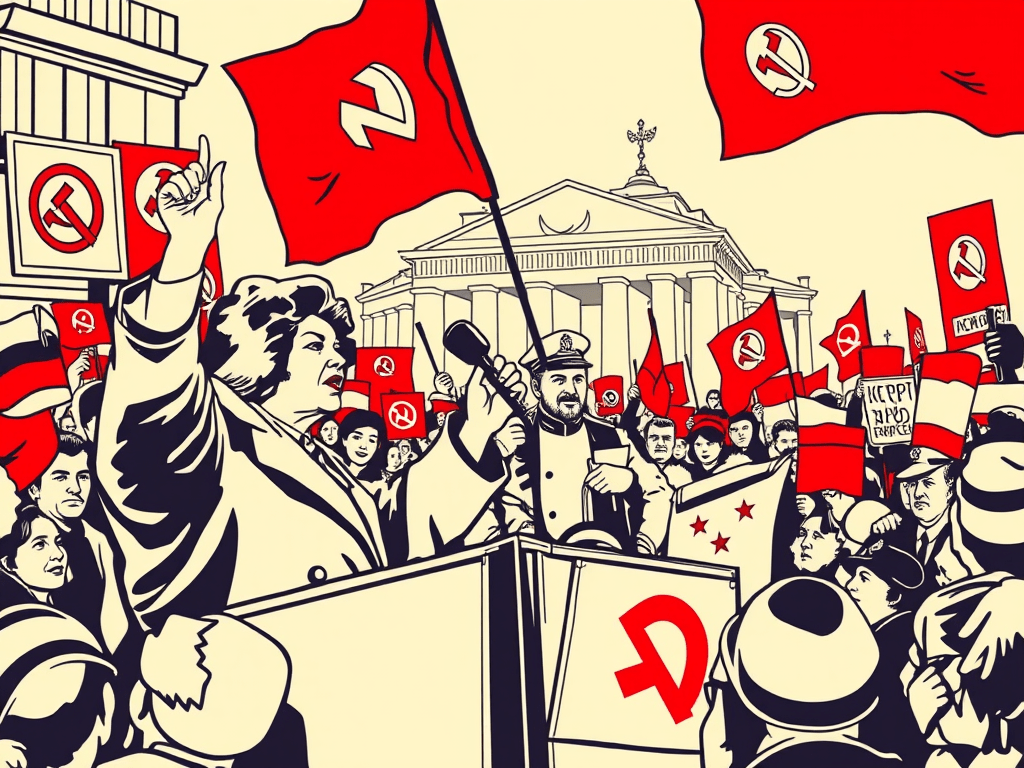
Nevertheless, the KPD did attempt its own anti-fascist mobilization. It organized militant defense formations such as the Roter Frontkämpferbund (Red Front Fighters’ League) and later Antifaschistische Aktion (Antifa). In the early 1930s street brawls between communist and Nazi paramilitaries were frequent, and communist cadres courageously fought Nazi stormtroopers in working-class neighborhoods. The KPD’s propaganda and posters in 1932 called for “an end to this system!”, urging workers to overthrow both capitalism and fascism. Notably, the Antifa emblem – two flags symbolizing united struggle – adorned the KPD’s Berlin headquarters, the Karl-Liebknecht-Haus, as a bold statement of the party’s commitment to fight fascism (see image).
Politically, the KPD remained a significant force until the end of the Weimar Republic. It polled between 10% and 17% of the vote in Reichstag elections throughout the late 1920s and early 1930s, at one point seating 100 deputies (November 1932) as the third-largest party in parliament. It had a strong base among industrial workers and the unemployed, and it continued militant grassroots organizing even as economic depression set in after 1929. Yet the KPD’s sectarian strategy arguably isolated it at the critical moment. When the Nazi Party – seen by some communists as just another variant of fascism not fundamentally different from the SPD – made electoral breakthroughs in 1930–1932, the divided left failed to stop Hitler’s ascent. In January 1933, Adolf Hitler took power as Chancellor. The KPD called for general strikes to resist the Nazi takeover, but without SPD support these calls went largely unheeded. The opportunity for a united working-class resistance had been fatally missed.
Anti-Fascist Struggle and World War II (1933–1945)
Hitler’s appointment in January 1933 marked the demise of the KPD in Germany – at least publicly and legally. The Nazis moved immediately to outlaw the communists. In late February 1933, the Reichstag fire was blamed (falsely) on a communist plot, providing a pretext for mass arrests. The Reichstag Fire Decree and Enabling Act effectively criminalized the KPD. The party was officially banned the day after the last semi-free election (March 1933) that brought Hitler to dominance. All 81 KPD deputies elected to the Reichstag were prevented from taking their seats and were hunted by the Gestapo. Thälmann himself was arrested in March 1933 and would spend 11 years in Nazi prisons before being executed on Hitler’s orders in 1944, making him a martyr of German communism.
Driven underground, the KPD attempted to organize a clandestine resistance within Germany. Despite enormous dangers, communist cells continued to distribute anti-Nazi literature and conduct sabotage throughout the 1930s. The KPD and affiliated groups led significant parts of the anti-Nazi resistance, especially in industrial centers and among some intellectual circles. For example, communist networks were involved in resistance actions like the Red Orchestra (Rote Kapelle) spy network and partisan activities. However, the repression was merciless: between 1933 and 1939, the Nazis killed an estimated 30,000 German communists and imprisoned around 150,000 in concentration camps. Most of the KPD’s prominent leaders who did not escape abroad were imprisoned or murdered. The party’s organization on German soil was effectively smashed by the late 1930s, although small resistant units flared up even during the war (for instance, communist inmates in Buchenwald and other camps formed resistance committees).
Many KPD members fled into exile. A government-in-exile of the KPD, led by surviving figures like Wilhelm Pieck and Walter Ulbricht, operated first from Paris and later from Moscow. In exile, the KPD aligned with the Comintern’s Popular Front strategy (adopted in 1935 after Hitler’s triumph), which finally abandoned the “social fascism” thesis in favor of broad anti-fascist unity. The KPD in exile thus rhetorically welcomed cooperation with any anti-Nazi forces, including social democrats and bourgeois democrats. However, this came too late to change events inside Germany. Notably, some exiled KPD leaders took part in international anti-fascist efforts – for example, German communists volunteered in large numbers to fight in the Spanish Civil War (1936–39) as part of the International Brigades, seeing that struggle as part of a wider fight against fascism.
Tragically, the exiled communists faced peril not only from the Nazis but also from Stalin’s terror in the late 1930s. The Stalinist purges in the Soviet Union engulfed many foreign communists on Soviet soil, including Germans. According to historian Eric D. Weitz, fully 60% of German communists who had taken refuge in the USSR were executed or died in the gulag during the purges, a higher toll than that inflicted by the Nazis on German communists in the same period. In a grim twist, Stalin’s security services even handed some German exiles over to Hitler’s Gestapo as part of secret dealings in 1939–41. This decimated a generation of KPD cadres. The “anti-fascist” Soviet regime thus ended up victimizing the very German anti-fascists who looked to it for shelter – a bitter historical irony often glossed over in pro-communist narratives, but important to acknowledge in any honest analysis. From a pro-communist but critical standpoint, one might argue that these atrocities were a betrayal of internationalist solidarity, stemming from Stalin’s distortions of Marxism-Leninism rather than inherent to communism itself. Nevertheless, the effect was to leave the KPD’s exile leadership severely weakened.
When World War II began, the KPD in exile formed the National Committee Free Germany with German POWs in the USSR, hoping to encourage anti-Hitler sentiment among the German population and Wehrmacht. In 1945, as the Third Reich collapsed, surviving communists emerged from prisons, concentration camps, and exile, prepared to rebuild the party on German soil. The KPD had paid a heavy price in blood during the Nazi years, earning a legacy (in communist eyes) as heroic anti-fascist resisters despite the ultimate failure to prevent Nazi rule.
Postwar Realignment: From KPD to SED in East Germany (1945–1956)
The defeat of Nazi Germany in 1945 opened a new chapter for the KPD, but one that quickly diverged between East and West. With Germany divided into occupation zones, the communists found themselves with vastly different prospects under Soviet vs. Western Allied authorities.
In the Soviet-occupied Eastern Zone, the KPD (led by returning exiles Pieck and Ulbricht) re-established itself with Soviet backing even before the war had fully ended. The KPD’s initial postwar platform, outlined in June 1945, actually emphasized a “democratic-antifascist” transformation rather than immediate socialism – calling for land reform, nationalization of Nazi-owned industries, and a parliamentary democratic republic. This moderate stance reflected both tactical realism (Germany was in ruins) and Comintern directives to pursue a broad anti-fascist coalition. However, a top priority for the KPD was to unify the working class. Learning from the bitter experience that “fascism attained power by splitting the working class,” Pieck and Ulbricht believed that reunification of communists and social democrats was imperative to prevent “reaction” from ever again triumphing in Germany. Thus, beginning in late 1945, the Soviet Military Administration encouraged (and pressured) the SPD in the East to merge with the KPD. Many rank-and-file Social Democrats in the East were wary, favoring only a close alliance rather than a full merger. But under intense Soviet and KPD campaigning – including intimidation of SPD members and the sidelining of anti-merger socialists – the fusion went ahead. In April 1946, at a unification congress in Berlin, the eastern KPD and SPD formally combined to form the Socialist Unity Party (Sozialistische Einheitspartei Deutschlands, SED). KPD Chairman Wilhelm Pieck and East SPD leader Otto Grotewohl joined as co-chairs of the new SED, sealing “the end of the independent existence” of both parties. While communists hailed this as the fulfillment of working-class unity (the SED’s founding manifesto declared that “the fusion of the Social Democratic Party and the Communist Party is the demand of the hour, whose fulfillment brooks no delay” ), in truth the merger was largely forced. Historians have established that “pressure and intimidation tactics” by Soviet and German communist authorities played an “essential role” in creating the SED. From a pro-communist perspective, one might argue the end justified the means – given the catastrophe Germany had experienced, unity was vital. Indeed, the SED program promised to defend democratic freedoms while also “building up socialism” in the long run. But the democratic elements proved short-lived: by the late 1940s, the SED (under Ulbricht’s dominance) became a classic Marxist-Leninist “party of the new type,” tolerating no opposition.
The establishment of the SED in the Soviet zone laid the groundwork for a communist-ruled East German state. In October 1949, the Soviet zone became the German Democratic Republic (GDR), with the SED as the governing party. Wilhelm Pieck became GDR President (1949–1960) and Walter Ulbricht became General Secretary of the SED, effectively the regime’s strongman. The ideological line in East Germany was unwaveringly Marxist-Leninist: the SED declared itself a Leninist “party of the working class” leading a dictatorship of the proletariat (though they used euphemisms like “people’s democracy” initially). Luxemburg’s legacy, while honored ceremonially (as an anti-fascist martyr), had little influence on policy; the GDR’s system was modeled on the Stalinist Soviet Union, with centralized economic planning, one-party rule, and the stifling of dissent. Over time, the SED regime would itself practice repression against those deemed enemies or deviants – including former comrades. In 1950–1951, for example, the SED leadership carried out purges accusing certain members of “Titoism” or bourgeois nationalism; even some veteran communists were imprisoned or executed. The East German State Security (Stasi) was established to monitor and quash opposition. Thus, the party that had suffered repression now wielded it. From a communist standpoint, these harsh measures were justified as necessary to defend socialism from imperialist subversion, especially given the Cold War context. Major themes of GDR communists were the fight against fascism and militarism – the GDR styled itself an “anti-fascist state” where former Nazis were purged and socialist humanism could flourish. Yet, critics would note, the SED’s own authoritarianism contradicted the democratic socialist ideals that Luxemburg had championed.
Meanwhile, in Western Germany, the KPD’s fortunes were very different. After the war, the KPD was re-founded in the Western occupation zones as an independent party, participating in the first postwar elections. Led by figures like Max Reimann, the West German KPD initially had a small presence in parliament (securing under 6% of the vote in the 1949 federal election). However, as the Cold War intensified, the West German establishment grew hostile to the communists. The KPD in the West was viewed as a fifth column for Moscow and the Eastern bloc. In the early 1950s, the West German government of Chancellor Konrad Adenauer took legal action to ban the KPD under the new Federal Republic’s constitution. In 1956, the West German Federal Constitutional Court issued a verdict declaring the KPD unconstitutional and ordering the party dissolved. The court argued that the KPD sought to overthrow liberal democracy in favor of a “dictatorship of the proletariat” and thus endangered the free democratic order. The KPD’s assets were confiscated, its activities prohibited, and even “substitute organizations” were banned. This was one of the earliest cases of a Western democracy banning a communist party (mirroring the ban on a neo-Nazi party a few years prior). The 1956 ban forced the KPD underground in West Germany. Many members either quit politics or operated in semi-clandestine circles; some joined the new, legal Deutsche Kommunistische Partei (DKP) formed in 1968 as a kind of rebranded communist party with moderate face. From a pro-communist perspective, the ban was a grave infringement of political freedom – an anti-communist repression reminiscent (as East German propaganda eagerly pointed out) of 1933, when the Nazis outlawed the KPD. Indeed, East German commentary at the time likened Adenauer’s policies to fascism and called for a united front of democratic forces to oppose the ban. Regardless, the effect was that the KPD ceased to be a legal, mass actor in West German politics after 1956. West Germany’s exclusion of the far-left, combined with its economic success in the 1950s (“Wirtschaftswunder”), meant that communist influence in the West dwindled. The SPD also renounced Marxist class struggle in 1959 (Bad Godesberg Program), further isolating communists.
Thus, by the late 1950s, the historical KPD had effectively split into two successor paths: in the East, it was subsumed in the ruling SED of a socialist state; in the West, it was outlawed and marginalized. The year 1956 can be seen as a definitive end of the KPD as an independent party – a conclusion to its tumultuous journey in Western pluralism, even as its spirit lived on in the East’s one-party system. The final act came in 1990, when the SED (having rebranded itself as the PDS after the GDR’s peaceful revolution) merged with other left forces, formally closing the chapter on the KPD’s organizational lineage.
Luxemburgism vs. Marxism-Leninism: Ideological Currents within the KPD
Two major ideological currents – Luxemburgism and Marxism-Leninism – defined the theoretical battles inside the KPD and reflected broader debates in the communist movement. These currents are not merely abstract labels; they represent divergent approaches to revolution, party organization, and socialism, which played out in the KPD’s history.
Luxemburgism (named after Rosa Luxemburg) in the KPD context emphasized mass spontaneity, democratic governance from below, and critique of authoritarian tendencies. Luxemburg had been a brilliant theorist who advocated for revolutionary Marxism but sharply disagreed with Lenin on questions of party centralism and democracy. She believed that socialism could not be achieved by a small vanguard acting for the working class; rather, it had to be the conscious act of the great majority of workers themselves, exercising democratic control. In her December 1918 speeches and writings, Luxemburg stressed that no elite could “introduce” socialism on behalf of the proletariat – “only the proletarian mass action” could bring about the new society. She championed the workers’ councils as the vehicle of proletarian power, envisioning a highly democratic dictatorship of the proletariat in which freedom of expression and pluralism would be preserved. Her famous maxim “Freedom is always the freedom of those who think differently” (written in 1918 criticizing Bolshevik restrictions) encapsulates Luxemburg’s democratic ethos. Within the KPD’s early years, this spirit lived on to an extent: for example, the party debated openly whether to participate in parliamentary elections or focus solely on extra-parliamentary action, and it initially allowed internal factions (like Levi’s more moderate wing vs. “left communists”). Even after Luxemburg’s death, KPD intellectuals like Paul Frölich and August Thalheimer tried to keep her ideas alive, editing her works and upholding her theory of mass strike and revolutionary spontaneity. However, as the KPD came under Comintern discipline, Luxemburgism was increasingly viewed with suspicion. By the mid-1920s, Comintern leaders such as Grigory Zinoviev explicitly denounced “Luxemburgism” as a deviation that needed to be stamped out. The term “Luxemburgism” itself was initially coined pejoratively to brand those in the KPD or elsewhere who were seen as too soft or heterodox compared to Leninist orthodoxy.
Marxism-Leninism, as an ideology, refers to the synthesis of Marx’s theories with Lenin’s organizational and strategic principles, later codified and rigidified under Stalin. In practice, for the KPD, Marxism-Leninism meant adherence to the line of the Soviet Communist Party and the Comintern. It entailed a tightly organized party (democratic centralism), a willingness to use coercive/revolutionary means, and a top-down leadership style. The KPD began to gravitate toward this model in the early 1920s, especially after Levi’s expulsion in 1921. The decisive turn was in 1928 when Stalin’s influence became paramount. Thälmann’s leadership represents the victory of Marxism-Leninism within the KPD: he imposed an iron discipline and aligned every policy with Moscow. Under Marxism-Leninism, inner-party democracy in the KPD was curtailed – former leaders and theorists who had embraced Luxemburg’s open critique (like Franz Mehring or even Clara Zetkin) were sidelined or pressured to conform. The KPD press and schools stopped celebrating Luxemburg’s theoretical contributions except as a loyal Bolshevik ally (her disagreements were airbrushed or labeled “mistakes”). In 1932, the KPD’s official history narrative essentially listed Luxemburg’s “errors” (from national self-determination to her critique of the Bolsheviks) to firmly distinguish her ideas from Leninism. Thälmann’s 1931 essay cemented this stance. In sum, Luxemburgism was effectively excommunicated within the KPD by the time of the Third Period, surviving only as a sentimental memory of revolutionary heroes, whereas Marxism-Leninism became the party’s professed guiding light.
The tension between these currents is apparent in how the KPD approached key issues: for example, revolutionary strategy. Luxemburg favored spontaneous mass strikes and warned against putschist conspiracies; in 1921, Levi (in a Luxemburgist spirit) condemned the KPD’s rash insurrectionary attempt (the March Action) as “Bakuninist” folly, whereas the Comintern hardliners supported such militancy. Later, during the rise of Nazism, Luxemburg’s united-front strategy (she advocated working-class unity above all) was implicitly echoed by Trotsky and others urging the KPD to ally with the SPD – a policy consistent with Luxemburgist emphasis on unity against reaction. But the KPD under Marxist-Leninist dogma rejected this and maintained a purist line, arguably to disastrous effect. Another example is the relationship with democracy: Luxemburgists in the KPD valued democratic processes (even within the party), whereas the Stalinized KPD adopted an increasingly authoritarian stance, both internally and (later in the GDR) externally. It is telling that in 1956, when defending the ban on the KPD, West German authorities specifically cited the KPD’s commitment to the “dictatorship of the proletariat” and its rejection of the liberal democratic order. This was indeed a Marxist-Leninist hallmark – the notion that liberal democracy was a sham and must be supplanted by proletarian dictatorship (which in practice meant one-party rule). Luxemburg, in contrast, had envisioned the dictatorship of the proletariat as a de facto mass democracy, not the dictatorship of a party or clique. This fundamental theoretical divide remained unresolved. The KPD’s legacy thus carries both currents: Luxemburg’s humanistic, democratic revolutionary vision that inspired many rank-and-file activists, and Lenin’s (later Stalin’s) model that the party ultimately implemented.
From a sympathetic communist perspective, one might argue that both currents sought the same goal (socialism) but under different conditions: Luxemburgism was suited to the revolutionary upsurge and emphasized liberty, while Marxism-Leninism was deemed necessary in the face of entrenched capitalist resistance and fascist threats, requiring discipline and, if need be, coercion. In historical hindsight, however, the KPD’s embrace of undiluted Marxist-Leninist orthodoxy in the 1930s contributed to isolating it politically and tied its fate closely to that of the Soviet Union – for better or worse.
Comparisons with Other European Communist Parties
Placing the KPD in a broader European context highlights similarities and differences in strategy, theory, and historical role vis-à-vis its counterparts in France, Italy, and, of course, the Soviet Union.
The Communist Party of the Soviet Union (CPSU) was not just another party but the ideological and organizational center of the Communist International. The KPD had been, in the 1920s, the largest communist party outside the USSR and was seen by Moscow as a key to the world revolution. The CPSU’s influence on the KPD was decisive: Comintern instructions shaped KPD tactics (for instance, the ultra-left turn in 1928 was a Comintern mandate). Unlike the CPSU, however, the KPD never achieved national power on its own. Its relationship with the CPSU was often one of junior partner; tragically, as noted, Stalin even purged German communists he distrusted. In terms of internal theory, the CPSU experienced ferocious debates (Lenin vs. Luxemburg back in 1904, Lenin vs. Trotsky in 1920s, etc.), but by Stalin’s reign a monolithic ideology was enforced. The KPD mirrored this trajectory: initial intellectual vibrancy (with theoreticians like Luxemburg, Anton Pannekoek, Karl Korsch contributing to Marxist debates in Germany) gave way to strict ideological conformity by 1930. The CPSU’s historical role was obviously far larger, as the ruling party of a superpower, whereas the KPD’s historical role was largely that of an opposition and then a vassal (until the GDR, where KPD’s successor ruled a smaller state). Still, both parties claimed the mantle of revolutionary vanguard and framed their struggles as part of a global battle between capitalism and socialism.
The French Communist Party (Parti Communiste Français, PCF) provides a contrasting Western example. Founded in 1920 (just after the KPD) by a split from the French Socialists, the PCF also went through Stalinization, but with some differences. In the late 1920s, the PCF, like the KPD, initially followed the Third Period line of hostility to socialists. However, after Hitler’s rise, the PCF pivoted earlier to a Popular Front strategy. In 1936, the PCF joined a coalition with the Socialist Party (SFIO) and left-leaning Radicals, helping Léon Blum’s Popular Front government come to power. This stands in sharp contrast to the German scenario, where no such united left front materialized to stop fascism (by 1936, Hitler had already crushed the KPD and SPD). The PCF’s role in the Popular Front showed more flexibility and a willingness to work within a parliamentary framework for anti-fascist unity. Strategically, then, the French communists after 1934 pursued broad alliances – a path the KPD never had a chance to implement domestically, given its destruction. During WWII, the PCF played a major role in the anti-Nazi Resistance (after 1941), much as German communists tried to resist. After the war, the PCF emerged as a powerful legal party (even serving in coalition governments in 1944–47). By contrast, the KPD in West Germany was quickly marginalized and banned. In terms of internal theory, the PCF remained closely aligned with Moscow through the 1940s-1950s (supporting the Soviet line during the Cold War). However, in the 1960s and 1970s the PCF had an uneasy relationship with Eurocommunism – ultimately it remained more orthodox than the Italians, but it did tentatively embrace ideas of a “French road to socialism” with democratic liberties. The KPD/SED leadership, on the other hand, staunchly rejected Eurocommunism. In the late 1970s, the SED under Erich Honecker openly criticized the Italian and Spanish communists’ Eurocommunist trend as revisionist, and it maintained hardline pro-Soviet stances (e.g. supporting the intervention in Czechoslovakia in 1968 which the Italian and French CPs condemned). Thus, in theoretical openness, one could say the KPD/SED after the 1950s was less innovative than the Western parties; it froze into dogma while the PCF and especially the Italian Communist Party (PCI) explored more heterodox ideas.
The Italian Communist Party (PCI) became Western Europe’s largest communist party and followed a trajectory both parallel and divergent from the KPD. Like the KPD, the PCI was born in the early 1920s (1921 split from Italian Socialists) and suffered repression under fascism (Mussolini banned it, and it went underground). Both parties fought fascism courageously – Italian communists were key in the anti-Mussolini Resistance just as German communists resisted Hitler. But after WWII, the PCI operated in a democratic Italy, where it grew to command up to a third of the vote. The PCI, led by Palmiro Togliatti and later Enrico Berlinguer, adapted to national conditions by pursuing a democratic path to socialism. By the 1970s, Berlinguer explicitly distanced the PCI from the Soviet model, promoting “Eurocommunism” – a trend that advocated commitment to parliamentary democracy, independence from Moscow, and a more libertarian socialism. Berlinguer “pursued a more moderate line…championing a democratic route to socialism” and “distanced the party from the influence of the Soviet Union,” positioning the PCI as a proponent of national unity rather than class war extremism. This was a remarkable evolution compared to the KPD/SED, which never accepted such ideological pluralism. In the GDR, even in the 1980s, the SED stuck to orthodox Marxism-Leninism and suppression of dissent – there was no East German equivalent of Eurocommunism. Strategically, the PCI’s idea of a “historic compromise” (alliances with Catholic centrists) in the 1970s was light-years away from the KPD’s Third Period “class-against-class” line. One can argue that the Western communist parties learned from the KPD’s fate – recognizing that inflexibility and subservience to Moscow could lead to isolation or suppression. Indeed, the KPD’s destruction and the authoritarian turn of the Soviet bloc taught Western communists the need to embrace national democracy to remain relevant. The KPD itself did not have that opportunity in West Germany (where it was banned), and in East Germany the party in power saw no need to compromise with democratic norms until it was too late (1989).
In terms of historical role, the KPD and the PCI/PCF all saw themselves as part of an international revolutionary movement, yet their actual impact differed. The KPD’s historical role was paradoxical: it was the great hope of communism in a highly industrialized country, and its early strength made worldwide revolution seem plausible after Russia. But its failure to prevent Hitler was one of communism’s greatest tragedies. The French and Italian parties, in contrast, never seized power but did contribute to integrating the working class into postwar democratic politics (some historians credit them with preventing social explosions by their moderation). The Italian communists in particular helped shape Italy’s postwar republic and left a complex legacy of attempting to combine Marxism with democracy. The KPD’s legacy, filtered through the GDR, was to establish the second German state – the GDR – which for 40 years carried out an experiment in actually existing socialism on German soil. In that sense, the KPD (through the SED) achieved something neither the French nor Italian communists did: it governed a country (albeit a truncated one). The historical role of the KPD/SED was thus akin to other ruling Communist parties of Eastern Europe: it built a state-owned economy, provided social welfare and full employment, but also created a repressive surveillance state and curbed freedoms. By contrast, the Western communist parties had to function as oppositional forces and gradually became more reformist.
A noteworthy comparison is on the theme of repression: The KPD experienced immense repression (by Weimar authorities, Nazis, West German bans, and even Stalin’s purges). Conversely, when given power in the East, the KPD/SED itself practiced repression (against dissidents, churches, would-be opposition like the June 1953 East Berlin worker protesters whom Soviet tanks helped crush). The Soviet party similarly oscillated from being persecuted under Tsarism to persecuting others under Stalin. The French and Italian parties, never having state power, did not exercise repression (though in the immediate liberation period in France, communists in the Resistance were involved in extrajudicial reprisals against collaborators). Instead, they faced repression (e.g., PCF was briefly banned in 1939–41 after the Nazi-Soviet Pact, and Italian communists were persecuted pre-1945). These trajectories illustrate how context influenced communist strategy and ethics: those in power often justified harsh measures in the name of defending the revolution, while those in opposition often championed civil liberties – until roles were reversed.
In summary, the KPD’s development and outcomes must be understood in light of both indigenous German conditions and the broader communist movement’s fortunes. The German party’s fate was more tragic than most: crushed by fascism, divided by Cold War, and ultimately surviving only as a satellite of a foreign-imposed system. Yet its saga of revolutionary zeal, sacrifices, and controversies is emblematic of the 20th-century European left.
Conclusion
From its revolutionary inception in 1918 to its institutional demise in 1990, the German Communist Party traversed a dramatic historical arc. Born from the betrayal of war and revolution, the KPD sought to be the spearhead of proletarian emancipation in one of Europe’s most developed societies. Its early years, inspired by Luxemburg’s vision, embodied a bold experiment in marrying Marxism with mass democracy. However, the exigencies of class struggle and the gravitational pull of the Bolshevik model drew the KPD into the orbit of Marxism-Leninism, aligning it with the Comintern and Stalin’s USSR. Under that banner, the KPD achieved notable successes as the largest Communist party in the West, yet also fell into sectarian pitfalls – none more fateful than the refusal to unite with the social democrats against Nazism. The catastrophe of 1933 eradicated the KPD in Germany, turning its militants into underground fighters, prisoners, and exiles. In the crucible of anti-fascist resistance, the KPD earned honor and endured immense loss, even as Stalin’s terror compounded its suffering.
After 1945, out of the ashes of fascism, the KPD’s legacy diverged: in the East, it gained power (through the SED) and built a socialist state; in the West, it was suppressed as an enemy of democracy. The SED’s rule in the GDR showcased the KPD’s ultimate triumph and tragedy – the realization of many communist goals (social equality, elimination of Nazism’s remnants, a planned economy) but at the cost of political freedom and, arguably, the betrayal of the democratic socialist values that Rosa Luxemburg held dear. Meanwhile, in West Germany, the banning of the KPD highlighted the enduring force of anti-communism in German politics and completed the SPD’s evolution into the sole representative of the left in the Federal Republic (albeit a reformist, anti-communist left).
Ideologically, the contest between Luxemburgism and Leninism within the KPD was resolved in favor of the latter by the late 1920s – a fact that would shape the party’s destiny. Yet the tension never vanished entirely. Even in the GDR, ordinary party members would quietly cite Luxemburg’s wisdom or grumble about bureaucratic rigidity, reflecting an undercurrent of Luxemburgist critique in a Leninist party-state. In historical retrospect, one can appreciate Luxemburg’s warnings about democracy and freedom as prescient – the very issues that plagued communist regimes later – while also recognizing why Leninist discipline appealed to a party besieged by hostile forces. A pro-communist analysis can celebrate the KPD’s unwavering commitment to socialism and anti-fascism, its solidarity with the oppressed, and its contributions to social progress (for instance, the GDR’s extensive welfare state and advances in gender equality were not trivial achievements). At the same time, it must critically acknowledge the KPD’s failures and wrong turns: the sectarianism that divided workers, the subservience to Stalin that led to purges and moral compromises, and the repressive measures that alienated those they sought to liberate.
In comparing the KPD to its fraternal parties abroad, one sees that history afforded it few favors. Unlike the French and Italians, German communists faced the full brunt of fascist annihilation and then the front lines of the Cold War split. The KPD’s story is hence one of heroism and heartbreak – of idealists who set out to remake the world, only to be crushed or forced into convoluted alliances and authoritarian practices. When the Cold War ended and Germany reunified in 1990, the final reorganization of the SED into the PDS symbolized the end of an era. Yet the intellectual and moral questions raised by the KPD’s history remain alive. The dialectic between reform and revolution, freedom and equality, unity and principle – these issues that Luxemburg, Thälmann, Pieck and others grappled with are still relevant to left-wing movements today.
In conclusion, the German Communist Party’s seven-decade journey offers a profound case study in the promises and perils of revolutionary politics. Its history – rich with episodes of struggle against war, capitalism, fascism, and injustice – is inseparable from the broader narrative of communism in the 20th century. Its ideological currents – from the democratic fervor of Luxemburgism to the steely resolve of Marxism-Leninism – reflect both the diversity and the dogmatism that marked communist thought. And its legacy, viewed from a pro-communist perspective, is one of dedication to the cause of human emancipation under incredibly adverse conditions. While ultimately the KPD did not achieve a socialist united Germany on its own terms, it left behind lessons written in both triumphs and tragedies. These lessons continue to inform debates on the left: the necessity of working-class unity, the balance between revolutionary expediency and democratic values, and the enduring challenge of resisting oppression without becoming oppressive. The history of the KPD thus remains a vital chapter in the ongoing story of the struggle for a just and egalitarian society – a story whose final pages are yet to be written.
 Letters from Tomis
Leave a comment