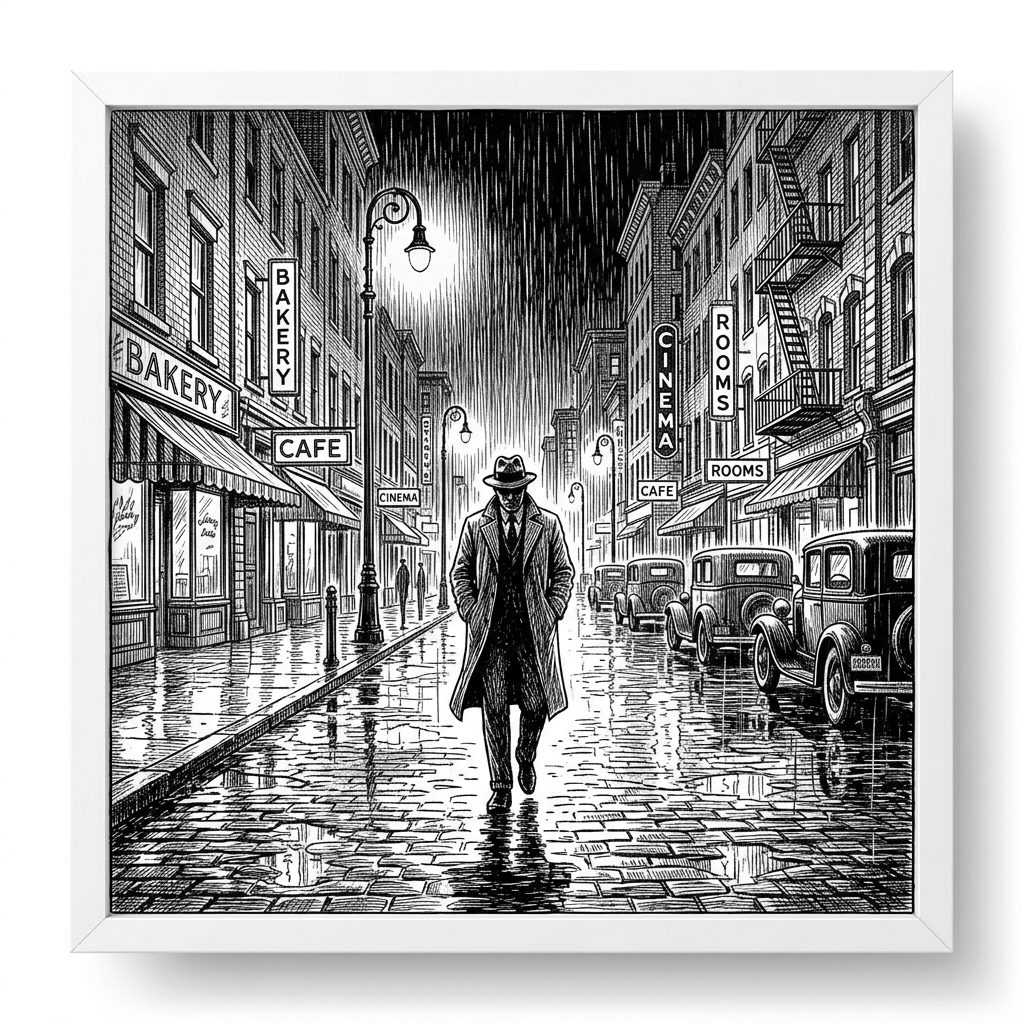
This essay was prepared for a party discussion.
Introduction
The noir novel occupies a distinctive place within twentieth century literature. Emerging from the social dislocations of the Great Depression, maturing during the Second World War, and flourishing amid the contradictions of postwar capitalism, noir transformed the detective story from a puzzle of rational deduction into a narrative of alienation, corruption, and social decay. While traditional detective fiction often restores order through the triumph of reason, noir exposes a world in which order itself is suspect. Institutions are corrupt, justice is compromised, and individuals struggle within social systems they neither control nor fully understand.
A Marxist analysis reveals that noir is not merely a literary style characterized by cynicism, violence, and moral ambiguity. Rather, it is a cultural form uniquely suited to depicting the contradictions of capitalist society. Noir narratives repeatedly confront themes central to Marxist theory: class conflict, commodification, alienation, reification, ideology, and the unequal distribution of power. The genre’s recurring figures—the private investigator, the drifter, the criminal, the corrupt businessman, and the femme fatale—embody social relations shaped by capitalist modernity.
This essay examines noir through a Marxist framework, arguing that the genre functions as both a critique of capitalism and an expression of the ideological limits imposed by capitalist society. Through analyses of key themes and representative works by Dashiell Hammett, Raymond Chandler, James M. Cain, David Goodis, Chester Himes, and others, it demonstrates how noir exposes the tensions between individual agency and structural power while reflecting the historical conditions of its production.
Historical Materialism and the Origins of Noir
Marxist literary criticism begins with the premise that cultural forms emerge from specific historical and material conditions. Noir developed during a period of profound economic and social instability in the United States. The Great Depression shattered confidence in liberal capitalism. Millions experienced unemployment, poverty, and displacement. Simultaneously, the concentration of wealth and power among industrial and financial elites became increasingly visible.
The noir worldview reflects this historical context. Unlike the genteel mysteries of Agatha Christie or Dorothy L. Sayers, noir is rooted in urban environments shaped by modern capitalism. Its cities are landscapes of inequality where wealth and poverty coexist in uneasy proximity. Skyscrapers tower above slums. Luxury hotels stand blocks away from flophouses. Corporate offices dominate neighborhoods populated by workers, immigrants, and the unemployed.
Dashiell Hammett’s Red Harvest (1929) provides an early example. The fictional city of Personville, known colloquially as Poisonville, is controlled by industrial capitalists who employ gangsters to suppress labor organizing. Violence emerges not from individual pathology but from class struggle. The novel depicts a society in which economic power determines political authority. Hammett, who had worked as a Pinkerton detective and witnessed labor conflicts firsthand, portrays capitalism as a system sustained through coercion and corruption.
From a Marxist perspective, this setting reflects the economic base that shapes the cultural superstructure. Noir’s bleak atmosphere arises not from abstract pessimism but from concrete social conditions. The genre’s moral darkness is inseparable from the contradictions of capitalist development.
Alienation and the Noir Protagonist
One of Marx’s most significant concepts is alienation. Under capitalism, workers become estranged from their labor, from the products they create, from other people, and ultimately from themselves. Noir protagonists frequently embody this condition.
The private detective, particularly in the works of Raymond Chandler, occupies a liminal social position. Philip Marlowe is neither capitalist nor worker in the traditional sense. He sells his labor as an independent investigator while remaining excluded from the wealth and power structures he encounters. He moves between social classes without belonging to any of them.
In The Big Sleep (1939), Marlowe navigates a world dominated by wealthy families, criminal syndicates, and corrupt officials. Although he possesses a personal code of ethics, his efforts rarely produce meaningful social change. The crimes he investigates reveal the moral bankruptcy of the ruling class, yet the structures that sustain that power remain intact.
This condition reflects what Marx described as the individual’s powerlessness within capitalist society. Marlowe recognizes corruption but cannot eliminate it. He possesses knowledge without power. His alienation is both economic and existential.
The same pattern appears in Ross Macdonald’s Lew Archer novels and in many later noir works. The detective becomes a symbolic figure for the isolated individual attempting to comprehend a social totality that remains fragmented and opaque. He glimpses the workings of power but never achieves mastery over them.
Commodification and Human Relationships
Marx argued that capitalism transforms social relations into market relations. Commodification extends beyond goods and services to encompass human interactions, emotions, and identities. Noir repeatedly dramatizes this process.
James M. Cain’s Double Indemnity (1943) and The Postman Always Rings Twice (1934) portray relationships shaped by economic desire. Love becomes inseparable from property, inheritance, and financial gain. Characters pursue one another not merely out of passion but because people themselves become objects of exchange.
In Double Indemnity, Walter Huff and Phyllis Nirdlinger plot murder to obtain insurance money. Their relationship is mediated by capital from the beginning. Desire and greed become indistinguishable. The logic of the market infiltrates intimacy, transforming affection into transaction.
The femme fatale occupies a particularly important position within this dynamic. Marxist critics often interpret her as a figure produced by commodified social relations. She is simultaneously subject and object, exercising agency within a system that reduces human beings to market value. Her sexuality becomes a form of capital deployed within structures that limit other avenues of power.
This interpretation complicates simplistic readings that portray the femme fatale solely as a misogynistic stereotype. While noir frequently reflects patriarchal anxieties, it also reveals how capitalism commodifies gender itself. Female characters navigate systems in which beauty, sexuality, and marriage function as economic resources.
Class Power and the Illusion of Justice
A central theme in noir is the failure of legal institutions to deliver justice. Marxist theory explains this phenomenon through the concept of the state as an instrument that protects dominant class interests.
In many noir novels, police departments, courts, politicians, and business leaders operate as interconnected systems of power. Corruption is not presented as an exception but as a structural feature.
Hammett’s The Glass Key (1931) exemplifies this dynamic. Political authority, organized crime, and economic power merge into a single network. Legal institutions exist largely to legitimize existing hierarchies rather than challenge them.
Similarly, Chandler’s Los Angeles is populated by wealthy industrialists whose influence extends into law enforcement and government. Crimes committed by elites often go unpunished, while marginalized individuals bear the consequences.
From a Marxist perspective, these narratives expose what Louis Althusser later described as ideological and repressive state apparatuses. The law appears neutral yet functions to preserve class relations. Noir repeatedly demonstrates that formal equality before the law masks substantial inequalities of power.
This theme helps explain the genre’s persistent skepticism toward authority. Noir protagonists often distrust institutions because those institutions serve interests fundamentally opposed to justice.
Reification and the Urban Environment
Marxist theorist Georg Lukács developed the concept of reification to describe how social relationships appear as objective and impersonal forces under capitalism. Noir’s urban landscapes vividly illustrate this phenomenon.
Cities in noir are rarely communities. They are systems. Individuals move through environments dominated by corporations, bureaucracies, and anonymous economic forces. Buildings, streets, and institutions acquire an almost autonomous power.
David Goodis’s Philadelphia novels exemplify this tendency. In works such as Down There (1956), the city appears indifferent to human suffering. Characters drift through bars, cheap hotels, and neglected neighborhoods shaped by economic decline. Social structures seem immutable and impersonal.
This environment produces a distinctive psychological effect. Individuals experience society as something external and uncontrollable. Economic relations become naturalized, appearing as facts of existence rather than human creations.
Noir’s atmosphere of fatalism emerges partly from this reified perception of social reality. Characters often believe they are trapped by destiny when they are actually constrained by historical and economic conditions.
Race, Capitalism, and Noir
Marxist analysis also benefits from examining how race intersects with class within noir narratives. Capitalism has historically relied upon racial hierarchies to divide labor and justify unequal exploitation. Noir often reflects and critiques these dynamics.
Chester Himes’s Harlem detective novels represent one of the most significant interventions in the genre. Works such as Cotton Comes to Harlem (1965) depict a social order shaped by both racial oppression and economic inequality.
Unlike many white noir writers, Himes places Black communities at the center of the narrative. His Harlem is not merely a backdrop but a social world structured by systemic exploitation. Police violence, political corruption, and economic deprivation emerge as interconnected phenomena.
Himes demonstrates how racial oppression functions within broader systems of class domination. The exploitation of Black communities serves economic interests while maintaining social divisions that benefit existing power structures.
A Marxist reading recognizes that race and class are not competing explanations but mutually reinforcing dimensions of capitalist society. Noir’s exploration of urban inequality becomes richer when these intersections are acknowledged.
The Criminal as a Product of Capitalism
Traditional crime fiction often portrays criminals as deviations from social norms. Noir adopts a different perspective. Criminality frequently appears as a logical response to capitalist conditions.
Many noir protagonists pursue illegal activities because legitimate avenues of advancement are blocked. Economic desperation, social exclusion, and structural inequality push characters toward crime.
In Horace McCoy’s They Shoot Horses, Don’t They? (1935), participants in a dance marathon endure physical and psychological degradation for the possibility of financial reward. Although not strictly a detective novel, the work shares noir’s emphasis on economic desperation and social collapse. The system itself appears criminal, exploiting vulnerable individuals for profit and entertainment.
Similarly, Jim Thompson’s novels portray characters whose violence and deceit emerge from environments shaped by poverty, exploitation, and alienation. Criminal behavior reflects systemic dysfunction rather than individual moral failure.
This perspective aligns with Marxist theories that locate crime within material conditions rather than abstract notions of good and evil. Noir frequently suggests that capitalist society produces the very criminality it claims to oppose.
Ideology and False Consciousness
Despite its critical tendencies, noir rarely presents revolutionary alternatives. This limitation can be understood through Marxist concepts of ideology and false consciousness.
Noir exposes corruption but often individualizes its causes. Villains are frequently wealthy or powerful, yet systemic critique remains incomplete. The genre reveals capitalism’s consequences without always identifying capitalism itself as the underlying problem.
The detective may uncover a conspiracy, expose a murderer, or reveal political corruption. However, the broader social order generally survives intact. Readers witness symptoms rather than transformation.
Fredric Jameson argues that popular cultural forms often contain utopian impulses constrained by ideological limits. Noir exemplifies this tension. It recognizes the failures of capitalist society while struggling to imagine a coherent alternative.
Consequently, noir occupies an ambiguous position. It is simultaneously critical and conservative. It challenges dominant narratives of progress and prosperity while remaining trapped within the horizons of the society it critiques.
Noir and Late Capitalism
The relevance of Marxist noir criticism extends beyond the genre’s classical period. Contemporary neo-noir continues to engage with evolving forms of capitalism.
Works such as James Ellroy’s L.A. Confidential (1990) depict alliances among political elites, corporations, law enforcement agencies, and organized crime. The novel reveals how power operates through interconnected institutions rather than isolated individuals.
Similarly, modern noir frequently addresses globalization, financial speculation, surveillance, and corporate influence. Economic systems become increasingly abstract, yet their consequences remain deeply personal.
The persistence of noir suggests that the contradictions identified by earlier writers have not disappeared. Instead, they have adapted to new historical circumstances. Contemporary readers continue to recognize themes of alienation, inequality, and corruption because these conditions remain central features of capitalist modernity.
Indeed, noir may be particularly suited to analyzing late capitalism because it emphasizes hidden structures, opaque systems, and unequal power relations. The detective’s search for truth mirrors the effort to understand complex social realities concealed beneath appearances.
Conclusion
A Marxist analysis reveals noir as far more than a literary genre devoted to crime and mystery. At its core, noir is a cultural response to the contradictions of capitalist society. Its themes of alienation, commodification, corruption, inequality, and social fragmentation reflect historical conditions produced by modern capitalism.
The genre’s protagonists embody forms of estrangement described by Marx. Its urban settings illustrate reification and class division. Its depictions of crime expose the failures of legal and political institutions. Its treatment of gender, race, and economic power reveals the ways capitalism shapes human relationships and social identities.
Yet noir’s significance lies not only in its critique. The genre also demonstrates the ideological limits of that critique. Noir often recognizes systemic problems without envisioning systemic solutions. Its characters achieve moments of understanding but rarely transform the structures that constrain them.
This tension contributes to noir’s enduring appeal. Readers encounter a world that feels both historically specific and persistently familiar. The shadows that darken Hammett’s Poisonville, Chandler’s Los Angeles, Goodis’s Philadelphia, and Himes’s Harlem are not merely atmospheric devices. They are manifestations of social contradictions that continue to shape modern life.
Noir serves as a powerful literary record of capitalism’s human consequences. Its detectives, criminals, drifters, and dreamers wander through landscapes marked by exploitation and inequality, searching for meaning in a world where truth is obscured by power. In doing so, noir illuminates not only the mysteries at the center of its plots but also the deeper mysteries of the social order itself.


Leave a Reply