Exploring Time and Nature in Daniel Mason’s North Woods
Book Review
Mason, Daniel. North Woods. Random House, 2023.
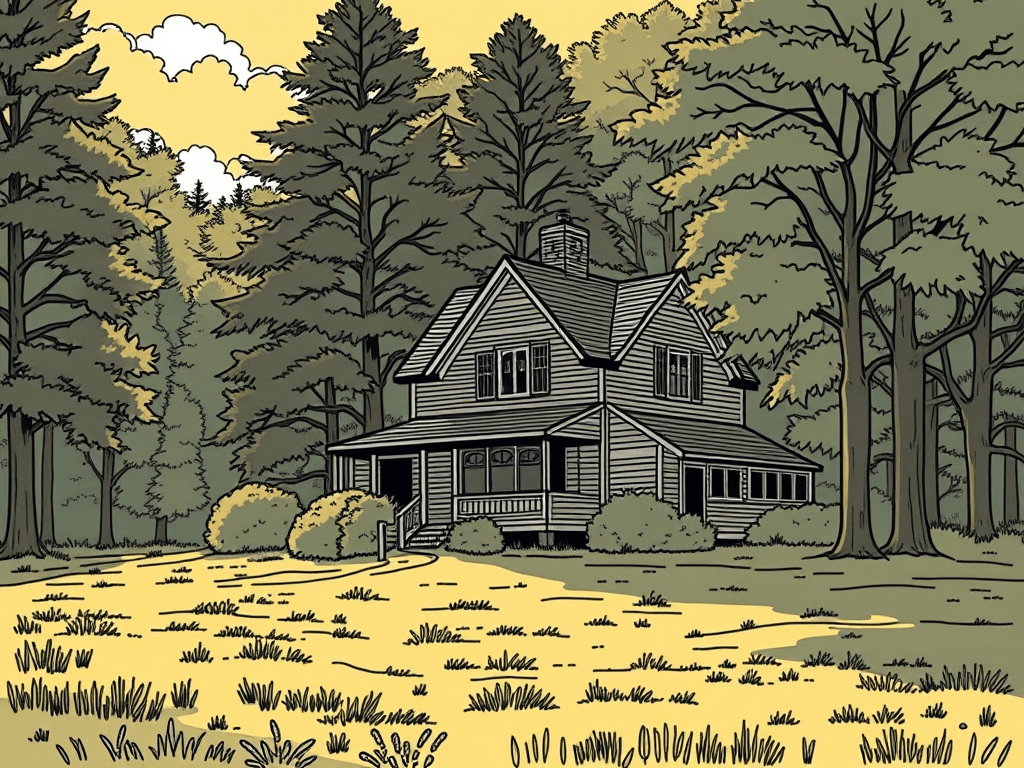
Daniel Mason’s North Woods is an ambitious and formally inventive novel that uses a single geographic locus—an old house and the land surrounding it in rural New England—as the narrative engine for a sweeping meditation on American history, environmental change, artistic making, and the long afterlife of human desire. Rather than advancing through a conventional plot arc, Mason constructs the novel as a polyphonic archive: a layered sequence of lives, documents, voices, and eras that accrete like rings in a tree. The result is a work that feels at once historiographic and haunted, an ecological epic built out of intimacy, loss, and recurring patterns of habitation.
At the structural level, North Woods belongs to a lineage of “place novels” (and arguably “house novels”) in which the setting does not merely contain the story but becomes the story’s organizing consciousness. Mason’s technique recalls both microhistorical practice and the experimental historiography of contemporary fiction: the narrative repeatedly returns to the same plot of land, showing how the meanings of labor, ownership, privacy, and survival mutate across centuries. In this way, the novel refuses the liberal fantasy of progress as continuity; instead it depicts time as uneven, recursive, and materially sedimented. Mason’s house is never simply a backdrop—it is an archive that absorbs memory, violence, tenderness, and language.
One of the novel’s most striking achievements is its capacity to unify disparate temporalities without forcing them into a single ideological conclusion. Mason’s episodic structure could easily collapse into gimmick or anthology-like fragmentation, yet the novel coheres through pattern and motif: repeated returns to the same natural features, traces of earlier lives embedded in the physical landscape, echoes in diction and image. This architectural principle gives North Woods an organic unity—less the unity of linear causality than of ecological interdependence. Mason composes history not as a series of heroic acts but as ongoing entanglement: between humans and land, memory and matter, consumption and decay.
The book is also notable for its tonal range. Mason alternates modes—lyric meditation, documentary realism, gothic suspense, domestic tragedy, even moments that verge on the comic or grotesque. This tonal plurality is not merely stylistic display. It suggests that history cannot be contained by a single representational register: the lived realities of colonial survival, nineteenth-century rural economies, artistic aspiration, and contemporary sensibilities require different idioms. In Mason’s hands, formal variation becomes historical argument. The novel implies that the past is not silent; rather, it speaks in multiple genres, and to hear it one must be willing to read across forms.
A central thematic current in North Woods is the instability of possession. The house repeatedly changes hands, and with each shift the meaning of ownership is revised. Mason critiques the myth of property as permanence by dramatizing how quickly “belonging” collapses into contingency—fire, illness, economic downturn, inheritance disputes, war, and the sheer unpredictability of the natural world. Even as settlers and later inhabitants attempt to inscribe their dominance upon the land—through architecture, farming, naming, and boundary-making—the forest returns, the soil changes, and the house bears witness to the fragility of human arrangements. This cyclical reassertion of nature is not romanticized. Mason does not simply celebrate wilderness as sublime or pure; rather, he emphasizes nature’s indifference, its power to erase and preserve with equal force.
Ecology is thus not background but epistemology: North Woods asks readers to understand time not only through human narrative but through environmental duration. In this sense, the novel participates in contemporary ecological fiction (and in climate-era reimaginings of history), yet it avoids the didacticism that can limit the genre. Instead of inserting explicit moral commentary, Mason allows the land’s transformations—deforestation, agriculture, regrowth, and ongoing alteration—to become a silent metric by which human ambition is measured and found wanting.
If the land provides the novel’s deep structure, art provides its persistent counterpoint. Across the centuries, various inhabitants attempt to make meaning—through writing, painting, collecting, cataloging, or storytelling. Yet these artistic acts are never portrayed as purely transcendent. Mason frames art as both refuge and obsession, a means of survival and a form of capture. The novel repeatedly asks: what does it mean to represent a place? Is artistic attention a kind of care, or a kind of appropriation? This becomes especially charged when the novel explores characters whose aesthetic desire intersects with possession—turning the house into an object of fixation. Mason seems especially interested in how art can preserve what history would otherwise crush, while also exposing how art can distort, exploit, or sentimentalize.
Stylistically, Mason’s prose is frequently exquisite—controlled, sensuous, attentive to the textures of weather, wood, animal life, and human gesture. Importantly, the lyricism seldom feels ornamental; it emerges from the book’s core proposition that matter holds meaning. The house is composed of boards, nails, sap, and labor; Mason writes with a consciousness of craft that mirrors the material craft of building. His sentences often enact the novel’s thematic intent: they collect detail, accumulate residue, and allow the reader to feel time pressing into objects.
At its best, North Woods offers a subtle critique of American historiography itself. By choosing a marginal site rather than a center of political power, Mason decentralizes the narrative of nation. Instead of presidents and wars as the organizing timeline, he presents a history of ordinary lives—many of them erased or unrecorded—and suggests that the nation’s reality is built out of such obscured strata. This is not an outright polemic; it is an aesthetic-political decision embedded in form. The novel implies that what we call “history” is often a matter of archival privilege, and that fiction may be uniquely capable of retrieving the felt dimensions of existence—especially for those whose experiences did not survive in official documents.
If the novel has a limitation, it lies in the risks inherent in its very design. Some readers may find the fragmentation emotionally distancing; the shifting casts and registers can interrupt conventional attachment. Yet one might argue that this distance is part of the novel’s ethical and intellectual wager. The book rejects the comforting illusion that lives neatly resolve, that one narrative can contain all others, or that the past is simply prologue. Instead, Mason offers a more unsettling but arguably truer vision: history as accumulation without closure, meaning as something that flickers and fades, and the land as the one durable witness to human transience.
Ultimately, North Woods is a serious literary achievement: a novel of ideas that does not sacrifice sensory richness, a historical meditation that remains attentive to personal grief and longing, and an ecological text that insists upon the material continuity between human stories and the nonhuman world. Mason’s central insight—that a single place can hold centuries of human dreaming and undoing—becomes, in the novel’s closing resonance, both elegy and indictment. The forest does not remember us as we remember ourselves; it merely persists. And in that persistence, Mason finds a profound, unsettling kind of truth.


Leave a comment