Unpacking Racial Capitalism in Chester Himes’s The Real Cool Killers
Book Review
Himes, Chester. The Real Cool Killers. Vintage Crime/Black Lizard, 2008.
Chester Himes’s The Real Cool Killers (1959) is often read as a fast, brutal Harlem detective novel featuring Himes’s recurring police duo, Coffin Ed Johnson and Grave Digger Jones. Yet when approached through a Marxist lens, the book reveals itself as something much more politically searing: a compressed anatomy of racial capitalism in the mid-century United States, in which class domination is enforced not only through police violence and economic deprivation, but through the ideological management of Black life itself—religion, spectacle, gossip, moral panic, and the everyday terror of scarcity. The novel’s title is not simply lurid or ironic; it is an accusation aimed at the social order that manufactures “killers” out of dispossession, and then recycles their destruction into legitimacy for the very institutions that produced them.
Marxist criticism is especially suited to Himes because his Harlem is not a romanticized neighborhood, nor merely a cultural setting, but an urban economic formation: a spatial concentration of exploited labor, surplus populations, informal economies, predatory landlords, and police occupation. The detective plot—an apparent “senseless” killing entangled in rumor and misrecognition—functions less like the rational puzzle of classical detective fiction than as a narrative form adequate to capitalism’s chaos. If bourgeois ideology promises that crime can be understood as an individual moral failure, Himes insists instead on crime as a social relation. Violence is not a deviation from Harlem’s normal life; it is one of capitalism’s normal expressions in a segregated, excluded zone.
Harlem as a “colonial” space of racial capitalism
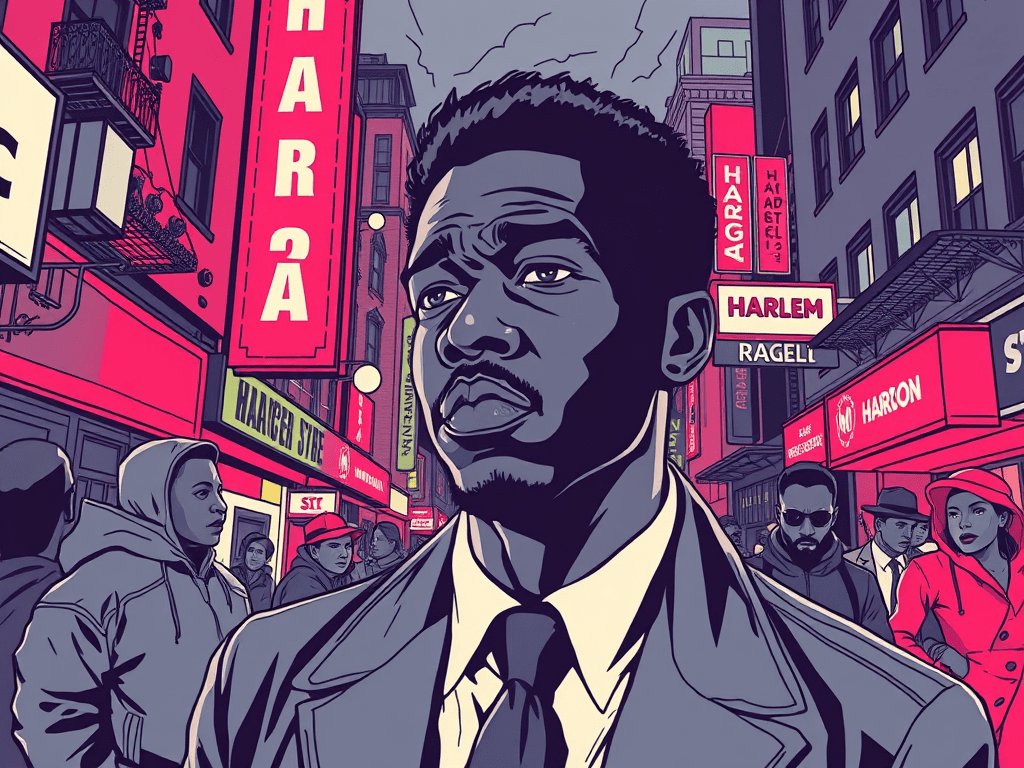
The most salient Marxist feature of The Real Cool Killers is its depiction of Harlem as internally colonized territory—an enclave within the metropolis governed less by democratic consent than by coercion, surveillance, and deprivation. Himes’s policemen are not simply “flawed heroes.” They are the novel’s clearest representation of the state’s repressive apparatus. Coffin Ed and Grave Digger work as both enforcers and interpreters of a community whose daily life is structured by a brutally uneven distribution of wealth and security. Their authority is premised on violence, and Himes does not allow readers to forget that. The policing of Harlem appears not as protection but as management: a labor of containing the contradictions of a system that generates poverty and then criminalizes its consequences.
From a Marxist perspective, this makes the novel a critique of what later theorists would describe as the racialized regulation of surplus populations: capitalism’s “need” to dispose of or immobilize bodies excluded from stable wage labor. Harlem’s residents are not treated as full subjects of citizenship, but as objects of policy, discipline, and spectacle. The police function less as neutral arbiters than as an occupying force, responding to disorder created by structural deprivation with intensified repression.
The false “individualization” of crime and the social production of violence
The novel’s central murder is surrounded by panic, rumor, and the rapid conversion of uncertainty into accusation. Here Himes dismantles the bourgeois myth that crime is legible as the action of isolated individuals. Instead, the narrative insists on the social production of criminality. What appears “irrational” in the murder—the senselessness, the chaotic crowd dynamics, the contagious violence—becomes intelligible as the lived form of capitalist alienation.
In Marxist terms, alienation is not simply psychological: it is material, rooted in a world where human relations are mediated by commodification and scarcity. Himes’s characters inhabit a Harlem where desperation is routine, and where the difference between survival and catastrophe may be a few dollars, the whim of a cop, or the caprice of a landlord. Violence erupts not because Harlem is naturally violent, but because Harlem is structurally dispossessed. Himes therefore reverses the usual logic of crime fiction: the “mystery” is not who committed the murder, but why the social order makes such killing so possible—and so profitable ideologically.
Ideology: religion, spectacle, and the management of consciousness
One of Himes’s sharpest Marxist insights lies in the ideological textures of Harlem life. The novel is saturated with moralizing discourse—religious talk, public gossip, scandal—while material deprivation persists in the background as a constant, grinding reality. From a Marxist perspective, these forms of discourse act as ideological screens. They do not “cause” Harlem’s misery, but they help manage and interpret it in ways that deflect attention from structural exploitation.
Religion appears not merely as personal belief but as a social institution entangled with money, authority, and charisma—often indistinguishable from hustle. This is a particularly Himesian insight: ideology is not primarily propagated from above through polished propaganda, but circulates as everyday performance, con artistry, and desperate self-making. Under racial capitalism, the line between faith and fraud is not moral but economic: both arise in spaces where conventional avenues of security are blocked.
The police as class instruments—not moral agents
Marxist readings emphasize that the state is not an impartial mechanism above society but an instrument shaped by dominant class interests. Himes’s Harlem policemen embody this contradiction. They are Black officers, operating in a Black community, yet employed as agents of a state that maintains white bourgeois order. This contradiction does not make them symbolic “traitors,” nor romantic heroes; it makes them tragic functionaries in a machine that cannot resolve Harlem’s contradictions—only suppress them.
Coffin Ed and Grave Digger are violent because the institution they serve is violent; their occasional sympathy does not redeem them because sympathy cannot alter structural function. They may understand Harlem, but their job is not to liberate it. They are tasked with producing “order”—meaning the continued reproduction of the existing social relations. This aligns with Marxist theories of policing as the maintenance arm of capitalist property and racial hierarchy, where law is less about justice than about stabilizing exploitation.
Commodity culture and the fetish of “cool”
The title itself invites Marxist analysis. “Cool” is not merely an aesthetic; it is a commodity-sign, a form of symbolic capital that substitutes for material capital. Within a society that denies Harlem residents access to wealth and institutional power, “cool” becomes both armor and currency—something that can be performed, traded, defended, and fought over. To call these figures “real cool killers” is to expose how capitalist culture commodifies even violence and death, turning them into styles, rumors, reputations.
This is a kind of proletarian consumerism without commodities: style becomes the substitute for property; spectacle becomes the substitute for security. In Marxist terms, Himes is mapping a localized version of commodity fetishism, where objects and images take on exaggerated social power precisely because social life is otherwise stripped of control. “Cool” stands in for the freedom that capitalism promises but cannot deliver.
Conclusion: Himes’s revolutionary realism
The Real Cool Killers is not revolutionary in the sense of offering a program or solution, but it is revolutionary in its realism: it forces readers to confront crime as a symptom of social relations rather than an interruption of them. Harlem appears not as a moral problem but as a political economy—an urban formation produced by segregation, wage exploitation, and state repression. In that sense Himes’s novel functions as a Marxist text even when it does not use Marxist language. It dramatizes the base—material scarcity, housing insecurity, labor exclusion—and shows how the superstructure—police power, religious ideology, cultural “cool,” moral panic—both reflects and manages those conditions.
If bourgeois detective fiction typically reassures readers that order can be restored through intelligence and proper authority, Himes offers a bleaker truth: the “order” being restored is itself the crime. The real killers are not only individuals in the street. The real killers are the social relations that grind people into desperation, then punish them for how they survive.


Leave a comment