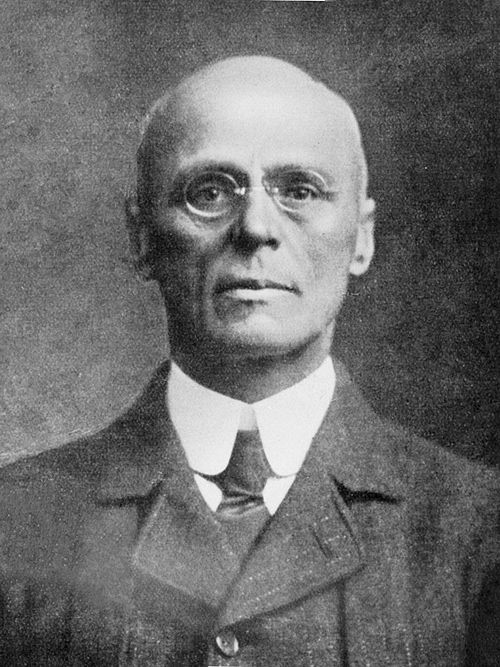
My Socialist Hall of Fame
During this chaotic era of vile rhetoric and manipulative tactics from our so-called bourgeois leaders, I am invigorated by the opportunity to reflect on Socialists, Revolutionaries, Philosophers, Guerrilla Leaders, Partisans, and Critical Theory titans, champions, and martyrs who paved the way for us—my own audacious “Socialism’s Hall of Fame.” These are my heroes and fore-bearers. Not all are perfect, or even fully admirable, but all contributed in some way to our future–either as icons to emulate, or as warnings to avoid in the future.
Introduction
Herman Gorter occupies a singular position in modern European intellectual history as both a foundational figure of Dutch literary modernism and a rigorously original Marxist theorist. His career traces an arc from aesthetic innovation—most famously the long poem Mei—to uncompromising revolutionary politics, culminating in his role as a leading exponent of Left Communism. Gorter’s life and work illuminate the tension between art and politics at the turn of the twentieth century, as well as the broader crisis of European socialism precipitated by the First World War and the Russian Revolution.
Early Life and Education
Born in 1864 in Wormer, the Netherlands, Gorter was the son of a Mennonite minister, a background that instilled in him a lifelong seriousness of ethical purpose and a sensitivity to collective moral life. He studied classical philology at the University of Amsterdam, immersing himself in Greek and Latin literature. This classical training profoundly shaped his poetic sensibility, particularly his concern with form, rhythm, and the relationship between individual subjectivity and universal meaning.
During his student years, Gorter came into contact with the Tachtigers (“Eighties Movement”), a group of young Dutch writers committed to aesthetic renewal and the principle that art should express the most intimate emotions of the individual. This literary milieu provided the foundation for Gorter’s early poetic achievements.
Literary Breakthrough: Mei and Aesthetic Modernism
Gorter achieved immediate fame with the publication of Mei (1889), a monumental lyrical poem often regarded as a cornerstone of Dutch modern poetry. The poem’s sensuous language, musical structure, and pantheistic vision marked a decisive break with moralizing realism and positioned Gorter as a leading voice of aesthetic modernism in the Netherlands.
Yet even at this early stage, Mei reveals tensions that would later define Gorter’s intellectual trajectory. The poem’s exaltation of beauty is shadowed by an awareness of transience and social limitation, prefiguring his eventual dissatisfaction with purely aesthetic solutions to human suffering. Subsequent collections, such as Verzen (1890), deepen this introspective exploration while hinting at an emerging ethical and social concern.
Turn to Socialism and Marxism
In the 1890s, Gorter increasingly turned away from aestheticism toward socialist politics, influenced by the rapid industrialization of the Netherlands and the growing labor movement. He joined the Social Democratic Workers’ Party (SDAP) and began studying Marx intensively. This transition was neither abrupt nor purely instrumental: Gorter understood Marxism as a scientific and ethical framework capable of resolving the contradictions he perceived between beauty, individuality, and social injustice.
By the early twentieth century, Gorter had become one of the leading Marxist intellectuals in the Netherlands. His theoretical writings sought to reconcile historical materialism with a philosophy of consciousness and culture, arguing that socialism required not only economic transformation but also a profound reconfiguration of human sensibility.
Revolutionary Theory and Left Communism
The outbreak of the First World War marked a decisive radicalization in Gorter’s politics. Like other internationalist Marxists, he rejected the war as an imperialist conflict and condemned the capitulation of mainstream social democracy to nationalist interests. After the Russian Revolution, Gorter initially welcomed Bolshevik victory but soon became critical of what he perceived as authoritarian tendencies and tactical compromises.
His most influential political text, Open Letter to Comrade Lenin (1920), articulates a systematic Left Communist critique of Bolshevik strategy. Gorter argued that Western Europe’s advanced capitalist economies required mass workers’ councils rather than party-led insurrection, and he warned that reliance on parliamentary tactics or centralized party authority risked reproducing new forms of domination. While Lenin sharply criticized these views, Gorter’s analysis exerted lasting influence on council communism and later libertarian Marxist traditions.
Later Years and Legacy
In his final years, Gorter remained politically active but increasingly isolated, as revolutionary defeat and repression swept across Europe. He continued to write poetry and theoretical essays, maintaining that art and revolutionary consciousness were inseparable dimensions of human emancipation. He died in 1927, leaving behind a body of work that defies easy categorization.
Gorter’s legacy is dual but unified: as a poet, he helped inaugurate modern Dutch literature; as a Marxist theorist, he offered one of the most rigorous critiques of party-centered socialism. Contemporary scholarship increasingly recognizes that these dimensions are not opposed but complementary. Gorter’s lifelong struggle was to imagine a form of social life in which beauty, freedom, and collective solidarity could coexist without contradiction.
Selected Bibliography
Primary Works by Herman Gorter
• Gorter, Herman. Mei. Amsterdam: W. Versluys, 1889.
• ———. Verzen. Amsterdam: W. Versluys, 1890.
• ———. Historisch Materialisme voor Arbeiders Verklaard. Amsterdam: De Tribune, 1908.
• ———. Open Brief aan den Kameraad Lenin. Berlin: Kommunistische Arbeiter-Zeitung, 1920.
Secondary Sources
• Bock, Hans Manfred. Syndikalismus und Linkskommunismus von 1918–1923. Meisenheim am Glan: Anton Hain, 1969.
• Gerber, John. “Herman Gorter and the Origins of Council Communism.” History of Political Thought 5, no. 2 (1984): 291–312.
• van der Loo, Frits. Herman Gorter: Dichter en Revolutionair. Amsterdam: SUN, 1988.
• Pannekoek, Anton. Lenin as Philosopher. London: Merlin Press, 1975.
• Weston, James. “Aesthetics and Revolution in the Work of Herman Gorter.” European Journal of Cultural Studies 12, no. 3 (2009): 347–365.


Leave a Reply