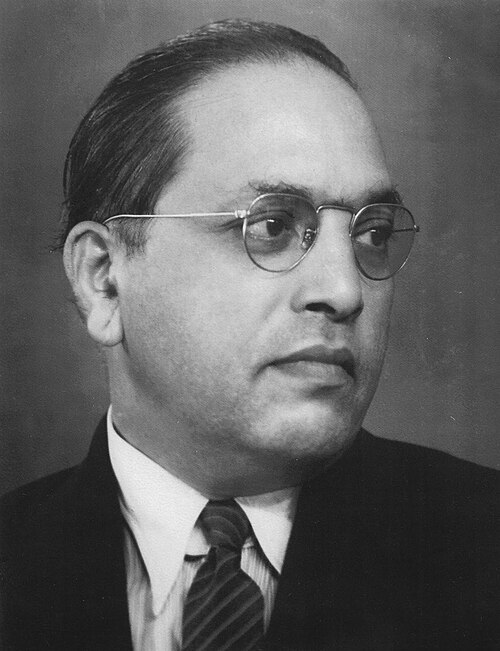
B.R. Ambedkar: Architect of Modern Indian Democracy
My Socialist Hall of Fame
During this chaotic era of vile rhetoric and manipulative tactics from our so-called bourgeois leaders, I am invigorated by the opportunity to reflect on Socialists, Revolutionaries, Philosophers, Guerrilla Leaders, Partisans, and Critical Theory titans, champions, and martyrs who paved the way for us—my own audacious “Socialism’s Hall of Fame.” These are my heroes and fore-bearers. Not all are perfect, or even fully admirable, but all contributed in some way to our future–either as icons to emulate, or as warnings to avoid in the future.
Introduction
Bhimrao Ramji Ambedkar stands as one of the most formidable intellectuals and political actors of the twentieth century. A jurist, economist, social theorist, and revolutionary democrat, Ambedkar was the principal architect of the Constitution of India and the most uncompromising critic of caste hierarchy in modern South Asia. Unlike many leaders of India’s anti-colonial movement, Ambedkar framed emancipation not primarily in nationalist terms but through a rigorous critique of social domination, locating caste as a structural system of exploitation embedded within religion, law, and political economy. His work occupies a unique position at the intersection of liberal constitutionalism, radical social democracy, and anti-theological materialism.
Early Life and Formation
Ambedkar was born on 14 April 1891 in Mhow, Central Provinces, into the Mahar caste, an “Untouchable” community subjected to extreme social exclusion. His early experiences of segregation—being denied water, schooling access, and social dignity—were formative, shaping his lifelong conviction that social hierarchy, not merely colonial rule, constituted India’s fundamental problem. Unlike many contemporaries who romanticized village life, Ambedkar understood caste as a daily regime of violence and humiliation.
Exceptional academic performance enabled him to escape the educational constraints imposed on Dalits. He earned degrees from Bombay University before studying abroad, first at Columbia University, where he was influenced by John Dewey’s pragmatism, and later at the London School of Economics, where he completed doctoral work in economics. His early writings, particularly The Problem of the Rupee (1923), demonstrate a sophisticated understanding of political economy and monetary theory, anticipating debates that would later shape Indian fiscal policy.
Political Theory and the Critique of Caste
Ambedkar’s most enduring theoretical contribution lies in his analysis of caste as a system of social reproduction. In Annihilation of Caste (1936), he rejected the notion that caste was a distortion of Hinduism; instead, he argued that caste was its logical and doctrinal core. For Ambedkar, caste was not merely a division of labor but a division of laborers, maintained through endogamy, ritual purity, and religious sanction. This analysis prefigured later sociological accounts of structural inequality and remains foundational to Dalit studies.
Unlike Gandhi, who sought reform within Hinduism, Ambedkar insisted that caste could not be dismantled without confronting religious authority itself. His critique extended to nationalism: political independence without social equality, he argued, would merely transfer power to upper-caste elites. In this respect, Ambedkar’s thought aligns more closely with Marxist critiques of formal political freedom that ignore material and social relations, though he remained skeptical of orthodox Marxism’s neglect of caste as a distinct mode of domination.
Law, Constitutionalism, and Radical Democracy
Ambedkar’s appointment as Chairman of the Drafting Committee of the Indian Constitution (1947–1950) represented the culmination of his legal and political philosophy. He envisioned the Constitution as a weapon for social transformation rather than a neutral framework. Fundamental Rights, affirmative action (reservations), and protections for marginalized communities were central to his project of “constitutional morality,” a concept he defined as the internalization of democratic values beyond formal institutions.
Ambedkar was acutely aware of the limits of constitutionalism. In his final speeches, he warned that political democracy could not survive without social and economic democracy—a formulation that resonates strongly with later critical legal theory. His resignation as Law Minister in 1951, following the failure of the Hindu Code Bill, underscored his frustration with the persistence of patriarchal and caste interests within postcolonial governance.
Conversion to Buddhism and Late Thought
In 1956, shortly before his death, Ambedkar converted to Buddhism along with hundreds of thousands of followers. This act was not merely spiritual but profoundly political. Buddhism, as Ambedkar reconstructed it in The Buddha and His Dhamma, represented an ethical rationalism opposed to hierarchy, priestcraft, and metaphysical fatalism. His Buddhism was humanist, egalitarian, and explicitly anti-Brahmanical, offering an alternative moral foundation for social emancipation.
This final phase of Ambedkar’s life reflects a synthesis of ethics and politics: law alone was insufficient without a moral revolution. His conversion marked a rejection of Hinduism as irredeemable and affirmed his belief that liberation required both institutional change and cultural rupture.
Legacy and Contemporary Relevance
Ambedkar’s legacy has expanded dramatically in the twenty-first century, particularly among Dalit, Bahujan, and radical democratic movements. Once marginalized in nationalist historiography, he is now recognized globally as a major political theorist whose work anticipates debates on identity, structural inequality, and constitutional justice. His insistence that democracy must be social before it can be political continues to challenge liberal and nationalist orthodoxies alike.
For Marxist and critical theorists, Ambedkar poses a productive provocation: class analysis without caste is incomplete. His work compels a rethinking of materialism, ideology, and social reproduction in postcolonial contexts.
Select Bibliography
Primary Works by B. R. Ambedkar
Ambedkar, B. R. Annihilation of Caste. 1936. Annotated Critical Edition, edited by S. Anand, Navayana, 2014.
Ambedkar, B. R. The Buddha and His Dhamma. Siddharth College Publications, 1957.
Ambedkar, B. R. The Problem of the Rupee: Its Origin and Its Solution. Thacker, 1923.
Ambedkar, B. R. What Congress and Gandhi Have Done to the Untouchables. Thacker, 1945.
Ambedkar, B. R. States and Minorities. Government of India, 1947.
Ambedkar, B. R. Dr. Babasaheb Ambedkar: Writings and Speeches. 17 vols., Government of Maharashtra, 1979–2003.
Secondary Scholarship
Jaffrelot, Christophe. Dr. Ambedkar and Untouchability: Analysing and Fighting Caste. Permanent Black, 2005.
Omvedt, Gail. Ambedkar: Towards an Enlightened India. Penguin India, 2004.
Rodrigues, Valerian, ed. The Essential Writings of B. R. Ambedkar. Oxford University Press, 2002.
Rege, Sharmila. Against the Madness of Manu: B. R. Ambedkar’s Writings on Brahmanical Patriarchy. Navayana, 2013.
Yengde, Suraj. Caste Matters. Penguin Random House India, 2019.
Zelliot, Eleanor. From Untouchable to Dalit: Essays on the Ambedkar Movement. Manohar, 1992.


Leave a comment