Navigating Leadership in C.S. Forester’s The Good Shepherd
Book Review
Forester, C. S. The Good Shepherd. Little, Brown and Company, 1955.
C. S. Forester’s The Good Shepherd (1955) occupies a distinctive place in twentieth-century war literature, diverging sharply from triumphalist or spectacle-driven narratives of World War II. Rather than dramatizing grand battles or patriotic fervor, Forester compresses his narrative into a single, relentless episode of naval escort duty in the North Atlantic. The novel’s austere focus on command responsibility, psychological endurance, and moral obligation elevates it beyond genre fiction into a sustained meditation on modern leadership under conditions of industrialized warfare.
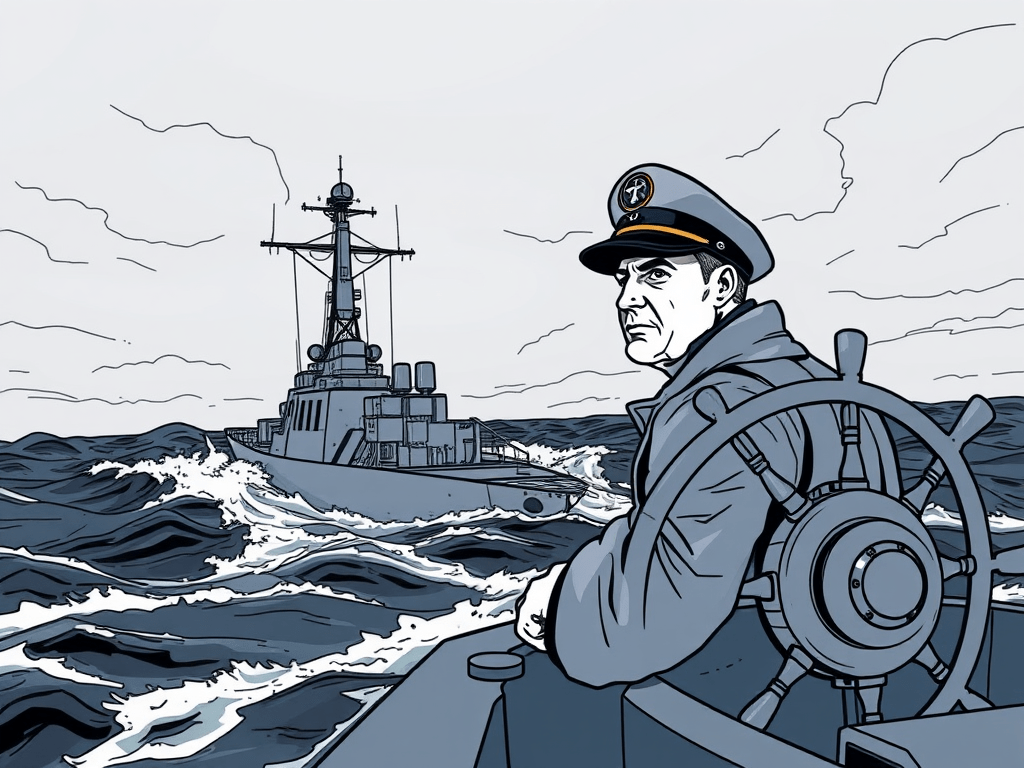
At its core, The Good Shepherd is a study of Captain George Krause, commander of a U.S. Navy destroyer escort tasked with protecting an Atlantic convoy against German U-boats. Forester structures the novel almost entirely around Krause’s interior consciousness. The result is a narrative that privileges mental labor over physical action: calculations of fuel consumption, sonar bearings, escort spacing, and timing dominate the text. This emphasis reflects Forester’s broader thematic concern with war as an exercise in endurance, discipline, and ethical decision-making rather than heroism or glory.
Forester’s narrative technique is notably modernist in its restraint. The novel unfolds in near real time, its temporal compression mirroring the exhausting continuity of command at sea. There are no chapter breaks that offer psychological relief; instead, the reader experiences the same unbroken strain that Krause endures. This formal choice reinforces one of the novel’s central insights: command is not episodic but continuous, allowing no genuine rest. Even moments of apparent quiet are charged with anticipation and anxiety, underscoring the omnipresent threat posed by unseen adversaries beneath the sea.
Thematically, The Good Shepherd interrogates the moral burden of leadership. Krause is deeply conscious that every tactical decision carries human consequences—often irreversible ones. Forester resists romanticizing these decisions. When Krause orders depth-charge attacks, the narrative does not linger on spectacle but on uncertainty: Did the attack succeed? Was fuel wasted? Have lives been saved or lost unnecessarily? This ambiguity reflects the ethical complexity of modern warfare, where outcomes are rarely visible or immediately knowable.
Forester’s treatment of religion and moral philosophy further deepens the novel’s intellectual texture. The title itself invokes the Christian metaphor of the shepherd who sacrifices for his flock, a comparison Krause repeatedly and uneasily reflects upon. His prayers are pragmatic rather than pious, directed less toward divine intervention than toward the hope of making correct decisions. Faith, in this context, functions as a moral framework rather than a source of comfort. Krause’s religiosity underscores the novel’s argument that command requires an ethical compass even when certainty is unattainable.
Equally significant is Forester’s portrayal of technology. Radar, sonar, fuel gauges, and convoy geometry dominate the narrative vocabulary. Yet technology never supplants human judgment; instead, it magnifies responsibility. Krause’s expertise allows him to interpret data effectively, but it also binds him more tightly to the consequences of error. In this sense, The Good Shepherd anticipates later critiques of technocratic warfare by insisting that machines do not absolve moral accountability—they intensify it.
Critically, Forester’s restrained prose style reinforces the novel’s thematic seriousness. His language is precise, utilitarian, and largely devoid of ornamentation. Emotional moments emerge not through lyrical excess but through understatement: exhaustion, doubt, and fear accumulate gradually until they exert a profound emotional force. This stylistic discipline aligns Forester with realist traditions of war writing while also distinguishing his work from more overtly ideological or sentimental narratives.
While some will argue that The Good Shepherd lacks the character depth or dramatic variation of Forester’s Horatio Hornblower series, such critiques misunderstand the novel’s purpose. Its narrow focus is deliberate. By limiting the narrative almost exclusively to Krause’s consciousness, Forester creates a claustrophobic ethical laboratory in which the nature of command can be examined with exceptional rigor. The absence of subplots or romantic diversions is not a weakness but a structural necessity.
In conclusion, The Good Shepherd stands as one of the most intellectually serious naval novels of the Second World War. Its exploration of leadership as moral labor, its rejection of heroic simplification, and its formal alignment with the psychological realities of command render it enduringly relevant. Forester’s novel not only documents a specific historical moment but also offers a timeless inquiry into the ethical costs of responsibility in conditions where certainty is impossible and failure is measured in human lives.


Leave a Reply