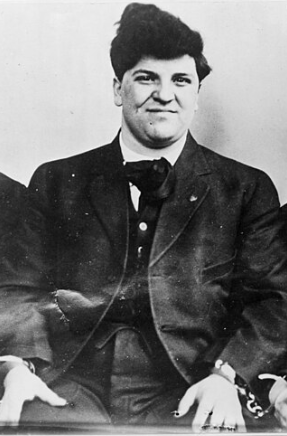
My Socialist Hall of Fame
During this chaotic era of vile rhetoric and manipulative tactics from our so-called bourgeois leaders, I am invigorated by the opportunity to reflect on Socialists, Revolutionaries, Philosophers, Guerrilla Leaders, Partisans, and Critical Theory titans, champions, and martyrs who paved the way for us—my own audacious “Socialism’s Hall of Fame.” These are my heroes and fore-bearers. Not all are perfect, or even fully admirable, but all contributed in some way to our future–either as icons to emulate, or as warnings to avoid in the future.
Early Life and Background
Joseph James Ettor (6 October 1885 – 19 February 1948) was born in New York City to Italian immigrant parents. Although detailed records of his youth are somewhat sparse, the extant sources indicate that from an early age he entered the workforce, performing a variety of labor-intensive jobs—including newspaper hawking, working as a waterboy on a railroad, saw-filing in a lumber mill, barrel-making, ship-yard work, and cigar-factory labor. These formative years seem to have shaped his later identification with immigrant and unskilled-labor communities.
Fluent in Italian (and by some accounts bilingual or multilingual in migrant-worker communities), Ettor was able to mobilize laborers of diverse backgrounds, a skill which would prove central in his union-organizing career.
Organizing Career and Role in the IWW
In 1906, Ettor began his full-time organizing work with the Industrial Workers of the World (IWW). By 1908 he was elected to the IWW’s General Executive Board, a position he held until about 1914. During this period he traveled widely in the United States, organizing workers in lumber strikes on the West Coast, steel and shoe-factory workers in the East, and immigrant laborers in various industries.
Arguably his most historically significant involvement came during the 1912 textile strike in Lawrence, Massachusetts—commonly known as the “Bread and Roses” strike. Called to Lawrence by the Italian-language branch of IWW Local 20, he arrived alongside Arturo Giovannitti to organize worker committees grouped by nationality, deliver speeches to large crowds, coordinate strategy, and engage with municipal and union leadership alike. During the strike an Italian-born mill worker, Anna LoPizzo, was shot and killed. Although Ettor and Giovannitti were miles away at the time of the shooting, both were arrested and charged as accessories to murder in a highly politically charged trial. They were held for ten months without bail before being acquitted on 26 November 1912.
Ettor’s rhetorical abilities and his skills at organizing ethnically diverse workers made him a public figure of the radical labor movement. He often emphasised industrial unionism as a path to worker emancipation rather than purely craft-union reform. He published the pamphlet Industrial Unionism: The Road to Freedom through the IWW in 1913.
Later Life and Decline of Activity
By the mid-1910s, the radicalism of the IWW, internal conflicts, and the intensifying political environment (including World War I and the Red Scare) curtailed the influence of many of its leading organizers. Ettor left the IWW leadership ranks in 1914, and by 1916 was no longer prominently active in major national IWW campaigns.
In his later years, Ettor relocated to California, where he ran a fruit orchard in San Clemente. He died there in 1948.
Significance and Legacy
Ettor’s significance lies primarily in three interlinked dimensions:
1. Mobilization of immigrant labor: His fluency in Italian (and potentially other languages) and his experience of working-class jobs allowed him to act as a bridge between radical union organizations and ethnically diverse labor communities.
2. Radical unionism in action: Through his role in the IWW and in the Lawrence strike, he exemplified the “industrial unionist” vision that sought to organize entire workplaces and industries, rather than limiting unionism to skilled trades.
3. Public symbolic role: The Lawrence trial turned Ettor into a public figure. Although he was acquitted, the case became a symbol of the state’s crackdown on radical labor and generated attention to workers’ rights and immigrant labor conditions.
For scholars of early 20th-century labor movements, immigration, and radical unionism, Ettor remains a compelling case study — representing how radical organizing intersected with immigrant experience, industrial change, and the pressures of early 20th-century American politics.
Major Works
• Ettor, Joseph J. Industrial Unionism: The Road to Freedom. Chicago: Industrial Workers of the World Publishing Bureau, 1913.
• Ettor, Joseph J., and Arturo Caroti. Unionismo industriale e trade-unionismo: Può un socialista e industrialista far parte dell’A.F. of L.? Resoconto stenografico del contradittorio tra Joseph J. Ettor ed Arturo Caroti. Chicago: Industrial Workers of the World, n.d. [1912] (in Italian).
Primary Sources:
• Ettor, Joseph J. Industrial Unionism: The Road to Freedom. Chicago: IWW Publishing Bureau, 1913.
• Ettor, Joseph J., and Arturo Caroti. Unionismo industriale e trade-unionismo: Può un socialista e industrialista far parte dell’A.F. of L.? Chicago: IWW, n.d. [1912].
Selected Secondary Sources:
• “Ettor, Joseph James (06 October 1885–19 February 1948), labour activist.” American National Biography Online. Oxford University Press.
• “Joseph Ettor.” The Samuel Gompers Papers, University of Maryland.
• “Ettor, Joseph J. (1885-1948).” Jane Addams Digital Edition.
• Zinn, Howard (ed.). “Nov. 26, 1912: Lawrence Textile Strike Acquittal.” Zinn Education Project (online).
• Watson, Bruce. Bread and Roses: Mills, Migrants, and the Struggle for the American Dream. New York: Viking, 2005. (Provides narrative context for the Lawrence strike)
• Ebert, Justus. The Trial of a New Society: Being a Review of the Celebrated Ettor-Giovannitti-Caruso Case, Beginning with the Lawrence Textile Strike that Caused It and Including the General Strike that Grew Out of It. [Ohio]: IWW Publishing Bureau, n.d. [1913].
 Letters from Tomis
Leave a comment