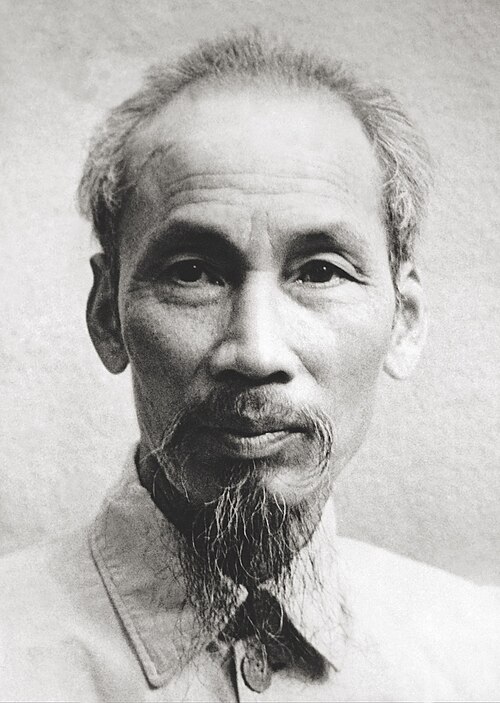
My Socialist Hall of Fame
During this chaotic era of vile rhetoric and manipulative tactics from our so-called bourgeois leaders, I am invigorated by the opportunity to reflect on Socialists, Revolutionaries, Philosophers, Guerrilla Leaders, Partisans, and Critical Theory titans, champions, and martyrs who paved the way for us—my own audacious “Socialism’s Hall of Fame.” These are my heroes and fore-bearers. Not all are perfect, or even fully admirable, but all contributed in some way to our future–either as icons to emulate, or as warnings to avoid in the future.
Early Life (1890–1919)
Ho Chi Minh was born as Nguyễn Sinh Cung on 19 May 1890 in Hoàng Trù village, Kim Liên commune, Nam Đàn district, Nghệ An province in French Indochina. His father, Nguyễn Sinh Sắc (or “Nguyễn Sinh Huy”/“Huy” in some sources), was a Confucian‐trained village schoolmaster and mandarinate official under the Nguyễn dynasty, who later became discredited under the colonial regime. From a young age, Ho Chi Minh was exposed to the contradictions of colonial racism, impoverished peasants, and nationalist ferment.
He attended the Quốc Học (National High School) in Huế beginning around 1907–08, but was expelled (or left) after participation in protest‐actions against French rule. In 1911 he signed on as a cook helper aboard a French merchant vessel (the “Amiral de Latouche-Tréville”) and travelled to Marseille, Le Havre and other ports, initiating his period abroad.
Formative Years Abroad (1911–1924)
Between 1911 and the early 1920s, Ho Chi Minh travelled and worked in various countries, including France, Britain, the United States, Africa and Asia, using aliases such as “Nguyễn Ái Quốc” (Nguyễn the Patriot). In France he became active in the anti‐colonial movement, co-founding the Groupe des Patriotes Annamites in Paris and petitioning at the Versailles Peace Conference for the rights of Vietnamese under colonial rule. In 1923 he moved to Moscow and enrolled at the Communist University of the Toilers of the East (KUTV), becoming a functionary of the Comintern. His time abroad fused his nationalism with Marxist-Leninist orientations and prepared him for the founding of a communist party in Indochina.
Revolution and Return to Vietnam (1925–1945)
In the mid‐1920s Ho Chi Minh established the Vietnamese Revolutionary Youth League in Canton (Guangzhou), transforming later into the Indochinese Communist Party (1930). Under Japanese occupation during World War II, he organized the League for the Independence of Vietnam (Việt Minh) in 1941, uniting nationalist and communist forces to resist both Japanese and French colonialism. On 2 September 1945, in Hanoi, following the Japanese surrender, he proclaimed the independence of the Democratic Republic of Vietnam (DRV) and was elected President (Chairman) of its Provisional Government.
Leadership of the DRV and the First Indochina War (1945–1954)
As leader of the DRV, Ho Chi Minh confronted the return of the French colonial army. In December 1946 he declared the start of the First Indochina War. The climactic Battle of Điện Biên Phủ (1954) resulted in the French defeat and the Geneva Accords, which temporarily partitioned Vietnam at the 17th parallel. In this period he also oversaw land reform campaigns in North Vietnam, which included controversial executions and political purges, part of the process of consolidating the communist state.
Vietnam War Era and Later Years (1954–1969)
After 1954 Ho Chi Minh remained President of North Vietnam (officially until his death) and chairman of the Workers’ Party of Vietnam. Although increasingly a symbolic figure while operational command passed to colleagues like Võ Nguyên Giáp and Phạm Văn Đồng, he maintained ideological leadership and mobilized international diplomacy. During the Vietnam War (Second Indochina War), he supported the southern insurgency (Viet Cong) and the supply chain known as the “Ho Chi Minh trail”. Ho Chi Minh died on 2 September 1969 in Hanoi.
Ideology and Leadership Style
Ho Chi Minh combined Vietnamese nationalism with Marxism-Leninism, forging the slogan “independence, freedom, happiness” for Vietnam. His leadership style merged guerrilla war strategy, mass mobilization, and state‐building. He was widely credited with the successful termination of French colonial rule—making him a seminal figure in global decolonization. But his leadership also carried the hallmarks of Leninist‐party discipline, top‐down campaigns (notably land reform) and the creation of a personalized cult of leadership in North Vietnam. Recent scholarship highlights the humanitarian rhetoric of Ho, but also the realpolitik and ruthlessness necessary in the revolutionary context.
Legacy
Ho Chi Minh’s impact on Vietnamese history and the global Cold War era is immense. He served as the symbolic “founding father” of modern Vietnam. In recognition, Saigon was renamed Ho Chi Minh City in 1976. His image and writings still pervade Vietnamese political culture. Internationally he remains a symbol of anti-colonial struggle, though scholars debate both his political achievements and the human cost of his campaigns.
Concluding Remarks
Ho Chi Minh’s life encapsulates many of the major politico‐historical currents of the 20th century: European colonialism and its collapse, the rise and spread of communism, nationalist revolutions, the Cold War’s global South, and the complex interplay of ideology, charismatic leadership, and mass mobilization. For graduate study, his career offers fertile terrain: the negotiation of nationalism and socialism; the dynamics of guerrilla vs. conventional warfare; the state‐formation processes in post‐colonial regimes; and the interplay of personality and institution in revolutionary leadership. While widely celebrated in Vietnam, his legacy also invites critical scrutiny—especially regarding internal repression, centralized power structures, and human costs. A sophisticated academic engagement with Ho Chi Minh must therefore balance admiration for anti-colonial achievement with rigorous analysis of governance, ideology, and historical consequence.
Bibliography
Monographs and Scholarly Works
- Brocheux, Pierre. Ho Chi Minh: A Biography. Cambridge University Press, 2007.
- Duiker, William J. Ho Chi Minh: A Life. Hyperion, 2000 (and subsequent editions e.g. 2012).
- Duiker, William J. The Communist Road to Power in Vietnam. Westview Press, 1982.
- Gaiduk, Ilya V. Confronting Vietnam: Soviet Policy toward the Indochina Conflict, 1954–1963. Stanford University Press, 2003.
- Fall, Bernard. Last Reflections on a War. Doubleday, 1988.
- Dommen, Arthur J. The Indochinese Experience of the French and the Americans: Nationalism and Communism in Cambodia, Laos, and Vietnam. Indiana University Press, 2001.
Primary Sources & Collections
- Ho Chi Minh. Selected Works of Ho Chi Minh. Foreign Languages Publishing House (Hanoi).
- Marxists Internet Archive. “Ho Chi Minh: Biography.” (Online resource)
 Letters from Tomis
Leave a comment