Book Review
Grann, David. The Wager: A Tale of Shipwreck, Mutiny, and Murder. Doubleday, 2023.
Introduction
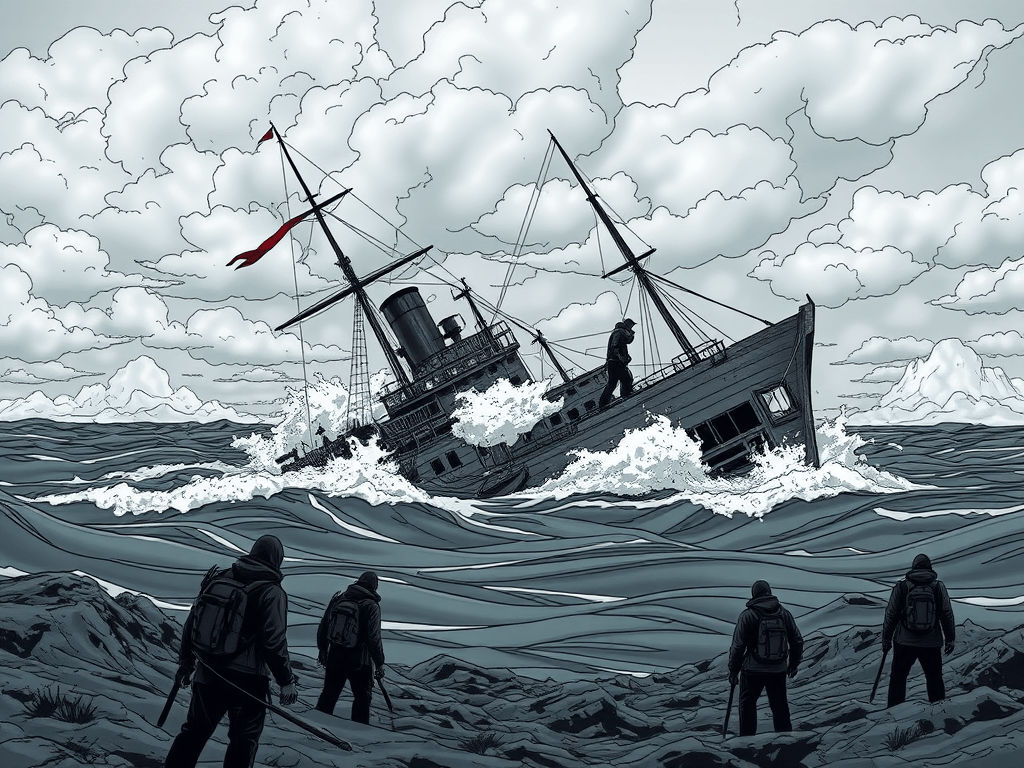
David Grann’s The Wager (2023) is, on its surface, a gripping maritime survival narrative, but it ambitiously aims to do more: to excavate how narratives of authority, truth, and memory compete in the aftermath of calamity. Drawing on scattered archival sources, survivor journals, and court records, Grann reconstructs the ill-fated voyage of HMS Wager, its wreck off the coast of Patagonia, the struggle for survival on a barren island, and the conflicting stories that emerged when the survivors returned home.
Narrative Methodology and Historiographical Posture
One of the book’s strengths is Grann’s ability to sustain suspense while remaining grounded in archival rigor. The author interweaves multiple survivor accounts—particularly those of Captain David Cheap, gunner John Bulkeley, and midshipman John Byron—with Admiralty logs and court-martial records. This multi-perspectival approach dramatizes the contradictions between memory, interest, and institutional record.
In historiographical terms, The Wager occupies the space between archival monograph and literary nonfiction. Grann reaches a wide audience without diluting historical complexity, though moments of narrative expediency occasionally override analytical nuance. His contextualization of the voyage within the War of Jenkins’ Ear situates the episode as symptomatic of eighteenth-century imperial crisis.
Themes and Contributions
Authority and the Fragility of Order
Grann charts the erosion of command as Cheap’s authority collapses amid starvation, illness, and despair. The resulting mutiny foregrounds the tension between obedience and moral autonomy, a dynamic that echoes through maritime and military history.
Memory, Narrative, and the Politics of Truth
The book’s narrative crux lies in competing testimonies: who defines “mutiny,” and whose version of survival becomes official history? The Admiralty’s eventual suppression of scandal reveals how empire depends on narrative control as much as on naval might.
Survival, Human Nature, and the Extremes
Through vivid accounts of disease, deprivation, and violence, Grann transforms survival into moral allegory. His prose—measured yet cinematic—frames ethical questions about loyalty, self-preservation, and the limits of civilization under duress.
Empire and Historical Recovery
By resurrecting this largely forgotten disaster, Grann exposes the human costs of imperial ambition. The Wager’s voyage, meant to expand Britain’s reach, instead becomes a microcosm of colonial hubris and collapse. Yet the book’s near-absence of indigenous perspectives signals a continuing imbalance in imperial historiography.
Limitations and Critical Challenges
While Grann’s archival synthesis is impressive, his narrative voice occasionally overdetermines moral interpretation. The absence of lower-deck sailors’ voices and indigenous witnesses constrains the story’s social range. Moreover, the book’s preference for psychological realism over systemic analysis leaves underexplored the economic and political logics driving imperial exploration.
Conclusion
The Wager succeeds both as an engrossing narrative and as an inquiry into historical truth. It belongs to the tradition of maritime historiography that includes works like Nathaniel Philbrick’s In the Heart of the Sea and Simon Schama’s Rough Crossings, but Grann’s contribution is distinguished by its meditation on storytelling itself: how history is made not only from facts, but from the struggle over who owns them. For scholars of history, literature, and empire, The Wager offers a rich case study in the ethics of narrative reconstruction.
 Letters from Tomis
Leave a comment