Book Review
Euripides. Heracles. Translated by William Arrowsmith, University of Chicago Press, 1958.
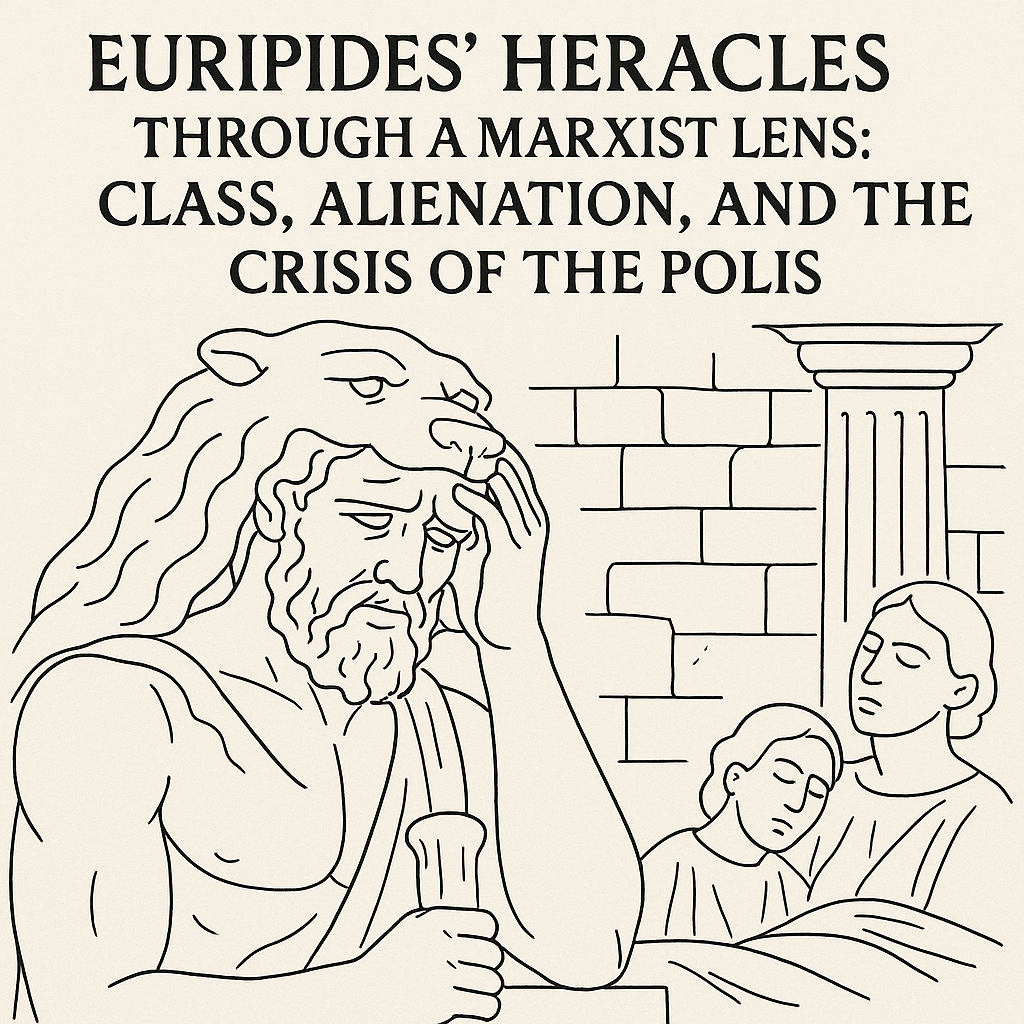
Euripides’ Heracles occupies a paradoxical position within the classical canon: a tragedy that both exalts and indicts the heroic ideal, exposing the social and ideological contradictions of the polis that produced it. From a revolutionary Marxist perspective, Heracles can be read as a dialectical meditation on alienation, violence, and the crisis of the slaveholding order that undergirded Athenian democracy. In dramatizing the hero’s descent from savior to parricide, Euripides reveals the internal disintegration of a world sustained by conquest and patriarchal domination.
Class Contradiction and the Crisis of the Polis
In the wake of the Peloponnesian War, Athens’ imperial project—its dependence on tribute, slavery, and expansion—mirrored the contradictions of Heracles himself. The hero, defined by labor and violence, represents the commodification of human strength under conditions of domination. His labors, celebrated as divine service, in fact mark his alienation: he performs impossible tasks not for his own emancipation but for the maintenance of an oppressive cosmic and political order. Heracles is thus the proletarianized hero, whose power is endlessly extracted by kings and gods alike.
When Euripides’ play begins, Heracles is absent—laboring in Hades—while his family suffers under the tyranny of Lycus. The hero’s return should restore order, yet his very arrival inaugurates catastrophe. This structural irony expresses what Marx termed the “fetishism of heroism”: the social dependence on the individual savior to resolve systemic contradictions that can only be abolished through collective transformation. Heracles’ superhuman strength, divorced from class consciousness or solidarity, can only reproduce the violence of the system that oppresses him.
Madness and Ideological Alienation
The intervention of Hera and Iris, driving Heracles into madness, is often interpreted as divine cruelty. Yet from a Marxist standpoint, divine compulsion operates as the ideological apparatus of the ruling order—religion functioning as both mystification and enforcement of material conditions. The gods’ manipulation of Heracles dramatizes the subordination of human agency to an external, fetishized power. His madness is not merely psychological but historical: it embodies the ideological dislocation of a subject who cannot reconcile his labor with his humanity.
Heracles’ slaughter of his wife and children can thus be read as the violent implosion of patriarchal and heroic ideology. In killing his family, he destroys the very oikos that legitimized his existence as a free male citizen. Euripides thereby exposes the latent barbarism of the polis, whose foundations in slavery and patriarchal kinship render every victory pyrrhic. The tragedy’s horror lies in its recognition that the values of the polis—honor, virility, obedience to divine law—are themselves incompatible with human freedom.
Theseus and the False Promise of Bourgeois Humanism
The arrival of Theseus in the final act introduces a new ideological register: compassion, friendship, and rational humanism. Theseus’ offer of refuge in Athens gestures toward a moral resolution grounded in civic virtue. However, from a revolutionary Marxist perspective, this resolution is false and ideological. Theseus embodies the self-congratulatory liberalism of the Athenian state, presenting charity as an antidote to structural injustice. His benevolence depends on the same social order that produces Heracles’ suffering: an imperial democracy built on slave labor and patriarchal subordination.
Euripides, consciously or not, reveals the limits of this humanism. Heracles’ survival is not redemption but the persistence of alienation. His shame and exhaustion signify the exhaustion of the heroic mode itself—a precursor to the moral collapse of the Athenian empire. The tragedy closes not with catharsis but with historical foreboding: the recognition that no individual, however noble, can transcend the contradictions of his class and epoch.
Toward a Dialectical Reading of Tragedy
In Marxist terms, Heracles can be read as a tragedy of the base intruding upon the superstructure. The economic and social foundations of the polis—its exploitation of labor, women, and conquered peoples—erupt through the ideological veneer of heroism and divine order. The play’s fragmentation, its abrupt tonal shifts, and its refusal of conventional closure reflect the disintegration of a social totality at its limit. Euripides’ radical innovation lies precisely here: he dramatizes not the restoration of order but the exposure of its impossibility.
Thus, Heracles anticipates the dialectical movement of history itself. The hero’s madness, the gods’ cruelty, and Theseus’ hollow magnanimity together stage the contradictions of a society poised on the brink of its own dissolution. In this sense, the tragedy can be read as a proto-revolutionary text: not yet advocating class struggle, but revealing the psychic and moral devastation inherent in a world sustained by domination.
Conclusion
From a revolutionary Marxist standpoint, Euripides’ Heracles is neither merely a domestic tragedy nor a study in divine persecution—it is an allegory of historical decay. Heracles, the enslaved laborer turned self-destructive warrior, embodies the collapse of the heroic and the birth pangs of historical consciousness. His suffering gestures toward the necessity of a new social order founded not on individual might or divine sanction, but on collective emancipation.
Euripides’ tragic vision, in its bleak humanism and political despair, thus points dialectically toward the revolutionary horizon: the recognition that liberation can only arise when the laboring subject ceases to serve the gods of power and begins to transform the world in their own image.
 Letters from Tomis
Leave a comment