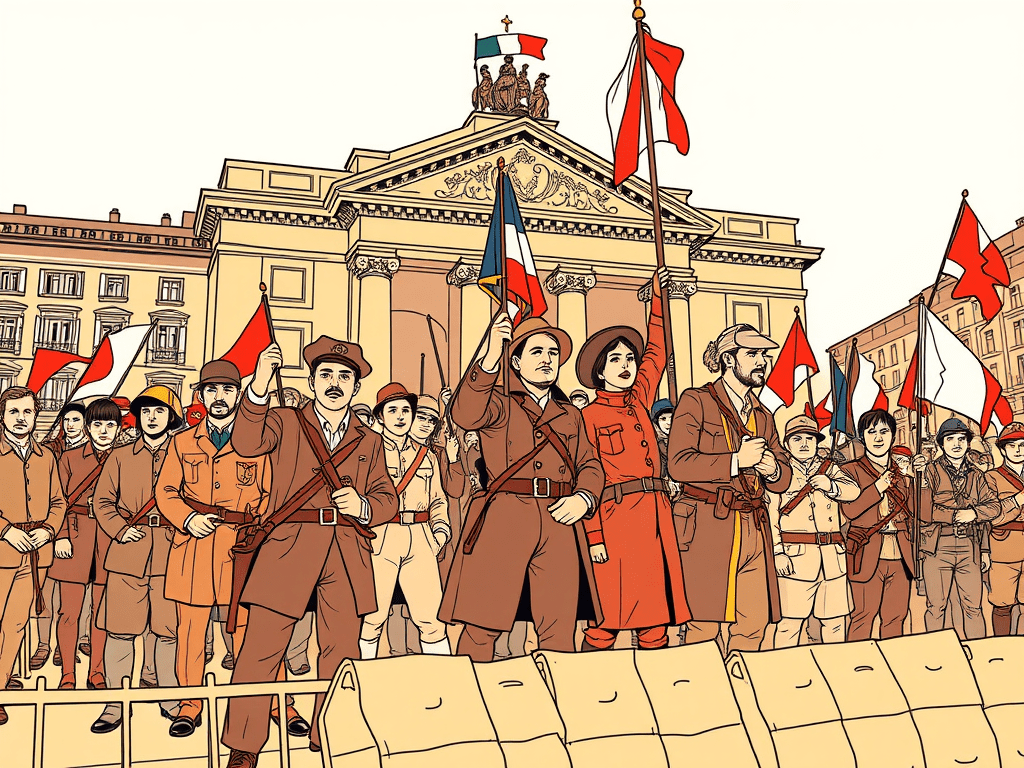
The Paris Commune of 1871 stands as a defining moment in the history of working-class struggle. In the aftermath of the Franco-Prussian War and the collapse of the French Second Empire, the people of Paris rose in revolutionary insurrection and for about two months created the first government explicitly led by workers and radicals. From a communist perspective, the Commune exemplified the dictatorship of the proletariat in practice: it was the working majority seizing power, dismantling the old bourgeois state, and enacting policies in the interests of labor and the poor. Marx, Engels and later Lenin celebrated the Commune’s ideals and lessons, treating it as a prototype of a socialist republic. This essay examines the Paris Commune as an instance of class warfare against bourgeois state power, analyzes its revolutionary nature, and explores its deep impact on Marxist theory and the development of communist praxis.
Historical Background and Class Polarization
The Commune arose in a moment of national crisis and class polarization. In January 1871 France had suffered a crushing defeat to Prussia. The imperial government collapsed, and a provisional republican government under Adolphe Thiers, representing conservative and bourgeois interests, signed a humiliating peace treaty. Paris had endured a cruel siege, with starvation and social hardship crushing its working-class neighborhoods. Thiers and his government retreated to Versailles, threatening Paris with harsh control. Meanwhile, the Paris National Guard – made up largely of workers and artisans – and the Parisian poor increasingly saw themselves at odds with the rural-dominated bourgeois Assembly in Versailles. For them, the war’s outcome confirmed that the ruling classes had betrayed France’s interests and deepened popular misery.
Tensions boiled over when Thiers’s government ordered the disarmament of the National Guard by seizing the city’s defensive cannon on March 18, 1871. The workers and National Guard battalions refused to disarm. They rose up, shot down two generals sent to enforce the order, and occupied the city hall. This dramatic clash was essentially a class confrontation: Parisian laborers and radicals, emboldened by desperation, defied the authority of the conservative bourgeois government. In a matter of hours, the city council and most government ministers fled Paris for Versailles, leaving a power vacuum. The radicals, socialists, communards and workers’ delegates seized control. In the revolutionary uprising, the ordinary citizens of Paris—workers, national guardsmen, and even shopkeepers—effectively declared a break with the old state. They formed a new municipal government. This moment, on March 18, marked the birth of the Paris Commune, which proclaimed itself the legitimate authority of Paris. For communists, these events were the opening salvo of class war: the working class would no longer accept the rule of the rich minority.
Proletarian Government: Council Democracy and the New State
Almost from its inception, the Commune put into practice principles that contrasted sharply with bourgeois government. The Commune Council (or Commune for short) was elected by universal male suffrage of Parisians, with one delegate per 20,000 inhabitants. All officials were made elective and immediately recallable. There were no permanent offices or lavish stipends. In fact, all elected commune officials drew only a worker’s wage. This direct, council-based democracy was revolutionary: instead of the propertied classes governing behind locked doors, working people held office. Ordinary National Guardsmen – the armed workers themselves – now enforced the laws, and the police became accountable to the Commune. In Lenin’s words, “The Commune was to be a working, not a parliamentary, body, executive and legislative at the same time.” No longer would a privileged bureaucratic caste or standing army be the instrument of rule. As Engels noted, by abolishing the standing army and reducing public officials to the level of the proletarian majority, the Commune had created a form of government that was no longer a “state” in the old sense but a transitional form in which state power genuinely served the laboring classes.
Communards famously declared that “the workers have grasped the weapons of the state.” But rather than using the old state apparatus as it stood, they shattered it. They tore apart the bureaucracy of the Second Empire and the fledgling Third Republic. The National Guard, now under workers’ control, became the city’s only armed force – every able-bodied citizen could bear arms on behalf of the Commune. The old army and the Palais-Royal police force were effectively dissolved. In place of these, the Commune armed the people themselves. This mass arming was itself a political act: it meant the workers’ democracy would rely on popular organization and self-defense, not hired soldiers loyal to the bourgeois government.
The Commune also dismantled the ideological apparatus of the old regime. It enacted separation of church and state: Church property was nationalized, priests lost their state salaries, and religious instruction in schools was halted. As Marx dryly observed, the priests were sent back to private life, “to feed upon the alms of the faithful in imitation of their predecessors, the Apostles.” In policy after policy, the Commune aimed to break the economic and social privileges of the rich. It cracked down on debt and rent for working-class families, banned exploitative labor practices, and encouraged worker control of abandoned factories. All these measures flowed from a clear class perspective: the Commune was the government of the great majority of Parisians – craftsmen, laborers, the poor – organized against the minority of capitalists and aristocrats who had long run the state for their own benefit.
Key features of the Commune’s governance included:
• Council democracy: All municipal officials were elected from the grassroots and immediately recallable by voters. There were no appointments or hereditary positions.
• Worker wages for officials: Every functionary, from the Commune Council down to local commissioners, received only a normal worker’s wage. All privileges and allowances of the old state dignitaries were abolished.
• Armed people, not standing army: The Commune disbanded the old army units in Paris and armed the National Guard – every citizen could serve in self-defense. This embodied the principle that the people themselves, through their councils, would be the real force of order.
• Separation of church and state: Religious orders lost their state status, schools became secular, and church property was seized. Spiritual authority was consigned to the private sphere of believers rather than the public power.
• Social and economic reforms: The Commune enacted progressive policies to alleviate the workers’ plight (see below). These laws directly overturned bourgeois economic power – for example, rents and debts were cancelled or postponed, and workers were given rights to occupy deserted workplaces.
• Universal public services: Even under siege conditions, the Commune tried to guarantee equal access to education, health, and employment. Public workshops were created under workers’ control. Women were encouraged to organize (e.g. a Women’s Union was formed to provide free meals and campaign for women’s rights), reflecting an understanding that the working class includes women and children too.
In practice, these measures meant Paris was run by its workers, for its workers. Instead of a parliament chosen from property-owners, the Commune was essentially a council of the working poor. This government did not disguise its class character: it placed power in the hands of the “toilers of Paris,” and set out deliberately to reverse centuries of exploitation. Such a structure confirmed what Marx and Engels had theorized: once the working class seizes power, it transforms the state apparatus into its own tool of liberation. The Commune’s workings prefigured what Marx would call the dictatorship of the proletariat – the rule by the laboring majority, exercised through democratic councils.
Social Reforms and Class-Oriented Policies
Beyond its political form, the Commune pursued a radical program of social reforms aimed at undermining bourgeois wealth and elevating the working class. Even though the Commune lasted barely two months, it passed laws that none before had attempted. These measures show how class-struggle logic guided its short-lived policy agenda:
• Cancellation of debts and rents: The Commune remitted all war-time rents owed by tenants and postponed debt payments for workers. Bourgeois landlords and loan-sharks were denied the windfall they expected; instead relief went to struggling families who had suffered under the siege.
• Labor protections: Night work and child labor in bakeries were outlawed – a revolutionary limit on capitalist exploitation of labor. Employers’ fines and punishments of workers were banned, striking at the arbitrary control bosses had exercised. National Guardsmen killed in defense of the Commune received pensions for their widows and children, acknowledging the soldiers’ sacrifice and supporting working families.
• Reclaiming pawned tools: Many workers had been forced to pawn their tools during the siege just to survive. The Commune decreed that tool owners could recover their pawned goods free of charge (up to a modest value). This gave artisans and laborers the means to resume their trades and earn a livelihood without capital.
• Workers’ control of factories: When capitalist owners fled the city, their factories and workshops were often left empty. The Commune endorsed the right of workers to occupy and run these deserted enterprises. They recognized the workers’ right to manage production directly, while promising compensation to owners when possible. This was an embryonic form of worker self-management, a practical attack on private property in industry.
• Educational reforms: Free, secular education for all was promoted. Church-run schools lost their religious instruction, reflecting the Commune’s commitment to a democratic and equal schooling system.
• Women’s rights and welfare: Though women could not yet vote for the Commune Council, women’s associations sprung up quickly, organizing aid to the wounded, cooperative kitchens, free soup lines, and campaigning for equality and the abolition of prostitution. These grassroots efforts challenged traditional gender roles, consistent with the socialist principle that women’s liberation was integral to class emancipation.
These policies reveal the Commune’s deep focus on working-class needs and its confrontation of bourgeois society. By abolishing rent for the poor, seizing pawnshop stores, and banning exploitative labor, the Commune directly attacked capitalist profit. It organized solidarity among workers (for example, by freeing pawned tools and helping the families of soldiers) and asserted the right to work under humane conditions. Such measures reflect communist ideals: collectivism over private profit, solidarity among the oppressed, and the use of state power to dismantle class privilege.
The Commune’s actions were a real-world testing ground of socialist measures. Marx and others noted with approval that these were not mere reforms to humanize capitalism, but steps toward socialism. Engels explained that when officials and soldiers are paid like ordinary workers, the specialty of state power begins to disappear. In effect, every decree of the Commune chipped away at class distinctions. Even skeptics would note that its intent was revolutionary: to reorganize society on the basis of equality and social need. This is why Marx hailed the Commune as “the harbinger of a new society.” In those actions — pardoning rents, staffing schools equally, and opening up collective control over production — the working class of Paris briefly gave form to the very society communists had long envisioned: one where class exploitation was abolished in all its petty forms, and where democracy was truly the rule of the majority.
Confrontation with the Bourgeois State: War and Suppression
No sooner had the Commune been established than it faced armed resistance from the bourgeois state. From the perspective of class struggle, the Commune’s existence was intolerable to France’s ruling classes. In Versailles, Thiers and the conservative Assembly refused to recognize the new government. They quickly gathered a large army – composed of rural conscripts and regular troops – and prepared to recapture Paris by force. To the bourgeoisie, Paris’s workers were rebels to be crushed; this was a clear political choice to uphold class rule by violence.
For nine weeks, the Commune and the workers’ National Guard prepared for defense. Barricades were erected in the streets, and desperate appeals for solidarity echoed through working-class districts. Large sections of Paris turned themselves into fortresses. The Commune also attempted to hold France together by declaring itself a government in insurrection, but its efforts to influence other regions or call a nationwide uprising largely failed – a point critics later would lament. Still, for those in Paris it was a fight to the death against an encroaching reaction.
In late May 1871, the Versailles forces stormed Paris. This final conflict, known as the “Bloody Week,” was gruesome. The Versailles army committed indiscriminate artillery bombardment and house-to-house shootings. Revolutionary leaders, rank-and-file guardsmen, and thousands of women and workers were massacred. Estimates suggest that tens of thousands of Communards died in the streets or were summarily executed. By May 28 the Commune was utterly defeated, its barricades dismantled, and Paris returned to bourgeois control.
From a Marxist viewpoint, this armed confrontation underscored the fundamental truth of the Commune: socialist revolution faces the wrath of the entrenched ruling class. The French Republic in Versailles was, in essence, the armed dictatorship of the bourgeoisie, and it unleashed its violence without mercy. Even in defeat, the Communards gained martyrs whose sacrifice would inspire future revolutionaries. Marx famously wrote that the Commune’s “exterminators” were already nailed to history’s pillory, suggesting that the wave of working-class resistance could not be fully extinguished. The bloodshed of Bloody Week, as horrific as it was, only deepened the conviction among socialists that the class struggle would continue.
The Commune’s confrontation with state power serves as a stark example of the revolutionary lesson: the bourgeois state will not yield power peacefully. Its machinery – army, judiciary, civil bureaucracy – must be overthrown. The Commune demonstrated what happens when workers openly defy that power: the counterrevolution resorts to mass violence. Consequently, revolutionaries after 1871 recognized that only through firm political preparation and readiness to defend gains could a workers’ uprising survive. In communist theory, the Commune’s fate taught that a revolutionary government must act quickly to neutralize the bourgeoisie’s ability to retaliate (for example, by confiscating their funds and dismantling their armed forces). The brutal suppression also sealed the Commune’s status as a symbol: it was an example of working-class heroism against overwhelming odds, and a warning that class struggle could erupt into civil war.
Marx and Engels: Celebrating the First Dictatorship of the Proletariat
Karl Marx and Friedrich Engels viewed the Paris Commune as a historic validation of their core theory. They celebrated it as the first real dictatorship of the proletariat – that is, the first time a workers’ majority openly exercised political power through their own democratic councils. In The Civil War in France (1871), Marx praised the Commune’s accomplishments and used it to clarify his ideas about the state. He wrote that “Working-men’s Paris, with its Commune, will be forever celebrated as the glorious harbinger of a new society.” This was a moment he had theorized: the old state – an instrument of class rule – was not simply co-opted by workers, but smashed and replaced.
Marx noted several revolutionary characteristics of the Commune. First, he highlighted that no standing army remained: the people themselves took up arms. This was crucial because it meant ordinary workers were now the masters of military force, not detached generals. Second, the Commune’s elected councils with recallable delegates confirmed Marx’s thesis that the proletariat would rule directly and accountably. He admired how officials drew the same wages as workers, symbolizing the end of the state’s privileged bureaucracy. In these features, Marx saw the Commune doing “what the program of the Communists in the Communist Manifesto had proclaimed”: it was winning “the battle of democracy” by the working class.
Most importantly, Marx distilled a fundamental lesson: the working class cannot simply lay hold of the ready-made state machinery and wield it for its own purposes. The Paris Commune proved this beyond doubt. The bourgeois state had to be torn down and rebuilt from below. In later years Marx wrote that the Commune’s lesson was that the revolution “begins by tearing down, not transforming, the rotten old machinery of the State.” This insight became an essential part of Marxist strategy. It meant that to establish socialism, workers could not enter bourgeois parliaments and use them; they had to create new institutions of power.
Engels amplified these ideas in later writings. On the twentieth anniversary of the Commune, he delivered a famous speech (1891) calling it the very definition of proletarian dictatorship. He emphasized that by abolishing the old standing army, police, and civil bureaucracy, the Commune no longer had a “state” in the old sense – it was an embryo of classless administration. Engels observed that the Commune’s very existence imposed authority from below: it was a state run by the workers, in the interests of the workers. He even used the exact phrase “dictatorship of the proletariat” to describe it: the Commune was literally the working class holding state power and using force against the bourgeois minority.
Both Marx and Engels also candidly examined the Commune’s weaknesses, not to discredit it but to learn from its experience. They pointed out that the Commune remained confined to Paris and never spread the revolution to the countryside or other cities. It did not completely reorganize the state machinery (for example, it did not immediately federalize France or ensure workers’ control outside Paris). Engels noted that the Commune’s committees voluntarily disarmed too much by transferring power too quickly to representative bodies, and by acting too leniently with its class enemy. But they saw these not as inherent flaws of proletarian rule, but as mistakes born of inexperience and the strength of bourgeois resistance. Overall, Marx and Engels’ verdict was overwhelmingly positive: the Commune had shown the world that the working class can and will govern when it decides to, setting an example that no later socialist could ignore. It confirmed their belief that the proletariat’s emancipation would be its own act, and it gave concrete form to concepts—councils, workers’ army, abolition of privilege—that until then had been largely theoretical.
Lenin on the Commune: Lessons for Revolutionary Praxis
Vladimir Lenin, writing decades later, treated the Paris Commune as a sacred text of revolution. In The State and Revolution (1917) and earlier works, Lenin closely analyzed the Commune’s structures and fate, drawing explicit lessons for his own time. He referred to the Commune as “the first attempt by a proletarian revolution to smash the bourgeois state machine.” Lenin was enthralled by the Commune’s radical measures and its spirit of working-class self-rule, yet he also sharpened the criticisms of Marx and Engels into practical guidance.
Lenin emphasized that the Commune replaced the old state’s “special institutions of class rule” with genuine democracy. Quoting Marx, he listed the Commune’s key innovations: abolishing the standing army in favor of the armed people; making all officials elected and accountable; eliminating officials’ privileges; and instituting free, secular education. He marveled that every official from mayor to low-level clerk drew an ordinary worker’s wage, turning the state from “a privileged parasite of society into an ordinary department of social work.” For Lenin, these measures exemplified proletarian democracy in action. He credited the Commune with introducing a new kind of political order in which the majority governed itself and crushed its exploiters by the very will of the people. As Lenin put it, the more the people as a whole take on the functions of government, the more the need for a separate state apparatus “withered away.” In Lenin’s view, each progressive measure of the Commune — from progressive education to workers’ control of production — was a step toward that stateless, classless society communists aim to build.
At the same time, Lenin built on Marx’s and Engels’s critiques to outline the Commune’s errors as lessons for future revolutionaries. He agreed that the Commune had “stopped halfway” by not seizing all the resources of the bourgeoisie and by overestimating bourgeois goodwill. For example, many advocates in the Commune argued, like Jourde, that the city could not live without the Bank’s reserves. Lenin wrote that this hesitation weakened the Commune’s material basis. He also criticized the Commune’s decision to suspend or downplay violent reprisals against the hated class enemy. Lenin felt that the Communards’ “excessive magnanimity” – treating traitors leniently and not swiftly crushing counter-revolutionary forces – cost them dearly. In State and Revolution, he notes that instead of finishing off Versailles decisively, the Commune delayed and allowed the enemy to regroup. These critiques formed a blueprint for Lenin’s own revolution: when the Bolsheviks later seized power, they took Lenin’s advice literally by nationalizing the banks, arming workers, and ruthlessly suppressing opposition.
Lenin distilled the Commune’s legacy into a set of guidelines. In his early writings (around 1905), he even itemized its “pluses” and “minuses”: on the plus side, separation of church and state, free public education, elected and removable officials, and abolition of bureaucracy — all radical reforms he urged Russian socialists to adopt. On the minus side, he faulted the Commune’s lack of centralized leadership and party organization, its failure to mobilize the vast majority of the country, and its unwillingness to fully confiscate bourgeois wealth. By the time of 1917, Lenin proclaimed that the Bolsheviks now had before them a ready “Commune-type” model: they could enact immediately the Commune’s social measures because they understood where they had gone wrong. In particular, Lenin’s famous exhortation to “smash the old state machine” and build a new type of state directly echoes the lessons of the Commune.
In short, Lenin saw the Paris Commune as the handmaid of Marx’s theory in practice. It convinced him that genuine socialist democracy was not utopian fantasy, but an outcome the working class could achieve. He argued that only by extending the Commune’s logic to its furthest conclusion could a revolution succeed. This meant forging a disciplined party to lead the masses, arming workers, and fully seizing the commanding heights of the economy. Lenin and the Bolsheviks treated March 18 (the Commune’s anniversary) as a sacred date, holding marches and festivals to remind themselves that they stood in the tradition of those Paris insurgents. The Commune gave them faith that workers could govern, but also the hard-won knowledge that to prevail, they needed unity, decisiveness, and socialist consciousness.
The Commune’s Legacy in Communist Theory and Practice
Though the Commune itself perished violently, its theoretical impact was enormous. Among Marxists, it became the chief example of how a workers’ state differs from bourgeois democracy, and how class struggle must be waged. The very phrase “Paris Commune” entered socialist vocabulary as shorthand for a workers’ council republic. Subsequent socialist thinkers — from Rosa Luxemburg to Trotsky — repeatedly pointed to the Commune when debating how to build socialism. It provided concrete proof that the working class could act as a revolutionary subject.
One profound legacy of the Commune was its model of mass councils (soviets) as opposed to centralized parliaments. Lenin’s own government in 1917 modeled itself as a network of soviets, recalling the Commune’s re-making of local government from below. The idea that political power should flow from assemblies of workers, rather than a permanent elite, resonated through communist practice. Many left currents even argued that the Commune presaged the “withering away” of the state, since its institutions already looked unlike any traditional monarchy or republic. In essence, Marxists came to view the Commune as the embryo of a classless administration, a foretaste of socialism.
In practical terms, the Commune inspired countless revolutionaries. Russian Marxists in the Tsarist era treated it as proof that their struggle was a global cause: even under brutal oppression, workers in Paris had seized power. Lenin and others often reminded comrades that Bolsheviks were building on the Commune’s foundations. In 1918, the nascent Soviet government celebrated the Commune’s spirit by designating March 18 a workers’ holiday. The connections went deep: Lenin placed an old Paris Commune flag in his coffin, and Soviet propaganda often equated the 1917 revolution with the unfinished work of 1871. In China, Mao Zedong also commemorated the Commune and analyzed its errors, showing its global reach as a symbol of proletarian uprising.
Theoretically, the Commune solidified Marx’s notion of historical materialism in a civic event. Marx and Engels argued that the Commune’s fate proved capitalism’s stubborn hold on political power and the difficulty of revolution. But equally, they believed that every lesson drawn would sharpen the proletariat’s ability to act in future revolutions. The Commune taught communists that abolishing class rule requires not timid reforms but a revolutionary rupture with the old state. It underscored that democracy under capitalism remained democracy of the rich until the working class intervened. Lenin later phrased this by emphasizing that socialists must not merely “worship” democracy for democracy’s sake, but extend it to “the dictatorship of the proletariat.” The Paris Commune was the first demonstration of that extension.
Moreover, the Commune shaped later theorists’ debates about strategy. Within Marxism, one school (the so-called council communists and libertarian Marxists) took the Commune’s example to argue that factories and councils, not centralized parties, would carry forward revolution. Others (like Lenin) stressed the need for strong party leadership, learning from the Commune’s organizational gaps. But all agreed that the Commune’s very existence validated the core Marxist claim: class struggle was the engine of history. It was cited to distinguish socialists from more reformist social democrats; after all, the Commune did not come from electoral politics but from insurrection, confirming Marxists’ belief in the necessity of revolutionary overthrow.
In sum, the Paris Commune’s importance lies far beyond 1871 Paris. It was simultaneously a peak of working-class militancy and a textbook for future revolution. Its experience fed directly into The Communist Manifesto’s later preface (written by Marx), which rephrased the plan for worker seizure of power. It led Engels to write the Communist Manifesto’s new introduction in 1891, celebrating Paris’s example. Lenin, Trotsky, and generations thereafter studied it to understand state power, counterrevolution, and the meaning of proletarian democracy. Even today, leftist scholars and activists invoke the Commune as proof that ordinary people can govern themselves and that the abolition of class society is conceivable.
Conclusion
Viewed through a communist lens, the Paris Commune of 1871 was far more than a brief municipal rebellion. It was a class revolution: the working people of a major city daring to overthrow bourgeois rule and reconstruct society on egalitarian principles. Its government was openly proletarian, its confrontations decisively anti-bourgeois, and its policies defiantly socialist. For Marx and Engels, it vindicated the concept of dictatorship of the proletariat and supplied countless lessons about the character of the state. For Lenin and the Bolsheviks, it became a living example to emulate and build upon. Though the Commune fell under fire, its legacy lived on in communist theory: it showed what a rupture with capitalism might look like, what paths to avoid, and what social justice can inspire.
The Commune’s experiment, however short, planted seeds in the revolutionary tradition. It proved that workers’ rule was possible in defiance of the “limits” imposed by capitalism. It demonstrated the political agency of the proletariat, emboldening later movements worldwide. Above all, it underscored that the emancipation of labor must be the act of the laborers themselves. In this sense, the Paris Commune endures as the first, visceral realization of communist democracy – an event whose theoretical implications continue to inform the struggle for a classless, stateless society.
 Letters from Tomis
Leave a comment