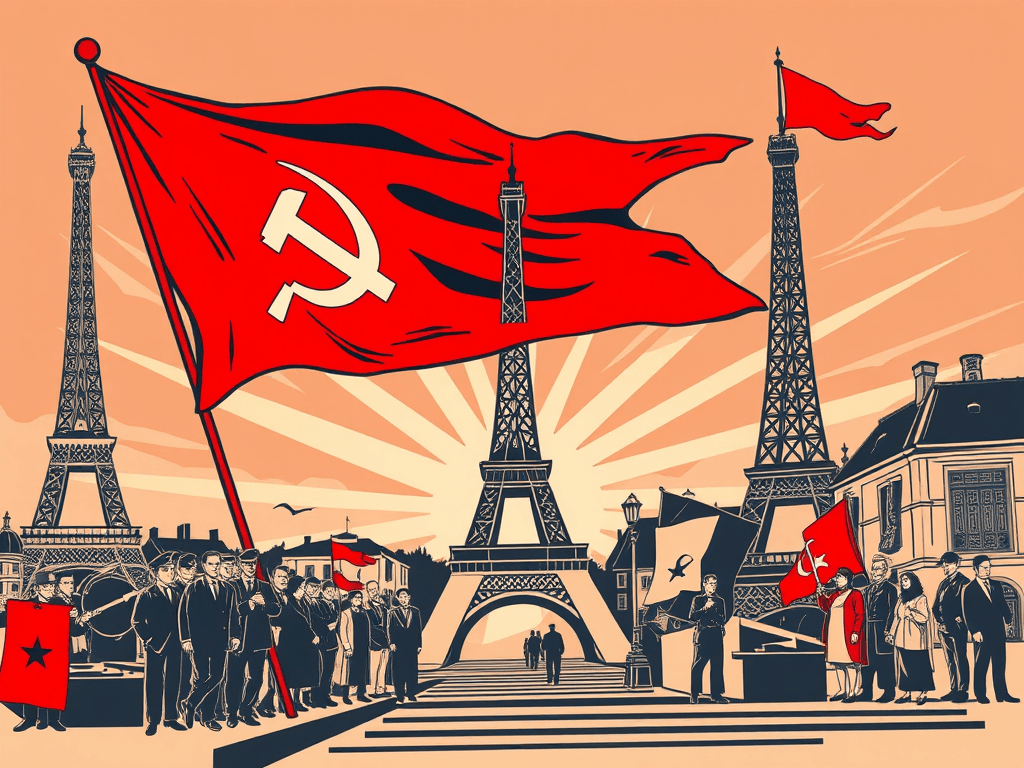
The French Communist Party (Parti communiste français, PCF), founded in 1920, emerged from a schism within the French socialist movement following the Russian Revolution of 1917. It rapidly grew into one of France’s most influential political forces throughout the 20th century, significantly impacting French politics, labor movements, and intellectual life.
Initially formed at the Congress of Tours in December 1920, the PCF split from the French Section of the Workers’ International (SFIO), driven by disagreements over alignment with the Soviet Union and revolutionary Marxism. Early leaders like Ludovic-Oscar Frossard, Marcel Cachin and Maurice Thorez consolidated the party’s structure and promoted rigorous adherence to Comintern directives, embedding it firmly within the international communist movement.
During the 1930s, the PCF expanded its influence through its staunch opposition to fascism and Nazism. It supported the Popular Front government of 1936 alongside socialists and radicals under Léon Blum, contributing significantly to reforms such as paid vacations and improved labor rights. Despite its strong anti-fascist stance, the party faced severe repression and banning during World War II. Yet, its members were significant participants in the French Resistance, elevating the PCF’s prestige considerably in the post-war era.
Post-1945, the PCF reached the peak of its popularity, becoming the largest political party in France by membership. Maurice Thorez and Jacques Duclos emerged as prominent figures, advocating a Soviet-aligned stance during the Cold War. However, its alignment with Moscow led to political isolation, especially after supporting Soviet interventions in Eastern Europe, notably Hungary in 1956 and Czechoslovakia in 1968, events that sparked internal debates and caused membership fluctuations.
The 1970s and 1980s saw significant challenges for the PCF as France experienced economic restructuring and a shift toward neoliberal policies. The party entered an electoral alliance with François Mitterrand’s Socialist Party, leading to participation in government after Mitterrand’s 1981 election. However, policy disagreements, particularly on austerity and economic liberalization, strained this alliance, weakening the PCF’s political influence and voter base.
The collapse of the Soviet Union in 1991 profoundly impacted the PCF, forcing a reevaluation of its ideological and political positions. Throughout the late 20th and early 21st centuries, the PCF sought to redefine itself, emphasizing anti-globalization, social justice, and environmental issues, increasingly collaborating with left-wing alliances and movements such as La France Insoumise.
Today, while diminished from its historical peak, the PCF remains a relevant actor in French politics, continuing to advocate for working-class interests, economic redistribution, and social equality within the broader context of left-wing politics. Its historical legacy persists in French political culture, highlighting its pivotal role in shaping France’s social and political landscape throughout the last century.
 Letters from Tomis
Leave a comment