Introduction
Council communism is a distinctive Marxist ideology that emerged in the early 20th century, advocating a form of socialism built on workers’ councils rather than centralized party rule. As a current within the broader left-wing communist movement, council communism took shape largely in Germany and the Netherlands during the 1920s. It arose in response to the tumult of World War I and the Russian Revolution, as radical workers and intellectuals became disillusioned with both reformist social democracy and the Bolshevik model of revolution. This essay provides a comprehensive overview of council communism—defining its core principles, exploring its theoretical foundations, tracing its historical development and key figures, distinguishing it from Leninist-Bolshevik Marxism, and examining its legacy and relevance in contemporary thought. The aim is to shed light on how council communism’s emphasis on direct worker self-rule through councils offered an alternative vision of socialism, one that has influenced later anti-authoritarian leftist currents even as its own mass movement waned.
Defining Council Communism
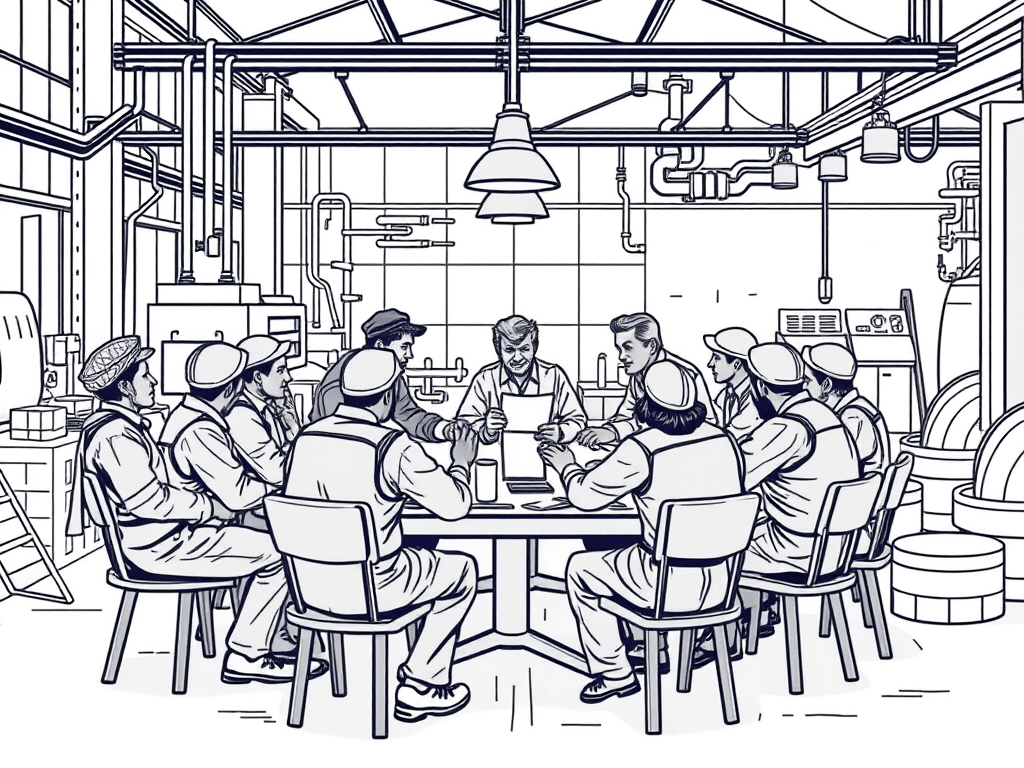
Council communism can be defined as a form of revolutionary socialism that holds workers’ councils (in German, Räte, often known by the Russian term soviets) to be the natural and essential form of working-class organization and governance. In council communist theory, during periods of intense class struggle—such as general strikes, factory occupations, or uprisings—workers will spontaneously form councils composed of delegates elected from workplaces or military units. These councils serve both as fighting organizations against capitalist authority and as the embryonic institutions of a new socialist order. Council communists argue that these directly democratic councils should wield both political and economic power after a revolution, replacing bourgeois parliaments, capitalist management, and even traditional trade unions and political parties. In essence, council communism advocates “council democracy”: a system where production and society are managed from the bottom up by workers themselves through mandated, recallable delegates.
From its inception, council communism stood in opposition to “state socialism” or any socialism administered by a centralized state apparatus above the workers. Unlike the model where a socialist party seizes state power and rules on behalf of the working class, council communism insists that the working class must rule itself through assemblies and councils. This ideology also firmly rejects parliamentary reformism—the idea of achieving socialism through gradual legislative change—and instead calls for immediate abolition of capitalism via revolutionary means. In summary, council communism is characterized by its insistence on direct proletarian control, anti-authoritarian governance, and a refusal to delegate the revolution to any external leadership or bureaucratic authority.
Theoretical Foundations
The theoretical foundations of council communism are rooted in Marxist thought but marked by a critical stance toward prevailing Marxist strategies of the time. Council communists drew inspiration from Karl Marx’s principle that the emancipation of the working class must be the act of the workers themselves. They believed that socialism could not be handed down by a party hierarchy or state officials; it had to be built and administered by workers through their own collective organs. In this spirit, council communists greatly valued class consciousness and saw revolutionary awareness as arising from workers’ own struggles and experiences. The development of mass consciousness and unity in action—particularly through direct confrontation with capitalist institutions—was viewed as the driving force of revolution.
Historical experience played a key role in shaping council communist theory. The 1905 Russian Revolution provided an early model of workers’ councils when striking workers formed the St. Petersburg soviet, revealing a new form of organization outside traditional unions or parties. The idea of the mass strike as a catalyst for revolution, notably analyzed by Rosa Luxemburg in her work The Mass Strike (1906), also left a deep imprint on the later council communist outlook. Left-wing radicals in the German Social Democratic Party (SPD) such as Anton Pannekoek and Rosa Luxemburg observed that as capitalism entered a period of crisis and war in the early 20th century, old methods of struggle (parliamentary debate, piecemeal reforms, routine union negotiations) were becoming obsolete. Instead, mass action and wildcat strikes indicated that workers were developing new, more militant forms of resistance. Council communism thus theorized that the era of capitalist decline would spur workers to bypass entrenched labor institutions and take matters into their own hands, forging councils to coordinate their fight and ultimately to govern society.
A crucial theoretical divergence from other Marxists concerned the role of the political party and the nature of revolution. Influenced by their reading of Marx and by contemporary events, council communists asserted that revolution is not a one-time coup led by a party, but rather an extended process of proletarian self-organization. They argued that a revolutionary movement should aim to “increase the power, autonomy and class consciousness of the workers” at every step. Tactics and forms of organization were to be judged by whether they empowered workers directly. This perspective led to rejecting the concept of a vanguard party imposing leadership from above. Instead, any revolutionary party or organization, in the council communist view, could only play a minoritarian, propagandistic role—educating and encouraging workers—while ultimate leadership and decision-making had to remain with the workers’ councils themselves. Otto Rühle, one of the German council communists, famously summed up this stance by declaring “the revolution is not a party affair.” In practice, this meant council communists discouraged reliance on any elite group to carry out the revolution or govern afterward.
Another foundation of council communist theory is the critique of bourgeois institutions (parliaments, traditional unions, and bureaucracies) as obstacles to revolution once capitalism reached a certain stage. Thinkers like Pannekoek and Herman Gorter argued that in Western Europe, where capitalist democracy and stable institutions were well established, these institutions served to integrate and defuse working-class militancy. Therefore, revolutionaries should not participate in parliamentary elections or work within conservative trade unions, as those would only “discipline” workers into the capitalist framework. Instead, council communists advocated for creating new revolutionary unions or factory organizations controlled directly by workers (such as Germany’s General Workers’ Union, AAUD, which they formed), or for leaving unions entirely in favor of building councils during mass strikes. Their emphasis was on direct action and workers’ self-initiative: when workers act collectively on a large scale—through wildcat strikes, factory committees, and inter-workplace councils—they both fight the capitalist class and construct the embryonic structure of socialist society in one movement.
In summary, the theoretical worldview of council communism centered on self-management, direct democracy, and spontaneity in the workers’ movement. It took Marx’s revolutionary humanism and pushed it to an anti-authoritarian conclusion: only the workers themselves, organized in councils at their workplaces and communities, could bring about and sustain a communist society. All intermediary bodies or would-be leaders were treated with deep skepticism, a stance that put council communists at odds with both the social-democratic and Bolshevik models of revolution.
Emergence and Early Historical Development
Council communism emerged out of the political ferment at the end of World War I, particularly the revolutionary upheavals in Germany and Central Europe. The German Revolution of 1918–1919 was a pivotal moment: as Imperial Germany collapsed, workers’ and soldiers’ councils sprang up across the country, challenging the authority of the old regime. These councils were similar in spirit to the Russian soviets and initially included a broad range of socialist factions. Radical left socialists, including those who would become council communists, saw in these German councils the promise of a proletarian revolution in Western Europe. However, the revolution’s outcome—the Social Democratic Party coming to power and violently suppressing the more radical elements (notably the Spartacist uprising in January 1919)—sobered the revolutionary left. Many concluded that traditional socialist parties and unions had betrayed the council movement and the workers’ cause.
In this context, a left-wing faction within the newly formed Communist Party of Germany (KPD) began to voice sharp disagreements with the party’s direction. The KPD had been founded at the end of 1918 by revolutionaries including Rosa Luxemburg and Karl Liebknecht, but after their deaths and under new leadership, the party aligned closely with the strategies advocated by the Bolsheviks in Moscow. A majority of the KPD’s rank and file in 1919 were opposed to participating in parliamentary elections or working inside the old trade unions, believing that energy should instead go toward building revolutionary workers’ councils and wildcat strike committees. This put them to the left of Bolshevik orthodoxy, since Lenin and the Communist International (Comintern) were urging communist parties worldwide to use “legal” avenues like elections and union leadership positions to strengthen the revolution. By late 1919, the tension within the KPD culminated in a split: the more radical anti-parliamentary, anti-union majority was effectively pushed out of the party by the leadership loyal to Moscow.
The expelled radicals founded the Communist Workers’ Party of Germany (KAPD) in April 1920. This marks the formal birth of council communism as a distinct political movement. The KAPD started with tens of thousands of militant workers and positioned itself as a revolutionary alternative to the official communist party. That same year, in the wake of the reactionary Kapp Putsch in Germany (which workers defeated through a general strike and council mobilization), the council communists also established the General Workers’ Union of Germany (AAUD), a revolutionary union federation meant to coordinate workplace councils and strikes independently of the reformist trade unions. The ideas driving these developments were articulated in influential pamphlets: for example, Herman Gorter’s The World Revolution (1918) and Open Letter to Comrade Lenin (1920), and Anton Pannekoek’s World Revolution and Communist Tactics (1920). These writings stressed that conditions in Western Europe required a different approach from Russia’s—one that rejected parliamentarism and the old union structures, relying instead on direct action and new organizations of workers.
Initially, the German council communists were enthusiastic about the Russian Revolution and had hoped to work within the Communist International. The KAPD even sent delegates to the Comintern’s congresses in 1920–21, seeking recognition. However, their openly dissident positions were not tolerated: Vladimir Lenin, at the Comintern’s Second Congress in 1920, lambasted the KAPD’s stance in his famous pamphlet “Left-Wing” Communism: An Infantile Disorder. Lenin argued that refusing to participate in elections or to work within mass organizations like trade unions was a naive, “infantile” deviation that would isolate revolutionaries from the working class. In Moscow’s view, the German ultra-left needed to discipline itself and follow tactics that had succeeded in Russia. The council communists, however, felt vindicated by their own experiences in Germany and the West. Gorter’s reply to Lenin (the Open Letter) politely but firmly insisted that Western European workers faced a powerful, seasoned bourgeois order, and thus they had to adopt new tactics: forging their own councils and unions free from opportunist leaders, and avoiding entanglement in the bourgeois political system. This exchange solidified the rift between council communism and Bolshevism.
By 1921, the break was complete. The KAPD withdrew from the Comintern after failing to change its course, and the council communist critique of the Bolshevik model grew more radical. Thinkers in this camp concluded that the Soviet Union itself was not truly socialist but had given rise to a new form of capitalist rule—often termed “state capitalism” or a “new bourgeoisie” (the party bureaucracy). In 1921, when the Soviet government under Lenin introduced the New Economic Policy (reintroducing some private trade and profit incentives), council communists saw it as confirmation that the Russian Revolution had become a bourgeois revolution in socialist guise. Some, like Otto Rühle, had already earlier asserted that the Bolsheviks were building a state-capitalist system. Pannekoek went so far as to argue that the Russian Revolution, given Russia’s underdeveloped conditions, had to accomplish a capitalist phase, whereas in the advanced West the task was a direct transition to communism led by workers’ councils. This sharp analysis underscored council communists’ conviction that Bolshevik centralism and one-party rule were fundamentally incompatible with genuine communism.
During the early 1920s, council communism was not confined to Germany. Its influence spread to other countries, creating parallel movements. In the Netherlands, revolutionaries like Pannekoek and Gorter led a left-wing split from the Dutch Communist Party, forming the Communist Workers’ Party of the Netherlands (KAPN) in 1921. Although smaller than its German counterpart, the Dutch council communist movement became an important intellectual center, producing theoretical works and analysis. In Britain, the suffragette-turned-communist Sylvia Pankhurst embraced council communist ideas after being expelled from the British Communist Party for her anti-parliamentary stance. She and her comrades formed a short-lived Communist Workers’ Party (British) in 1922 and published the newspaper Workers’ Dreadnought, which circulated council communist ideas in English. Similarly, in Bulgaria, a left faction of the Communist Party broke away and established the Bulgarian Communist Workers’ Party (1922), influenced by the German KAPD’s example. These developments were often coordinated: in 1922, the German and Dutch council communists, along with their allies, even attempted to create a new international organization—the Communist Workers’ International (KAI)—as a rival to the Moscow-led Comintern. However, this council communist International remained small and ineffective, reflecting the limited resources and isolation of the dissident groups.
By the mid-1920s, the initial revolutionary wave receded and council communist organizations entered a period of decline and internal strife. In Germany, the KAPD faced severe fragmentation. Debates raged over how rigid or flexible their tactics should be during the relative stabilization of capitalism under the Weimar Republic. One faction around Karl Schröder (the “Essen” tendency of the KAPD) argued for maintaining strict revolutionary principles until workers were ready en masse, while another faction (the “Berlin” tendency) was open to more practical engagement in day-to-day struggles (like supporting strikes for better wages) to win workers over. The split in 1922 between these tendencies weakened the movement significantly. Key leaders either left politics or, in some cases, drifted back to mainstream socialist organizations out of frustration. Herman Gorter died in 1927, and many of the founding militants were aging or demoralized as the prospect of imminent revolution faded. Membership in council communist groups dwindled to a few hundred activists.
By 1933, with the rise of the Nazi regime in Germany, any remaining council communist groups were crushed or forced underground, effectively ending the movement as a mass force. However, pockets of council communism survived in exile and in other countries. In the Netherlands, a group of theorists known as the Group of International Communists (GIC) continued to meet and publish into the 1930s, refining council communist economic ideas (such as detailed plans for a council-managed economy). Anton Pannekoek, who resided in the Netherlands, remained a guiding figure in this period: during the 1930s and 1940s he wrote important works like Lenin as Philosopher (1938), critiquing the philosophical basis of Leninism, and Workers’ Councils (written around 1941–1942), which became a seminal text summarizing council communist insights for a later generation. In these works, Pannekoek emphasized how workers’ councils could serve as both the instrument of revolution and the structure of a new democracy, insisting that socialism meant active, creative participation by the masses rather than passive following of orders.
Council communism also found a foothold beyond Europe through emigration and correspondence. Paul Mattick, a German council communist who moved to the United States, sustained the tradition abroad. In the 1930s and 1940s, Mattick published journals like International Council Correspondence and later Living Marxism, keeping council communist theory alive by analyzing current events (for instance, he interpreted the New Deal and fascism through a council communist lens) and debating other Marxists. Small study circles and publications inspired by council communism appeared as far afield as North America, South America, and Australia during the mid-20th century. These never amounted to large movements, but they preserved the intellectual heritage of the tendency through very adverse times (World War II and the Cold War). Notably, council communists in exile hailed events like the 1956 Hungarian Revolution, where workers’ councils briefly arose in Hungary against the Stalinist regime, as evidence that the working class’s instinct for self-organization remained alive. In Hungary, the spontaneous creation of councils in factories and cities during the revolt was seen as a confirmation of council communist predictions—though that uprising was ultimately crushed by Soviet tanks, it reinforced the council communist belief that true socialism would manifest through workers’ councils, even against authoritarian Communist parties.
Key Figures and Thinkers
Several key figures were instrumental in developing and promoting council communism’s ideas:
• Anton Pannekoek (1873–1960): Perhaps the most renowned theoretician of council communism, Pannekoek was a Dutch astronomer-turned-Marxist intellectual. He had been active in the left wing of the German and Dutch socialist movements since before World War I, writing on mass action and educational work in the SPD. Disillusioned by the SPD’s reformism and later by the trajectory of the Russian Revolution, Pannekoek became a leading voice of the council communist current. His writings, including World Revolution and Communist Tactics (1920) and the later book Workers’ Councils, articulate the vision of a society managed by workers themselves. Pannekoek stressed the importance of developing proletarian class consciousness and warned that a Bolshevik-style party dictatorship would merely replicate oppressive structures under a new name. He continued to write and correspond on council communist theory well into the 1950s, bridging the gap between the interwar movement and the New Left era.
• Herman Gorter (1864–1927): A Dutch poet and radical socialist, Gorter was another principal figure in council communism’s early years. Originally a member of the Dutch Social Democratic Party and then the Communist movement, Gorter broke with the orthodox line and helped found the Dutch KAPN and support the German KAPD. He is best known for his Open Letter to Comrade Lenin (1920), a detailed rebuttal to Lenin’s criticisms, in which Gorter defended the Western communists’ refusal to collaborate with parliamentary politics or reactionary union leaders. Gorter’s argument centered on the idea that Western European workers faced different conditions requiring more militant and purist tactics to build revolutionary strength. His passionate advocacy for workers’ self-direction and his critique of Bolshevik tactics made him an intellectual pillar of the council communist tendency until his death in the late 1920s.
• Otto Rühle (1874–1943): Rühle was a German educator and revolutionary who took an especially uncompromising anti-party position. He had been one of the original members of the Reichstag for the SPD who opposed World War I. Later he joined the KPD and then the KAPD, but he soon left even the KAPD, arguing that no party, however revolutionary, should dominate the workers’ movement. Rühle’s slogan “All power to the workers’ councils!” exemplified his view that the revolution’s social tasks (the reorganization of production and society) made political parties unnecessary and even harmful. In 1920, he authored the pamphlet Revolution is Not a Party Affair, asserting that the working class must directly take over the means of production through its councils and factory organizations without delegating authority to any separate political entity. Rühle also anticipated the critique of the Soviet Union as state-capitalist early on. His writings and life (eventually fleeing Nazi persecution) left a legacy of extreme councilism – emphasizing complete workers’ autonomy from parties.
• Sylvia Pankhurst (1882–1960): Though more famously known for her suffragette activism in Britain, Sylvia Pankhurst became an enthusiastic supporter of council communist principles in the early 1920s. She had radicalized during World War I and was drawn to communism, but clashed with the official Communist Party of Great Britain over her opposition to parliamentarism and insistence on workers’ direct action. After expulsion, she formed the Communist Workers’ Party in the UK and used her newspaper, Workers’ Dreadnought, to translate and spread texts by Gorter, Pannekoek, and other continental council communists. Pankhurst argued for workers’ committees to run industries and for solidarity with colonial revolts, linking council communism with anti-imperialist views. By the mid-1920s she withdrew from active communist politics, but her early contributions helped transmit council communist ideas to English-speaking audiences and bridged them with left libertarian currents in Britain.
• Paul Mattick (1904–1981): Mattick represents the continuation of council communism into the mid-20th century and its transplantation to new settings. A young participant in the German revolutionary movement, he emigrated to the United States in the 1920s. In Chicago and New York, Mattick joined with other immigrant workers to form circles influenced by council communism and left communism. He edited and wrote for several journals that kept alive the analysis and critique central to council communism. In works like Anti-Bolshevik Communism (1978, collecting his earlier essays), Mattick championed the council form of organization and provided a Marxian economic critique of both Western capitalism and Soviet-style regimes. He was instrumental in introducing council communist ideas to a generation of radical American workers and intellectuals, and he engaged in debates with other Marxists (for example, contrasting Rosa Luxemburg’s mass strike strategy favorably against Lenin’s vanguardism). Mattick’s lifelong commitment to these principles made him a key figure linking the original council communists of the 1920s to the New Left and beyond.
These figures, among others, formed the intellectual backbone of council communism. They contributed essays, manifestos, and theoretical works that defined the movement’s aims. It’s worth noting that there were also anonymous thousands of worker militants who attempted to put council communist ideas into practice on the shop floor and in uprisings—organizing wildcat strikes, forming factory councils, and resisting both capitalist bosses and bureaucratic union officials. While history records the leaders and theorists, the philosophy of council communism was very much a product of grassroots revolutionary fervor and experimentation by ordinary workers in the turbulent decades after World War I.
Major Historical Moments and Geographic Centers
The heartland of council communism was unquestionably Germany, with the Netherlands a close second, in the period of 1918–1924. Germany’s series of revolutionary crises provided the stage on which council communism rose and fell. Key moments include the November 1918 collapse of the German Empire, when workers’ and soldiers’ councils proliferated spontaneously. This was followed by power struggles in 1919, where the radical left (including future council communists) briefly established a Bavarian Council Republic in Munich and supported other local council regimes, all of which were eventually crushed by conservative forces. The founding of the KAPD in 1920 and its vigorous involvement in actions like the general strike against the Kapp Putsch (March 1920) were defining episodes. During the Kapp Putsch, when right-wing forces attempted a coup in Berlin, a massive strike erupted and workers’ councils took charge in some regions, demonstrating the potential of council governance (for example, in the Ruhr industrial area, workers formed a “Red Army” and councils that managed local affairs for a short time). Council communists pointed to these events as validation of their strategy, even though the mainstream Social Democrats and military ultimately suppressed the radical initiatives.
The Netherlands served as another important center. While the country did not undergo a revolution, Dutch council communists (sometimes referred to as the Dutch-German left) were very active in theory and propaganda. In the early 1920s, they established magazines and discussion circles that kept the flame alive even as the German movement splintered. Amsterdam and other Dutch cities hosted meetings of international sympathizers, and Dutch councilists like the GIC delved into questions of how a council-run economy might function (famously publishing a draft outline for a communist economy based on labor time accounting). This intellectual hub in the Netherlands played a crucial role in preserving council communist ideas through the 1930s.
Beyond Germany and the Netherlands, council communism had a more fleeting presence, but its influence did touch various locales. In Great Britain, the Workers’ Dreadnought group (Sylvia Pankhurst’s circle) attempted to promote “soviets” or workers’ councils as the basis for revolution in Britain’s industrial centers. Though this never materialized into a large movement, the Anti-Parliamentary Communist Federation in Scotland and England continued in the 1920s and 1930s as a small propaganda group aligned with council communist principles, opposing both Labour Party reformism and Moscow-line communism. In Italy, left communism took a somewhat different form (around Amadeo Bordiga and others), but there was a shared rejection of parliamentary politics; however, Italian left communists still believed in a disciplined party, which contrasted with the council communist anti-party ethos. In Eastern Europe, aside from Bulgaria’s short-lived group, mention can be made of individuals in Poland and Russia who adopted similar positions (for instance, some members of the Russian Communist Party like Gavril Myasnikov advocated for workers’ control and criticized the Bolshevik ban on factions—though they were quickly repressed).
The United States and the Americas saw a limited but notable echo of council communism primarily through immigrant communities. During the 1930s, small groups of radical workers in U.S. cities—often German or Eastern European immigrants—formed “workers’ council” groups and published newsletters. They participated in labor struggles, advocating for wildcat strikes independent of union officialdom. However, mainstream American labor and left politics remained dominated by trade unions and larger parties (Socialist and later Communist), so council communism never gained a mass following there. In Mexico and South America, a few intellectuals and anarchist-influenced socialists referenced the council communist critique, and as noted, a Chilean activist (Luis Vitale and others) disseminated some councilist writings. Australia even had an eccentric case where a journal called Southern Advocate for Workers’ Councils was produced by J.A. Dawson in the 1930s, showing the geographic reach of these ideas through print.
As a mass organized force, council communism’s peak was brief. By the late 1920s, major historical defeats shaped its trajectory: the failure of further revolution in Europe, the consolidation of Stalin’s power in the USSR (which disillusioned many left communists but also removed the Comintern as a potential ally), and then the onset of the Great Depression and the rise of fascism. In Germany, any remaining council communist or left-communist cells were forced into illegality once Hitler assumed power in 1933, and many militants had to flee or faced persecution. This effectively ended the “heroic period” of council communism.
Nonetheless, there were later moments which, while not led by council communist organizations, were seen as vindications of the council communist vision. One of the most significant was the Hungarian Revolution of 1956. During this uprising against Soviet rule, Hungarian workers formed councils in factories and across cities to manage strikes and local governance, independently of both the old state and the official Communist Party. For a few weeks, these councils operated in a truly grassroots democratic fashion, coordinating through central councils. Although the uprising was crushed, council communists and their intellectual descendants hailed it as evidence that workers’ councils remain a living form of struggle. Similarly, the global 1968 uprisings saw a revival of interest in workers’ self-management. In France’s May 1968 events, striking workers and students established action committees, and there was talk of forming “soviets” during the general strike. In Italy around 1969 (the “Hot Autumn”), worker assemblies and factory councils emerged in large factories, influenced by autonomist and left-Marxist ideas that overlapped with council communist themes. These instances were not directly led by an existing council communist movement, but they mirrored its core ideas and were often analyzed through its lens by sympathetic writers.
Geographically, by the late 20th and early 21st centuries, council communism survived as a minor current in leftist intellectual circles rather than a mass movement. Small groups in Western Europe (Germany, Netherlands, Britain, France) and North America continued to identify with the council communist tradition or the broader “left communist” tradition, publishing journals and historical studies. The legacy persisted especially in academic discussions of democratic alternatives to both capitalism and Soviet-style socialism, with workers’ councils frequently cited as a model of participatory socialism.
Distinctions from Leninism and Bolshevism
Council communism emerged in explicit opposition to Leninism and the Bolshevik approach, despite sharing Marxist revolutionary goals. The distinctions between council communist ideology and Leninist/Bolshevik Marxism are stark and can be summarized across several key dimensions:
1. Role of the Party and Leadership: The most fundamental difference lies in the conception of the revolutionary party. Leninism centers on the idea of a vanguard party – a tightly organized, disciplined party of professional revolutionaries that leads the working class, formulates strategy, and after seizing power, effectively rules in the name of the proletariat (as the Communist Party did in the Soviet Union). Council communism flatly rejects this model. Council communists argue that no party should wield state power or stand above the workers’ councils. They view the vanguard party concept as inherently elitist and a recipe for creating a new ruling class (the party bureaucracy). In a council communist scenario, a party (if it exists at all) would not govern; at most it would spread revolutionary ideas and encourage workers’ self-organization. The true “leading force” is not a party committee, but the collective decisions of the workers through their councils. This was a direct rebuttal to Lenin’s famous thesis (in What Is To Be Done?, 1902) that socialist consciousness must be brought to workers from outside by intellectuals. Council communists maintained instead that workers can develop revolutionary consciousness through their own struggles, and that any attempt by a party to substitute its will for that of the class would stifle that consciousness and recreate oppression.
2. Organizational Form of Revolution: Bolshevism in practice favored a centralized insurrection and a top-down restructuring of society. After the October Revolution of 1917, the Bolsheviks centralized power in the hands of the party and the state apparatus (including the Red Army and secret police), justified as necessary to defend the revolution. In contrast, council communism envisions the revolution as a bottom-up process where the creation of councils is itself the act of revolution. Instead of a small group seizing the state and then mobilizing the masses, council communists see the revolution growing organically from mass action (strikes, factory takeovers, regional general strikes) that coalesce into a network of councils. These councils would coordinate to disarm the capitalist state and assume governance. Thus, whereas Leninists often spoke of the “dictatorship of the proletariat” in terms of a party-led state exercising dictatorship on behalf of workers, council communists interpret the dictatorship of the proletariat to mean the collective rule of the workers themselves through direct democracy. To them, the only legitimate dictatorship of the proletariat is one exercised by workers’ assemblies and councils controlling their workplaces, communities, and armed defense—without an intermediary party dictatorship.
3. Attitude to Existing Institutions (Parliament and Unions): Leninist parties historically have been willing to use existing institutions as arenas of struggle, at least tactically. Lenin urged communists to participate in parliamentary elections (even bourgeois parliaments) and to work within established trade unions to win influence, arguing that abstention would cede those arenas to bourgeois or reformist forces. Council communists took the opposite stance, advocating a boycott of parliamentarism and avoidance of reformist unions. They believed engagement in those institutions would corrupt revolutionaries or mislead workers into pursuing gradual improvements rather than revolution. In Germany, this was not just theoretical—it was based on the experience that moderate socialist leaders in parliament and union officials had sided with capitalism to prevent revolution (as seen in 1918–1919). So council communists refused on principle to run in elections or enter coalition politics, and they often formed new “revolutionary union” groupings (like AAUD) instead of working inside mainstream unions. Bolsheviks criticized this as a recipe for isolation, but council communists countered that trying to work through capitalist state institutions or heavily bureaucratized unions was futile and legitimized those bodies. In essence, council communism’s purity in this regard set it apart from Leninism’s tactical flexibility.
4. Centralization vs. Decentralization: The Bolshevik model after victory was highly centralized—political power was concentrated in the party’s Central Committee and later Politburo, and economic power in the state apparatus that managed industry and planning. Council communism favors a far more decentralized structure. Workers’ councils at the local and enterprise level would federate and coordinate with each other, but sovereignty would remain at the base. Delegates would carry mandates from their assemblies and be subject to recall. The aim was to prevent the emergence of a new centralized authority that could override the rank-and-file. Council communists feared that any central committee or state commission given too much power would end up substituting itself for the collective will of the workers (a fear confirmed, in their view, by the way the Soviet Union evolved under first Lenin/Trotsky and then Stalin). Therefore, they stressed federalism: councils would send representatives to higher-level councils (city-wide, regional, national congresses of councils), but these representatives are strictly accountable and have no independent power base. Bolsheviks, while they initially also used a council (soviet) structure, in practice subordinated the soviets to party decisions. Council communists wanted the council structure to remain paramount and for any coordination bodies to be seen as servants of the local councils, not their commanders.
5. Evaluation of the Soviet Union and the End Goal: Because of the above differences, council communists early on arrived at a very different evaluation of what the Bolsheviks achieved in Russia. While Leninists (and later Stalinists) described the USSR as a workers’ state (whether healthy or degenerated), council communists tended to view the USSR as another form of class society, wherein the party bureaucracy had become a ruling class controlling the workers. They often used terms like “state capitalism” to describe the Soviet economy – meaning that while private capitalists were abolished, the exploitation of workers continued under state ownership with the surplus appropriated by a bureaucratic elite. This analysis distinguished them sharply from Leninists or even Trotskyists (who, despite their opposition to Stalin, still largely defended the October Revolution’s party leadership model). It aligned council communists more closely with some anarchist critiques. The end goal for council communists was a classless, stateless society managed by councils – effectively a libertarian communist vision – whereas Leninists spoke of the proletarian state that would eventually “wither away” but in practice prioritized strengthening the state in the short term. Council communists were impatient with any notion of a transitional state that was not directly under council control, fearing it would entrench itself and never wither.
In sum, council communism’s anti-Leninist stance made it a form of “libertarian Marxism.” It shares with anarchism a rejection of authoritarian structures and insistence on voluntary, grass-roots organization, although council communists usually distance themselves from anarchism by affirming the importance of organized economic planning and sometimes acknowledging a role for a revolutionary organization (albeit a non-authoritarian one). During the 1920s, these differences led to bitter disputes: Lenin personally attacked council communist leaders as “ultra-left” and unrealistic, while council communists accused Leninists of betraying the revolution’s democratic content. Over time, the term “council communism” itself came to signify an unequivocal rejection of Leninist one-party rule. Even within left-wing Marxism, council communists occupy a distinct niche for upholding workers’ councils and self-management as the only road to socialism.
Legacy and Contemporary Relevance
Although the council communist movement as an organized force diminished after the 1920s, its legacy has endured in various ways, influencing later generations of radicals and thinkers who sought a more democratic and grass-roots form of socialism. In the mid-20th century, when the horrors of Stalinism became widely recognized on the left, many dissident Marxists and socialist critics of the Soviet Union found themselves rediscovering or echoing council communist critiques. For example, the Hungarian Revolution of 1956 and the proliferation of workers’ councils during that revolt sparked a renewed interest in council communist ideas among intellectuals in Western Europe. The writings of Anton Pannekoek and other council theorists were revisited by figures in the emerging New Left. In France, the group Socialisme ou Barbarie (led by Cornelius Castoriadis and Claude Lefort in the 1950s) advocated for workers’ self-management and analyzed the USSR as a bureaucratic class society; while they came from a Trotskyist background, their conclusions were quite aligned with council communism. Similarly, the Situationist International and other radical groups of the 1960s championed workers’ councils as the form of true revolution, directly citing historical council communist experiences.
During the late 1960s, a wave of student and worker unrest across the capitalist world led to a brief revival of council communist influence. In the upheavals of May 1968 in France, some activists called for the formation of workers’ councils to take over factories and universities, explicitly pointing to the model of the Paris Commune and the German councils of 1918. The general strike in France in 1968, involving millions of workers, saw the occupation of factories and the establishment of worker committees—if not fully developed councils, at least council-like organs of direct democracy. In Italy around 1969–1970, during mass strikes in the industrial north, workers formed internal committees and assemblies that wrested control from unions, reminiscent of council organization. These instances showed the enduring appeal of council-oriented tactics in times of mass revolt. Council communists (by then mostly small study groups or individuals) actively engaged in these movements by circulating literature and encouraging the anti-hierarchical tendencies. Many anarchists and libertarian socialists during those years likewise embraced the idea of federations of workplace councils as the alternative to both Western capitalism and Soviet-style communism.
The intellectual legacy of council communism also penetrated academic and theoretical discussions about socialism and democracy. In political science and Marxist theory, council communism is often cited as a form of direct democracy or radical democracy. It posed early answers to questions of how a complex industrial society might be managed without a top-down bureaucracy: through self-governing councils at multiple scales. This has informed modern debates about workplace democracy and economic democracy. For instance, discussions of participatory economics or cooperative business models sometimes draw on the historical example of workers’ councils seizing factories (as happened in Italy 1920, Spain 1936, Hungary 1956) to argue that ordinary workers can indeed run production collectively. While not always credited, the council communist tradition underlies many modern leftist arguments that democracy must extend into the economic sphere, not just the political, and that representation must be accountable and recallable to prevent new forms of domination.
Moreover, council communism’s stress on anti-authoritarian organization made it a precursor to later autonomist and libertarian Marxist currents. In the 1970s, tendencies like Italian Autonomia and various councilist or communisation theorists took inspiration (directly or indirectly) from the earlier council movement’s refusal to compromise with established institutions. The idea that revolutionary movements should prefigure the society they want – by being internally democratic, non-hierarchical, and based on direct participation – owes much to the council communist critique of Leninist practice.
In contemporary times, explicit adherence to council communism is quite rare, but the core ideas resurface whenever movements form horizontal, council-like structures. For example, in recent decades, uprisings and protest movements around the world have often created “assemblies” or “committees” to make decisions collectively (such as the workers’ plenaries in Argentina during the factory occupations of the early 2000s, or the general assemblies in events like Occupy Wall Street in 2011). These are not lineal descendants of the council communists, but they resonate with the principle that ordinary people can organize themselves without hierarchical leadership. Modern activists seeking a democratic socialism sometimes look back to council communism as a historical proof-of-concept that bottom-up governance can challenge top-down systems.
Finally, the legacy of council communism endures as a cautionary tale and a vision. It’s a cautionary tale insofar as it reminds the left that revolutions can be betrayed not only by open opponents but by those who claim to speak for the workers while concentrating power in their own hands. It highlights the dangers of bureaucratization and the need for vigilance against new hierarchies. At the same time, it offers a vision of what a truly emancipatory socialism might look like: a federation of workers’ councils and communities cooperating to manage society collectively, fulfilling Marx’s ideal of the “free association of producers.” In an era where many question how democracy can be deepened beyond periodic elections, the council communist legacy suggests one answer: empower people to directly manage their workplaces and localities.
Conclusion
Council communism occupies a unique place in the history of Marxist and socialist thought. Born out of the revolutionary storms of the early twentieth century, it presented an alternative path to socialism—one that vehemently rejected both the gradualism of social democracy and the authoritarian shortcuts of Bolshevism. At its core, council communism championed the self-emancipation of the working class through the formation of workers’ councils, believing that only through such direct democratic organs could the working majority truly wield power and reorganize society. Throughout its brief heyday in the 1920s, council communism was at the forefront of debates on how to achieve communism in industrialized nations, and it left a rich theoretical legacy through the writings of Pannekoek, Gorter, Rühle and others. Historically, council communists played pivotal roles in the post-WWI revolutionary movements in Germany and beyond, even as their refusals to compromise isolated them politically. Their confrontations with the Bolsheviks highlighted fundamental questions of democracy versus centralism that continued to haunt the socialist movement thereafter.
Though the movement ebbed, many of its warnings and insights proved prescient. The fate of the Soviet Union—initial victory followed by bureaucratic degeneration—was essentially what council communists had predicted if a vanguard party monopolized power. In that sense, history vindicated some of their critique. On the other hand, the failure of council communism to establish lasting institutions also showed the difficulty of sustaining pure revolutionary democracy in the face of repression and conservative reaction. Yet, council communism’s vision did not vanish. It re-emerged whenever workers took independent action and sought to manage their own struggles, from Hungary in 1956 to various factory committees in later decades. Today, council communism is remembered and studied as a prototype of libertarian socialism—a reminder that within the Marxist tradition there has always been a current that emphasizes freedom, bottom-up power, and the profound extension of democracy into all realms of life.
In conclusion, council communism’s comprehensive outlook—its theory, its historical practice, and its enduring legacy—offers valuable lessons. It challenges future generations to consider how genuine working-class power can be built without replicating oppressive structures, and it keeps alive the hope that ordinary people, organized collectively, can both overthrow an exploitative system and create a radically democratic society in its place.


Leave a comment