My Socialist Hall of Fame
During this chaotic era of vile rhetoric and manipulative tactics from our so-called bourgeois leaders, I am invigorated by the opportunity to reflect on Socialists, Revolutionaries, Philosophers, Guerrilla Leaders, Partisans, and Critical Theory titans, champions, and martyrs who paved the way for us—my own audacious “Socialism’s Hall of Fame.” These are my heroes and fore-bearers. Not all are perfect, or even fully admirable, but all contributed in some way to our future–either as icons to emulate, or as warnings to avoid in the future.
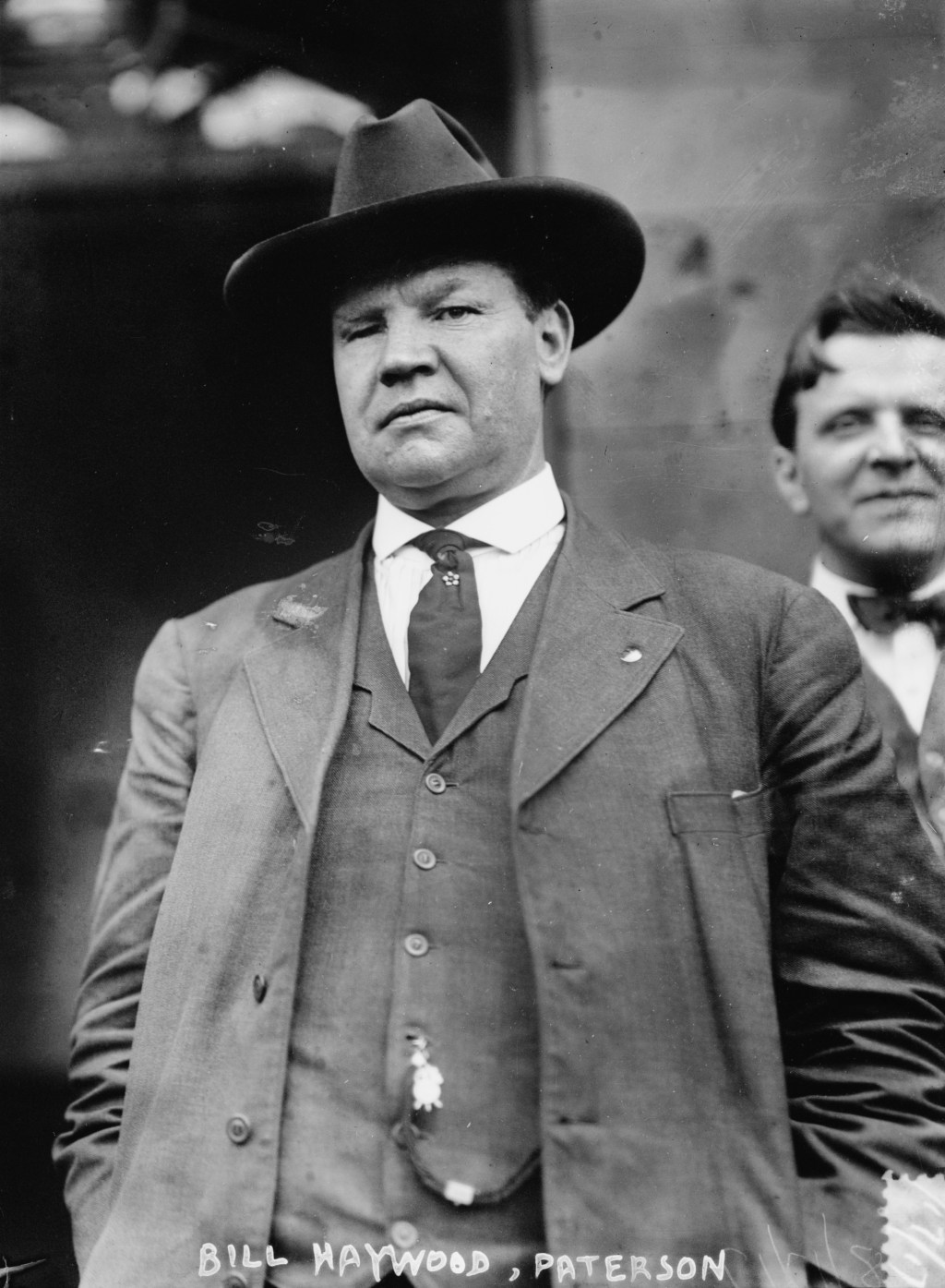
William Dudley Haywood (February 4, 1869 – May 18, 1928), famously known as “Big Bill” Haywood, stands out as one of the most influential and militant figures in American labor history. Born in Salt Lake City, Utah, Haywood emerged from a harsh frontier childhood shaped by poverty and hardship, experiences that would inform his lifelong commitment to workers’ rights and revolutionary syndicalism. A formidable speaker, organizer, and unapologetic radical, Haywood was instrumental in founding and leading the Industrial Workers of the World (IWW), profoundly shaping early 20th-century American labor activism.
Haywood’s entry into the labor movement was deeply personal. After an industrial accident in 1887 cost him an eye while mining silver in Idaho, he became acutely aware of the brutal realities faced by industrial workers. Influenced heavily by socialist ideology and class struggle, Haywood joined the Western Federation of Miners (WFM) in 1896, quickly rising to prominence due to his charisma, physical presence, and unwavering militancy. In 1905, alongside prominent radicals and socialists including Eugene V. Debs, Mother Jones, Daniel De Leon, and Lucy Parsons, Haywood helped establish the Industrial Workers of the World, an organization dedicated to the radical restructuring of society through industrial unionism, direct action, and solidarity among all workers.
Under Haywood’s leadership, the IWW (famously known as the “Wobblies”) organized miners, lumberjacks, migrant farm workers, and industrial laborers across America, embracing an explicitly anti-capitalist and anti-racist ethos. Haywood’s passionate advocacy for industrial unionism, his disdain for the craft-union conservatism of the American Federation of Labor (AFL), and his tireless fight for the rights of the poorest and most marginalized workers made him a hero among the working class—and an object of relentless persecution by government and capitalist interests alike.
Haywood’s uncompromising militancy placed him repeatedly in conflict with law enforcement. Notably, in 1907, he was tried—and acquitted—in connection with the assassination of former Idaho Governor Frank Steunenberg, a prosecution widely regarded as politically motivated. Later, Haywood was again targeted by federal authorities during World War I under the Espionage Act, alongside over one hundred other IWW leaders, convicted for alleged anti-war activities and obstruction of military recruitment. Facing a 20-year prison sentence in 1918, he was temporarily released on bail pending appeal, during which he made the fateful decision to flee the United States for revolutionary Russia in 1921.
In exile, Haywood sought refuge in Soviet Russia, drawn by the promise of the Bolshevik revolution and its stated commitment to worker power. He lived in Moscow until his death on May 18, 1928, contributing to international labor organizations and penning his memoirs. Although he died in relative obscurity far from the American workers he had inspired, Haywood’s legacy as a towering figure in labor radicalism endures, symbolizing the uncompromising struggle for justice and dignity for workers worldwide.
Bibliography
• Carlson, Peter. Roughneck: The Life and Times of Big Bill Haywood. W.W. Norton & Company, 1983.
(A comprehensive and vivid biography of Haywood, contextualizing his contributions within American labor history.)
• Dubofsky, Melvyn. We Shall Be All: A History of the Industrial Workers of the World. University of Illinois Press, 2000.
(An authoritative history detailing Haywood’s crucial role in the formation and direction of the IWW.)
• Foner, Philip S. History of the Labor Movement in the United States, Vol. 4: The Industrial Workers of the World, 1905–1917. International Publishers, 1965.
(A scholarly account focusing extensively on Haywood’s activism and leadership in labor movements.)
• Haywood, William D. Bill Haywood’s Book: The Autobiography of William D. Haywood. International Publishers, 1929; Reprint: 1983.
(Haywood’s own account, providing valuable firsthand insights into his philosophy, experiences, and struggles.)
• Kornbluh, Joyce L., ed. Rebel Voices: An IWW Anthology. Charles H. Kerr Publishing, 2011.
(A rich collection of primary documents, speeches, and writings by IWW leaders, including Haywood’s influential addresses.)
• St. John, Vincent. The IWW: Its History, Structure and Methods. IWW Publishing Bureau, 1917; Reprint: 2001.
(Contemporary account by an early IWW leader, offering context on Haywood’s strategic contributions.)
 Letters from Tomis
Leave a comment