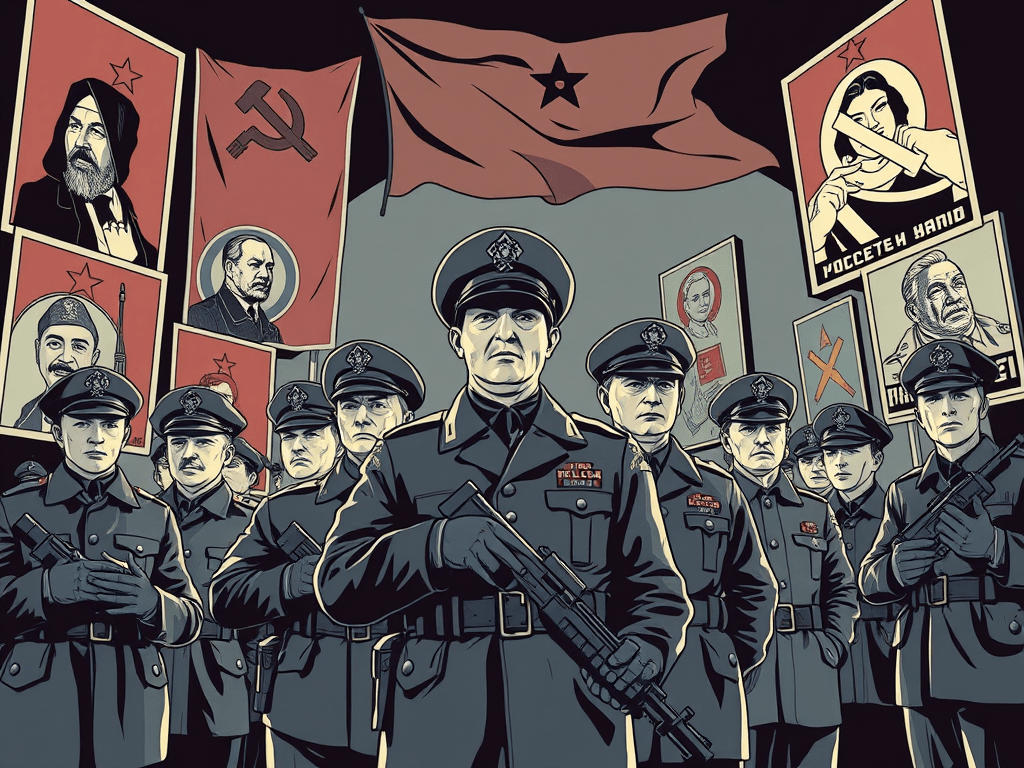
This is part 1 or 2 research essays on criminology in the Soviet Union, emphasizing ideology and socialist theory.
Introduction
Between 1920 and 1940, the Soviet Union’s law enforcement system evolved under the powerful influence of Marxist-Leninist ideology. In these formative decades of Soviet rule, policing and criminal justice were not merely tools for fighting crime; they became instruments for enforcing the revolutionary worldview of the Communist Party. The Bolshevik regime, led by Joseph Stalin, established a series of internal security organizations – from the Cheka to the GPU and later the NKVD – that were tasked with protecting the state and promoting socialist transformation. This essay examines how Marxist-Leninist ideology shaped the organization, objectives, and methods of Soviet law enforcement. It will explore key institutions like the Cheka, GPU, and NKVD, their surveillance tactics and repression strategies, and the close relationship between the police apparatus and the Communist Party. Across the 1920–1940 period, Soviet policing practices shifted in response to ideological goals such as prosecuting class struggle, exerting social control, and ensuring state security. Understanding these changes highlights the profound role of ideology in the evolution of law enforcement under the Soviet regime.
Marxist-Leninist Ideological Foundations of Law Enforcement
Marxist-Leninist ideology provided the foundation for Soviet law enforcement objectives and methods. Lenin and his fellow Bolsheviks believed that after the 1917 Revolution, the new socialist state was engaged in an ongoing class struggle against the remnants of the old order. In Marxist theory, the “dictatorship of the proletariat” justified extraordinary measures to suppress the former exploiting classes (nobility, bourgeois capitalists, and their allies) and to defend the revolution. Lenin argued that the proletarian state must use force and repression without hesitation against class enemies who would seek to overturn the socialist experiment. In practical terms, this meant that law enforcement in the Soviet Union was conceived not as an impartial bourgeois guardian of law and order for all citizens, but as a political weapon serving the interests of the working class. Justice was viewed through a partisan lens: actions were “criminal” not only if they violated formal laws, but especially if they threatened socialist society or Communist Party rule. This ideological stance gave Soviet policing a mission of social engineering – to reshape society by eliminating enemies, instilling socialist values, and ensuring absolute loyalty to the state.
Under Marxist-Leninist influence, the goals of policing went beyond crime control to include social control and state security. Soviet leaders believed that ordinary crime itself was rooted in the exploiting classes and capitalist degeneration, which would gradually disappear as socialism advanced. However, they also insisted that political opposition and counterrevolutionary activity would persist (and even intensify) as the regime built socialism. Therefore, the state needed an ever-vigilant security apparatus. Law enforcement agencies were expected to be ideologically committed “soldiers of the revolution,” carrying out the Communist Party’s directives. Concepts like bourgeois legality was dismissed as relics of the old regime. This ideological framework set the stage for the creation of powerful police institutions with broad mandates to surveil, punish, and reform society in line with communist goals.
The Cheka and Early Soviet Policing in the 1920s
In the wake of the October Revolution and ensuing Civil War, the Bolsheviks established the Cheka as the first instrument of their ideological law enforcement. The Cheka (short for “All-Russian Extraordinary Commission for Combating Counter-Revolution and Sabotage”) was created in December 1917 under Felix Dzerzhinsky. Its explicit task was to defend the revolution from “counterrevolutionary” threats and sabotage. From the outset, the Cheka embodied the Bolshevik view that strong measures were necessary to secure power. The Cheka detachments targeted those deemed “class enemies” – former nobles and capitalists. The Cheka operated and were guided by revolutionary expediency rather than purely legal procedure. This was seen by the regime as necessary to uproot the old society.
After the Civil War ended, the Bolsheviks moved to regularize their police system. In 1922, the Cheka was officially disbanded – a nod to critics within the party who feared its uncontrolled power – but it was immediately replaced by the State Political Directorate (GPU) under the NKVD of the Russian Republic, soon reorganized as the OGPU at the all-Union level. The OGPU (Unified State Political Directorate) carried forward the Cheka’s mission of political policing with somewhat more bureaucratic form. During the New Economic Policy (NEP) era of the 1920s, open operations against the population eased compared to the civil war years. The Stalinist GPU/OGPU monitored the public and quashed dissent in more systematic ways. They surveilled intellectuals, kept informants in factories and villages, and suppressed any emerging political opposition. For example, the OGPU oversaw the arrest and show trial of Socialist Revolutionaries and other non-Bolshevik politicians who were accused of anti-Soviet plots. In everyday policing, the Soviet authorities maintained a regular police force (the militsiya) to handle ordinary crimes like theft or murder, but even the treatment of ordinary criminals was influenced by class ideology – common criminals were often considered “socially harmful elements” to be reformed or removed for the good of society. Throughout the 1920s, the secret police and the legal system operated with the understanding that loyalty to the revolution was the paramount concern. If an individual’s background or beliefs marked them as anti-Soviet, they could be prosecuted regardless of formal innocence. By the end of the 1920s, with Stalin rising to power, the stage was set for a new wave of ideologically driven policing on an even larger scale.
Stalin’s 1930s: The NKVD and the Great Terror
The 1930s saw Soviet law enforcement reach new heights of organization and brutality under Joseph Stalin’s rule. Marxist-Leninist ideology – now interpreted by Stalin – demanded aggressive action to forge a socialist society and eliminate any forces of resistance. Stalin’s “revolution from above,” including rapid industrialization and forced collectivization of agriculture, relied on the coercive might of the police to implement policies and crush opposition. In 1930–1933, as the regime moved to collectivize peasant agriculture, the secret police (then the OGPU) were mobilized to wage class warfare in the countryside. Peasants labeled as “kulaks” (wealthier farmers or simply those opposed to collectivization) were declared class enemies. The security forces orchestrated mass deportations of these kulaks and their families to remote labor camps and special settlements. Resistance to grain requisitions or collective farm policies was met with arrests or even execution as “sabotage.” The OGPU’s role in this violent social engineering was an extension of ideological policing: it treated an entire social class as criminals to be eliminated for the sake of building socialism. The result was widespread terror in rural areas, contributing to catastrophic famine in 1932–33, but from Stalin’s standpoint it achieved the ideological goal of breaking the peasantry’s independence and extending state control.
In July 1934, the Soviet regime consolidated its policing apparatus by creating the NKVD (People’s Commissariat of Internal Affairs), which absorbed the OGPU and unified all internal security and police functions under one ministry. The NKVD, with Genrikh Yagoda as its initial chief, became a vast and powerful institution. It oversaw not only the secret police operations but also the regular police (militsiya), border guards, and the administration of prisons and the Gulag labor camps. This centralization reflected Stalin’s desire for a tightly controlled instrument that could enforce loyalty and order across all of Soviet society. Crucially, the NKVD was directly answerable to Stalin and the top party leadership, meaning it had carte blanche to act outside the constraints of law or local party oversight. In the mid-1930s, Stalin grew increasingly suspicious of “enemies” within the Soviet Union – including within the Communist Party itself. The assassination of Sergei Kirov, a high-ranking party leader, in December 1934 provided a pretext for Stalin to unleash the full force of the NKVD upon perceived opponents in what became known as the Great Terror or Great Purge.
Under Nikolai Yezhov, who replaced Yagoda as NKVD chief in 1936, the Great Terror reached a fever pitch. From 1936 to 1938, Soviet law enforcement engaged in mass repression on an unprecedented scale. The NKVD targeted a broad array of groups: party officials (even long-time Bolsheviks and comrades of Lenin), government administrators, military officers, professionals, and ordinary citizens – anyone suspected of harboring dissent or posing a threat (real or imagined) to Stalin’s rule. This was a period of pervasive paranoia, where mere accusations or past associations could doom a person. The ideological justification was that, as the Soviet Union advanced toward socialism, its enemies (now branded “enemies of the people”) were conspiring with capitalist powers or undertaking sabotage from within to halt progress. The NKVD methodically built case files of fabricated evidence and coerced testimonies to unmask these alleged conspiracies. One hallmark of the Great Terror was the infamous show trials held in Moscow, where prominent Bolshevik veterans – such as Zinoviev, Kamenev, Bukharin, and others – were forced to confess (after intense pressure and torture) to fantastic plots of treason, espionage, and wrecking. These highly publicized trials in 1936, 1937, and 1938 served the ideological purpose of proving that “Trotskyites,” Western agents, and hidden counterrevolutionaries had infiltrated the state and had to be eradicated. While the elite were paraded in show trials, countless lesser-known individuals were condemned in secret. The NKVD operated troikas (three-person commissions) and special boards that issued swift sentences without a normal court process – often a sentence to execution or to a labor camp – based on quotas set by Moscow for each region to find a certain number of “enemies.”
The repression statistics of the late 1930s illustrate the scale of terror: approximately one and a half million people were arrested for political reasons in 1937–38 alone, and hundreds of thousands were executed. Entire segments of society were decimated. The Red Army’s officer corps was gutted by arrests and executions of about half its leadership, reflecting Stalin’s fear of military disloyalty. Ethnic minorities like Poles, Germans, and others were specifically targeted in “national operations” of the NKVD on the suspicion that they could be fifth-column spies for foreign governments. In many cases, the victims of the Great Terror were innocent of any actual wrongdoing; their “crimes” were defined by ideological fiction. Families of those accused also suffered: spouses could be branded “wives of traitors” and sent to gulag camps, and children could be placed in state orphanages or even arrested if over a certain age. This policy of collective punishment stemmed from the belief that loyalty and disloyalty could be a family trait and that no potential source of subversion should go unchecked.
By late 1938, the frenzy began to subside. Stalin, recognizing that the purges had dangerously destabilized the state and military on the eve of impending war, dialed back the terror. Yezhov was dismissed and later executed (illustrating that even the highest enforcers were not safe from Stalin’s purges). Lavrentiy Beria took charge of the NKVD and initiated a review of some cases, releasing a number of people who had been unjustly imprisoned. Nonetheless, the basic structure of ideological policing remained intact. By 1940, the Soviet Union had been transformed into a highly policed society where any form of dissent was extraordinarily risky. The NKVD stood as a symbol of fear and obedience, having brutally fulfilled Stalin’s ideological imperatives. The 1930s thus demonstrated how completely law enforcement could be subordinated to the goals of class struggle, social control, and the security of Stalin’s regime.
Surveillance and Repression Tactics
To carry out their mission of total control, Soviet law enforcement agencies between 1920 and 1940 employed extensive surveillance and harsh repression tactics. The surveillance methods were both organizational and grassroots. From the early Cheka period onward, the secret police cultivated a vast network of informants and spies across the country. Ordinary citizens were encouraged – sometimes under pressure or out of fear – to report any “suspicious” or anti-Soviet behavior by neighbors, co-workers, even family members. This led to a culture of denunciation, especially in the 1930s when the NKVD actively sought accusations to meet arrest quotas. By relying on citizen informants, the Soviet state managed to penetrate the everyday private life of its populace; people never knew if a casual remark might be reported to the authorities. Additionally, the secret police planted undercover agents in factories, villages, universities, and social organizations to monitor conversations and attitudes. Telephone tapping and mail interception became routine – the OGPU and NKVD’s departments monitored mail for dissident content and listened to phone conversations (where the technology was available) to detect any sign of treachery. Travel and movement inside the country were strictly controlled through an internal passport system introduced in 1932: every urban resident needed official papers to live and work in a city. Those without valid documents – often peasants who fled collective farms, or “socially dangerous” persons like former aristocrats or criminals – could be expelled from cities or arrested. The passport system thus served as a surveillance and social filtering mechanism, allowing police to constantly check identities and remove “undesirables” from key areas.
When it came to quelling opposition or removing suspects, the Soviet security organs exercised brutal repression strategies. Arrests were typically conducted in a manner designed to maximize fear and minimize resistance – agents of the Cheka or NKVD would arrive late at night or before dawn to seize people from their beds, a scenario so common that it became a defining memory of Stalinist terror. Those detained were often held incommunicado; families might not know the fate of a loved one for weeks, if ever. Once in custody, prisoners were subjected to intense interrogation methods. The use of physical torture and psychological pressure was widespread, especially in high-profile political cases. Beatings, sleep deprivation, and threats against one’s family were employed to extract confessions or to compel the accused to name others as co-conspirators. Such coerced confessions were then used as “proof” of elaborate plots justifying further arrests – a self-perpetuating cycle of repression.
For those deemed guilty, punishments were draconian. The Soviet regime relied on two main punitive options: execution or the Gulag. Execution by shooting was common in periods like the Red Terror and the Great Terror; it was a quick way to eliminate enemies. The Gulag, a system of forced labor camps scattered across the Soviet Union, was another pillar of repression. The Gulag housed both common criminals and political prisoners. Law enforcement sent millions of convicted “enemies” – whether actual criminals, political dissenters, or innocent people caught in terror campaigns – to these camps. Conditions in the Gulag were harsh: prisoners endured hunger, cold, disease, and backbreaking labor in mines, forests, or construction projects. From an ideological perspective, the camps served a dual purpose: punishment and re-education. The state rhetoric held that through hard labor and exposure to socialist discipline, even class enemies might be reformed. Additionally, the labor of prisoners contributed to the Soviet economy – an example of building socialism dovetailing with policing, as large projects like canals, railways, and industrial mining were achieved partly through forced labor.
Rather than relying on standard courts and juries, the Stalinist security police often used administrative bodies to impose sentences swiftly. In the late 1920s, there were Revolutionary Tribunals for trying counterrevolutionaries, and by the 1930s the NKVD’s Special Board and various troikas handled the bulk of political cases in secret. These bodies could sentence someone to years in a labor camp or even death without a public trial or right of defense. This bypassing of normal legal safeguards was justified as necessary for dealing with extraordinary threats. It also allowed the leadership to conduct mass operations (like the 1937–38 purge operations against former kulaks or ethnic minorities) efficiently, by processing thousands of cases per week.
Through constant surveillance, a climate of denunciation, arbitrary arrests, and ruthless punishment, Stalin’s Soviet law enforcement instilled widespread fear. This fear was itself a deliberate tactic: it was meant to discourage anyone from even contemplating dissent. Most citizens adapted by practicing self-censorship and outward conformity to communist norms. In summary, surveillance and repression techniques in the USSR were deeply intertwined with ideological aims – they were designed to detect and obliterate any challenge to the Communist Party’s vision of order, thereby molding a society in which the government’s authority went virtually unchallenged.
The Police and the Communist Party
The relationship between the Soviet law enforcement organs and the Communist Party was one of intimate dependence. Unlike in liberal democracies where police are (in theory) politically neutral enforcers of law, in the Soviet Union the police – especially the secret police – were explicitly political instruments of the Party. From the earliest days of the Cheka, Lenin and the Bolshevik leadership directed security forces to act in line with party objectives. Dzerzhinsky, the Cheka’s founder, was himself a dedicated Bolshevik revolutionary, and he famously described the ideal Cheka officer as a loyal, ideologically pure warrior for the revolution. Being a “Chekist” became a proud identity, synonymous with being a devoted communist carrying out the Party’s will. The secret police reported to the top Party or government bodies (for example, the Cheka answered to the Council of People’s Commissars chaired by Lenin, and later the NKVD answered directly to Stalin and the Politburo). Therefore, the chain of command ensured that policing campaigns were politically authorized at the highest levels. Law enforcement did not initiate policy.
At the same time, the Communist Party used the police to enforce discipline within its own ranks. The secret police kept watch not only on the public but also on Party members for any sign of factionalism or disloyal thoughts. Intra-party rivalries during the 1920s (such as those involving Trotsky, Zinoviev, Bukharin and others in opposition to Stalin) often ended with the OGPU or later NKVD intervening – surveilling the opposition, collecting compromising information, and eventually arresting and eliminating these dissenting Party voices. This demonstrates how deeply the organs of state security were woven into the fabric of Party politics. Under Stalin, this dynamic intensified dramatically: the NKVD effectively became an instrument for Stalin to purge the Communist Party itself of anyone he mistrusted. The Great Purge was as much an internal Party cleansing as it was a broader societal terror. Central Committee members, regional Party secretaries, and even members of Stalin’s inner circle were not immune if they fell out of favor. The police would often work in tandem with Party processes – for example, a Party member accused of disloyalty might first be expelled from the Party (a political decision) and immediately handed over to the NKVD for arrest and punishment. In this way, formal party expulsions and police repression were two halves of a coordinated strategy to maintain Communist orthodoxy.
To maintain loyalty, the Communist Party ensured that key positions in the security apparatus were filled by trusted Party members. Virtually all high-ranking NKVD officers were Party members, and many had military or revolutionary credentials. They were expected to be well-versed in Marxist-Leninist ideology and to attend political education sessions like any other communist cadre. The Party also kept leverage over the police by periodically purging the security organs themselves. Stalin demonstrated this by removing successive NKVD chiefs: he had Genrikh Yagoda arrested and executed in 1938, and later did the same to Nikolai Yezhov in 1940, replacing them with the more reliable (and ultimately long-lived) Lavrenty Beria. These removals sent a clear message that the secret police, for all its power, was not above the Party’s authority. The police leadership’s fate depended on unwavering servility to Stalin’s line – a check against the police developing an independent agenda.
The Communist Party thus had a dual relationship with the police: it was the ultimate master of the security forces, setting their agenda; but it was also to some extent a subject of their scrutiny, since the police were used to enforce Party discipline. This created a climate where rank-and-file Party members often feared the secret police just as ordinary citizens did. Loyalty oaths, strict Party secrecy, and ritual public displays of support for Stalin were all partly driven by the knowledge that the NKVD was watching. In summary, Soviet law enforcement and the Party were fused together by ideology and power. The Party gave the police legitimacy and direction (“protect socialism, fight class enemies”), and the police gave the Party the muscle to carry out policies and silence opposition. This symbiosis ensured that policing was never just policing – it was a form of political governance. The result was a highly centralized authoritarian system in which the boundaries between Party will and law enforcement action were effectively erased in the pursuit of the Communist vision.
Continuity and Change in 1920–1940
The period from 1920 to 1940 was marked by both continuity and change in Soviet law enforcement practices as the state’s ideological priorities evolved. One continuous thread was the conception of the police as guardians of the revolution and executors of class-based repression. Throughout the entire era, Soviet security forces saw themselves as engaged in a war against class enemies and ideological foes. However, the manifestation of this mission changed significantly from the post-revolutionary 1920s to the Stalinist late 1930s.
In the early 1920s, law enforcement was overtly militant and improvisational. The Cheka acted as a revolutionary blunt instrument: relatively small in numbers but terrifying in reputation, it applied swift justice during an emergency period of civil strife. Once immediate threats subsided, the state pulled back on mass violence (during the NEP). The GPU/OGPU in the 1920s had to operate with a bit more subtlety, focusing on surveillance and targeted suppression. There was even talk among Bolshevik leaders of adhering to “socialist legality” – implying that the system should stabilize and rely more on predictable rules. Yet as Stalin’s policies took shape, these constraints fell away. By the 1930s, any earlier inclination towards legal moderation was abandoned. The NKVD became a massive bureaucracy of repression, far larger and more systematized than the Cheka ever was. It incorporated regular policing and used modern administrative techniques (files, archives, trained cadres) to impose control. This bureaucratization meant that repression was not only reactive but also preemptive and planned – exemplified by quotas for arrests and centrally coordinated purge operations.
The targets of enforcement also shifted with ideological emphasis. In the 1920s, enemies were defined largely in terms of former regimes and classes: White Army collaborators, tsarist officers, aristocrats, bourgeois businessmen, clerics, and non-Bolshevik political parties. By the late 1930s, after these groups had been largely marginalized, the definition of “enemy” broadened to include elements within the Soviet order: “saboteurs” in factories, “spies” in Soviet institutions, dissident communists or nationalists, and even the skeptical or unlucky citizen who could be labeled an “enemy of the people.” The concept of class struggle was adapted to new circumstances. Stalin propagated the idea that as the USSR got closer to true socialism, the class struggle did not fade but rather intensified – meaning new conspiracies and hidden enemies constantly arose. This counter-theoretical twist gave ideological cover for the ever-expanding purges of the 1930s, whereas Lenin’s generation had initially seen terror as a temporary expedient.
Another change was in the scale and intensity of repression during the Great Terror of 1936 – 1939. Entire institutions (the military, the Party, academia) were purged of suspected “undesirables.” The fear of arrest became a daily reality for people of all stations by the late 1930s, something that had somewhat receded in the more relaxed mid-1920s. Thus, what had been episodic waves of terror in Lenin’s time turned into a near-permanent climate of fear under Stalin.
Despite these shifts, the essential ideological rationale for Soviet law enforcement remained stable: the police were an arm of the revolution, and their ultimate loyalty was to the vision of a socialist state free of exploitation or subversion. Whether it was 1920 or 1940, a Cheka or NKVD officer would justify his actions with the language of defending the proletariat, safeguarding the Party, and securing the future communist society. Bourgeois legal norms and individual rights were always subordinate to these overarching socialist goals. In that sense, continuity prevailed in the ethos of Soviet policing.
By 1940, on the eve of World War II, the Soviet law enforcement system had matured into a formidable mechanism of state security and social control. It had weathered internal transformations – from Cheka to NKVD – and had flexibly expanded its list of enemies to align with the Party’s shifting focus. The changes across the period illustrate a regime learning to perfect its control over the population: initially improvising, later standardizing repression as a grim routine of governance. What remained unaltered was the profound imprint of ideology: Marxist-Leninist doctrine was both the justification for and the driving force behind the Soviet Union’s policing and justice system in these decades.
Conclusion
Between 1920 and 1940, the Soviet Union’s approach to law enforcement was fundamentally shaped by Marxist-Leninist ideology and the political imperatives of the Communist Party. What began as an ad-hoc revolutionary terror force in the Cheka evolved into the sprawling NKVD, but at every step the mission was defined in ideological terms – to defend the proletarian dictatorship, eliminate class enemies, and mold society towards socialism. The organization, objectives, and methods of policing in the USSR cannot be separated from this ideological context. Key security institutions like the Cheka, GPU/OGPU, and NKVD were not mere police agencies in a neutral sense; they were instruments of revolution and regime survival. They engaged in extensive surveillance and cultivated informant networks to sniff out dissent, reflecting the regime’s obsession with total awareness of society. They employed ruthless repression – from mass executions and torture to the vast penal labor camps of the Gulag – as tools to enforce the Communist Party’s will and to terrorize the populace into compliance. The intimate partnership between the police and the Party meant that law enforcement acted as an extension of Party politics, whether suppressing external foes or cleansing the Party itself of heretics.
Over the course of these two decades, Soviet law enforcement practices shifted from the fiery brutality of the civil war era to the colossal bureaucratized terror of the Stalin years, always under the banner of Marxist-Leninist principles. The ideological goals of class struggle, social control, and state security were not abstract ideals; they were operationalized by the police in everyday life – deciding who would be watched, who would be imprisoned, and who would be eliminated in the name of building a new society. By 1940, the Soviet Union had established one of history’s most coercive and ideologically driven policing systems. This system not only protected the Stalinist state from real and imagined threats, but also fundamentally shaped Soviet society – inculcating fear, obedience, and the understanding that the Communist Party’s ideology reigned supreme over law. The legacy of the 1920–1940 period would endure, as the patterns of ideological policing and repression continued to characterize Stalinized Soviet governance in the decades that followed.
 Letters from Tomis
Leave a comment