King, Ross. The Judgment of Paris: The Revolutionary Decade That Gave the World Impressionism. Walker & Company, 2006.
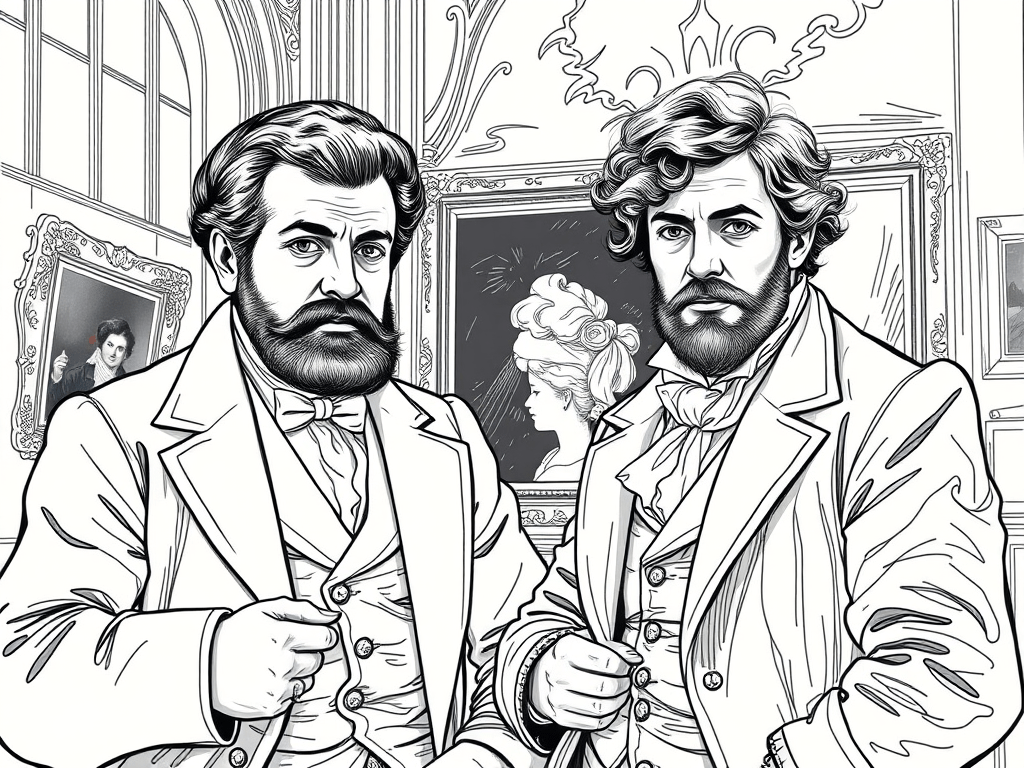
Ross King’s The Judgment of Paris: The Revolutionary Decade That Gave the World Impressionism (2006) offers a richly textured cultural history of the transformation of nineteenth-century French painting, situating the emergence of Impressionism within a broader matrix of political upheaval, institutional authority, and aesthetic contestation. Framed around the rivalry—both real and symbolic—between Jean-Louis-Ernest Meissonier and Édouard Manet, King’s narrative reconstructs the contested terrain of artistic legitimacy in Second Empire and early Third Republic France. The result is a work that operates at the intersection of art history, intellectual history, and narrative nonfiction, combining archival synthesis with novelistic storytelling.
At its core, King’s study is concerned with the institutional dominance of the Paris Salon and the ideological apparatus that sustained it. The Salon functioned not merely as an exhibition space but as a mechanism of cultural gatekeeping, determining artistic success and shaping public taste on a mass scale. As King demonstrates, acceptance into the Salon could define an artist’s career, while rejection often entailed financial and reputational ruin . In this sense, the Salon can be read through a Bourdieusian lens as a site of symbolic capital accumulation, where aesthetic value is inseparable from institutional validation. King’s depiction of the 1863 Salon des Refusés—authorized by Napoleon III in response to widespread protest—marks a rupture in this system, exposing the instability of academic authority and inaugurating a new public sphere of artistic debate.
King’s central interpretive device—the juxtaposition of Meissonier and Manet—functions as a dialectical framework through which competing artistic paradigms are explored. Meissonier, the consummate academic painter, embodies precision, historical nostalgia, and alignment with state-sanctioned taste. His meticulous technique and commercial success positioned him as “the world’s wealthiest and most celebrated painter” of his time . Yet, as King underscores, this very alignment with institutional orthodoxy renders Meissonier historically obsolete, his reputation collapsing in the wake of shifting aesthetic values. Manet, by contrast, represents rupture: his loose brushwork, modern subjects, and refusal of narrative clarity challenged the epistemological foundations of academic art. Initially derided and marginalized, Manet emerges in King’s account as the harbinger of a new visual regime, one oriented toward modernity, contingency, and perception rather than historical idealization.
One of the book’s principal strengths lies in its integration of artistic developments with contemporaneous political events. King situates the rise of Impressionism alongside the Franco-Prussian War, the fall of Napoleon III, and the Paris Commune, thereby emphasizing the extent to which aesthetic transformation is embedded within socio-political crisis . This contextualization aligns with Marxist art historical approaches that view cultural production as conditioned by material and ideological structures. The destruction of artworks during wartime and the politicization of artistic institutions underscore the vulnerability of culture to historical forces, while also revealing the role of art as a site of ideological struggle.
Stylistically, King adopts a narrative mode that privileges accessibility without sacrificing scholarly rigor. His prose is vivid and character-driven, often reconstructing scenes with a degree of dramatic flair more typical of historical fiction. While this approach broadens the book’s appeal, it occasionally risks oversimplification, particularly in its tendency to cast the Meissonier-Manet opposition in binary terms. The complexity of nineteenth-century artistic networks—encompassing figures such as Courbet, Degas, and Monet—is sometimes subordinated to the central dualism, which may obscure the heterogeneity of early modernist practice.
Moreover, King’s implicit teleology—his framing of Impressionism as the inevitable triumph of modernity—invites critical scrutiny. By privileging the eventual success of the avant-garde, the narrative risks reproducing a Whiggish account of art history, in which innovation is retrospectively validated and academic traditions are dismissed as reactionary. A more nuanced analysis might interrogate the persistence of academic forms and the ways in which “modern” and “traditional” aesthetics coexisted and interacted.
Nevertheless, The Judgment of Paris remains a compelling and intellectually substantive contribution to popular art history. Its synthesis of biography, institutional analysis, and historical context provides a valuable entry point into the cultural dynamics of nineteenth-century France. For scholars, the work’s greatest utility lies not in its originality of argument but in its capacity to animate the lived experience of artistic transformation, rendering visible the contingencies, conflicts, and uncertainties that underlie canonical narratives of modernism.


Leave a Reply