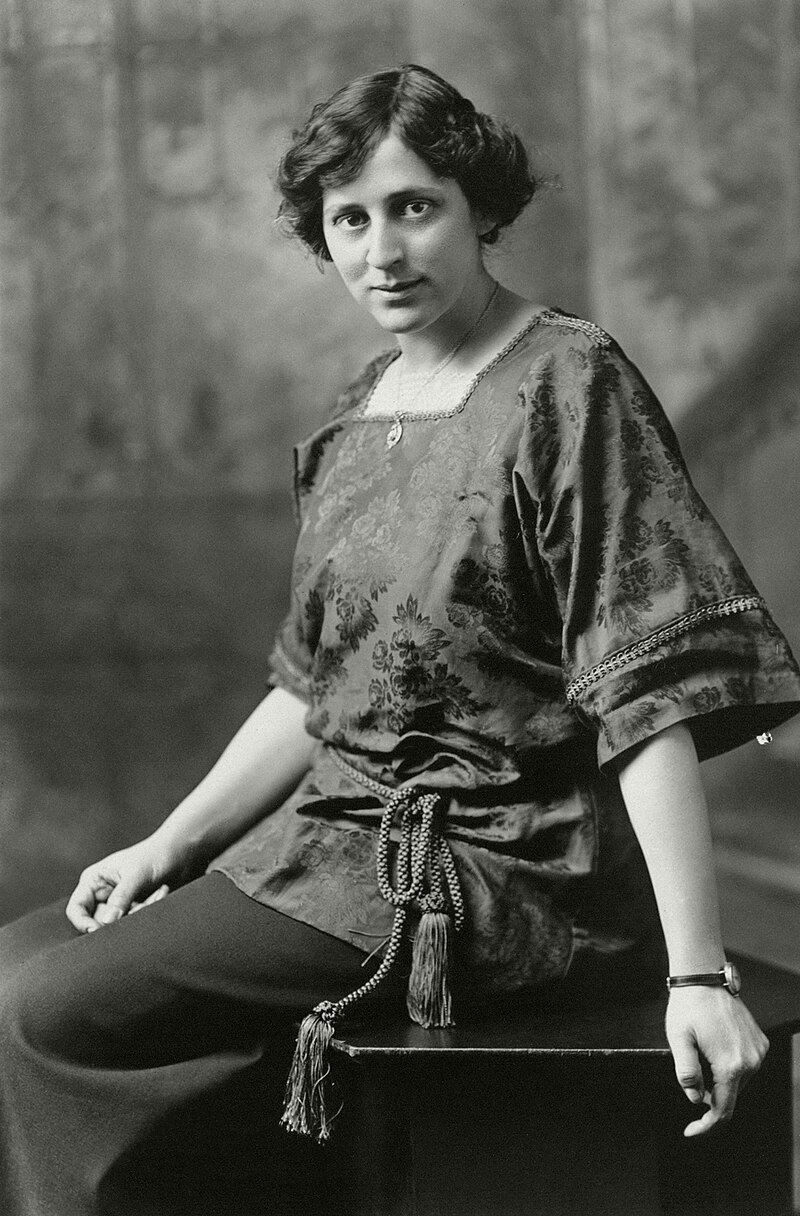
My Socialist Hall of Fame
During this chaotic era of vile rhetoric and manipulative tactics from our so-called bourgeois leaders, I am invigorated by the opportunity to reflect on Socialists, Revolutionaries, Philosophers, Guerrilla Leaders, Partisans, and Critical Theory titans, champions, and martyrs who paved the way for us—my own audacious “Socialism’s Hall of Fame.” These are my heroes and fore-bearers. Not all are perfect, or even fully admirable, but all contributed in some way to our future–either as icons to emulate, or as warnings to avoid in the future.
Introduction
Crystal Catherine Eastman (1881–1928) was one of the most formidable yet underappreciated radical intellectuals of the early twentieth century. A lawyer, journalist, feminist, pacifist, labor reformer, and co-founder of the American Civil Liberties Union (ACLU), Eastman’s political vision spanned a unique intersection of socialism and feminism. Her work anticipated much of what would later be called intersectional analysis, linking capitalism, patriarchy, imperialism, and the state in a unified theory of structural oppression. This biography explores her life and contributions through the lens of her engagement with socialist feminism, radical legal theory, and anti-militarism.
Early Life and Education
Crystal Eastman was born on June 25, 1881, in Marlborough, Massachusetts, to Rev. Samuel Elijah Eastman and Annis Ford Eastman—both progressive Congregationalist ministers. Her upbringing in a household steeped in moral reform and egalitarianism shaped her lifelong commitment to justice. She graduated from Vassar College in 1903 and earned a Master’s in sociology from Columbia University in 1904, studying under Franklin H. Giddings. She received her law degree from New York University Law School in 1907, graduating second in her class.
Her legal training, coupled with a sociological imagination, gave Eastman a distinct voice among early progressive reformers. Unlike many of her contemporaries, she approached legal reform not as an elite philanthropic exercise but as a tool for working-class emancipation, especially for women.
Legal Reform and Labor Advocacy
Eastman’s first major achievement was her work on the Pittsburgh Survey (1907–1909), a foundational sociological study of industrial conditions. Her report, Work Accidents and the Law (1910), became a seminal text in the movement for workers’ compensation. Eastman argued that industrial accidents were not mere individual tragedies but the predictable byproducts of a system that prioritized profit over human life.
Her analysis reflected a materialist understanding of law—one that emphasized the structural determinants of injury and injustice. Her advocacy was instrumental in passing New York’s first workers’ compensation law in 1910. This work revealed her commitment to what would later be recognized as socialist legal theory: a belief that laws under capitalism function to preserve property and labor discipline rather than justice.
Feminism and Socialist Politics
A suffragist and feminist, Eastman was a vocal member of the National Woman’s Party and a key author of the original Equal Rights Amendment in 1923. Yet Eastman’s feminism went beyond legal equality. She was among the first thinkers to argue that women’s oppression was rooted not only in political exclusion but also in economic dependence and the gendered division of labor.
In her widely circulated 1920 article, Now We Can Begin, Eastman stated:
“What we are fighting for is freedom… not just the vote, but freedom from economic dependence, freedom from compulsory motherhood, and freedom from war.”
This vision aligned Eastman with the socialist feminist current, distinct from both bourgeois liberal feminism and masculinist socialism. She called for communal childcare, equal wages, and reproductive autonomy—positions that would not gain mainstream traction until the women’s liberation movement of the 1970s.
Eastman also ran in socialist circles, albeit critically. She supported Eugene V. Debs and maintained close relationships with radicals such as Max Eastman (her brother), John Reed, and Emma Goldman. However, she criticized the Socialist Party’s failure to take women’s demands seriously, foreshadowing later debates within Marxist-feminist theory.
Anti-Militarism and Civil Liberties
Eastman was one of the most prominent anti-war activists during World War I. She co-founded the Woman’s Peace Party in 1915 and later helped launch the People’s Council for Democracy and Peace, which sought to organize mass opposition to U.S. intervention.
Her pacifism was rooted in a Marxist analysis of imperialism. Influenced by thinkers such as Rosa Luxemburg, Eastman believed war was a consequence of capitalist competition and a tool for repressing domestic dissent. Her anti-war work made her a target of government surveillance and censorship under the Espionage Act.
In response, Eastman co-founded the National Civil Liberties Bureau in 1917 alongside Roger Baldwin and Albert DeSilver. This organization became the American Civil Liberties Union (ACLU) in 1920. Eastman was the only woman among the founders and played a pivotal role in shaping its early strategy. The ACLU’s original mission—to defend the rights of war dissenters, labor organizers, and radicals—reflected her vision of civil liberties as a form of class struggle, not just abstract legal protections.
Journalism and Later Life
Throughout her career, Eastman was a prolific writer and editor. She co-edited The Liberator (1918–1922) with Max Eastman, a socialist magazine that featured political essays, poetry, and art. Her writing was marked by clarity, wit, and a refusal to compromise with bourgeois norms.
After World War I, Eastman moved to England, married British editor Walter Fuller, and had two children. While she continued to write and agitate for feminist causes, poor health and financial strain took their toll. She died of a brain hemorrhage in 1928 at the age of 47.
Legacy and Relevance
Crystal Eastman’s life remains a testament to the possibility of revolutionary synthesis. She bridged the gap between theory and practice, between feminism and socialism, between law and liberation. Her prescient critiques of wage labor, militarism, patriarchy, and legal formalism laid the groundwork for later movements.
In the era of intersectional feminism and revived interest in socialist politics, Eastman’s work speaks with renewed urgency. She envisioned a world beyond gender roles, national borders, and class hierarchies—a vision that continues to inspire scholars, organizers, and revolutionaries alike.
Selected Bibliography
Primary Sources:
• Eastman, Crystal. Work Accidents and the Law. New York: Charities Publication Committee, 1910.
• Eastman, Crystal. “Now We Can Begin.” The Liberator, December 1920.
• Eastman, Crystal. “Women and Revolution.” The Liberator, March 1919.
• Eastman, Crystal. The Equal Rights Amendment (pamphlets and speeches, 1920–1925).
Secondary Sources:
• Baker, Paula. The Moral Frameworks of Public Life: Gender, Politics, and the State in Rural New York, 1870–1930. New York: Oxford University Press, 1991.
• DuBois, Ellen Carol. Feminism and Suffrage: The Emergence of an Independent Women’s Movement in America, 1848–1869. Ithaca: Cornell University Press, 1978.
• Garrison, Dee. An American Radical: A Political Biography of Crystal Eastman. Philadelphia: Temple University Press, 1995.
• Gordon, Linda. Woman’s Body, Woman’s Right: A Social History of Birth Control in America. New York: Viking, 1976.
• Kornbluh, Joyce. Rebel Voices: An IWW Anthology. Chicago: Charles H. Kerr, 1988.
• Lutz, Alma. Created Equal: A Biography of Elizabeth Cady Stanton, 1815–1902. New York: The Macmillan Company, 1940.
• Stansell, Christine. American Moderns: Bohemian New York and the Creation of a New Century. New York: Metropolitan Books, 2000.
 Letters from Tomis
Leave a comment