My Socialist Hall of Fame
During this chaotic era of vile rhetoric and manipulative tactics from our so-called bourgeois leaders, I am invigorated by the opportunity to reflect on Socialists, Revolutionaries, Philosophers, Guerrilla Leaders, Partisans, and Critical Theory titans, champions, and martyrs who paved the way for us—my own audacious “Socialism’s Hall of Fame.” These are my heroes and fore-bearers. Not all are perfect, or even fully admirable, but all contributed in some way to our future–either as icons to emulate, or as warnings to avoid in the future.
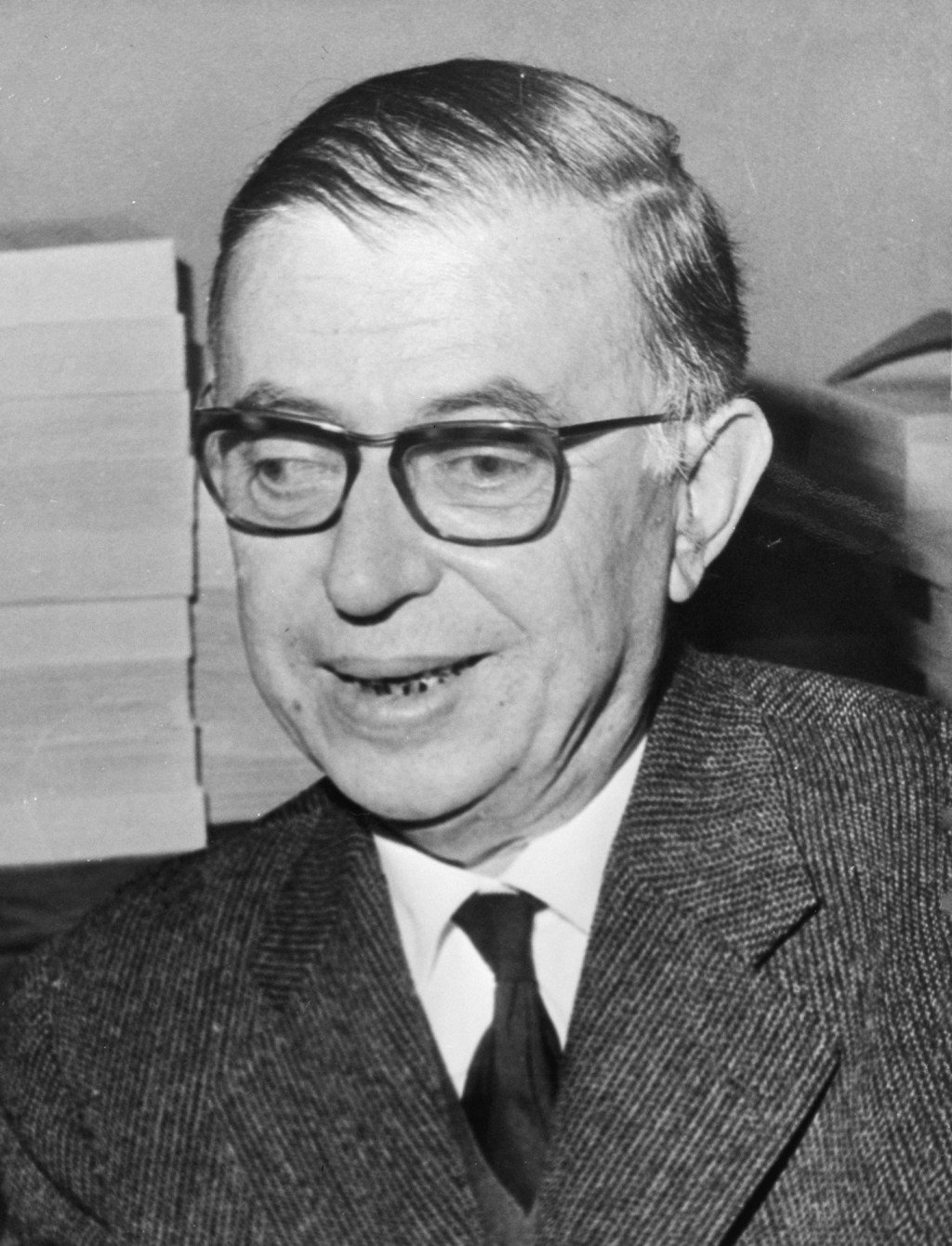
Jean-Paul Sartre (1905–1980) was a French philosopher, playwright, novelist, political activist, and literary critic, widely considered one of the most significant figures in 20th-century existential philosophy. Sartre’s extensive body of work explored the nature of human freedom, consciousness, responsibility, and the condition of existence in an absurd and indifferent universe. His intellectual pursuits profoundly influenced various fields, including philosophy, literature, politics, and psychology.
Born in Paris, France, Sartre studied philosophy at the École Normale Supérieure, where he was introduced to the phenomenological ideas of Edmund Husserl and Martin Heidegger. This grounding shaped his existentialist perspective, leading him to emphasize individual freedom and the responsibility inherent in human actions.
Sartre gained fame with his seminal philosophical work “Being and Nothingness” (1943), which laid the foundation for existentialist thought, articulating the idea that “existence precedes essence.” Sartre argued that individuals first exist and then create their essence through actions and choices, thus bearing full responsibility for their decisions.
Apart from his philosophical writings, Sartre achieved critical acclaim as a novelist and playwright. His notable literary works include the novel “Nausea” (1938) and the play “No Exit” (1944), which vividly express existentialist themes and have significantly shaped contemporary literature.
A committed Marxist, Sartre engaged actively in political discourse throughout his life. He was notably involved in leftist politics, supporting anti-colonial struggles, most famously through his vocal opposition to the Algerian War of Independence. His influential journal, “Les Temps Modernes,” served as a prominent platform for political and philosophical debate in post-war France.
In 1964, Sartre was awarded the Nobel Prize in Literature but famously declined it, citing his principle against accepting honors that could limit his intellectual independence.
Jean-Paul Sartre passed away on April 15, 1980, in Paris. His legacy endures in contemporary philosophy, literature, and critical theory, making him an enduring figure in intellectual history.
Selected Bibliography:
Philosophical Works:
• Sartre, Jean-Paul. Being and Nothingness: An Essay on Phenomenological Ontology. Translated by Hazel E. Barnes, Routledge, 2003.
• Sartre, Jean-Paul. Existentialism Is a Humanism. Translated by Carol Macomber, Yale University Press, 2007.
• Sartre, Jean-Paul. Critique of Dialectical Reason. Translated by Alan Sheridan-Smith, Verso Books, 2004.
Literary Works:
• Sartre, Jean-Paul. Nausea. Translated by Robert Baldick, Penguin Books, 2000.
• Sartre, Jean-Paul. No Exit and Three Other Plays. Translated by Stuart Gilbert, Vintage Books, 1989.
• Sartre, Jean-Paul. The Age of Reason. Translated by Eric Sutton, Penguin Books, 2001.
Biographical and Critical Works:
• Cohen-Solal, Annie. Jean-Paul Sartre: A Life. Translated by Anna Cancogni, The New Press, 2005.
• Flynn, Thomas R. Sartre: A Philosophical Biography. Cambridge University Press, 2014.
• Aronson, Ronald. Jean-Paul Sartre – Philosophy in the World. Verso Books, 1987.
 Letters from Tomis
Leave a comment