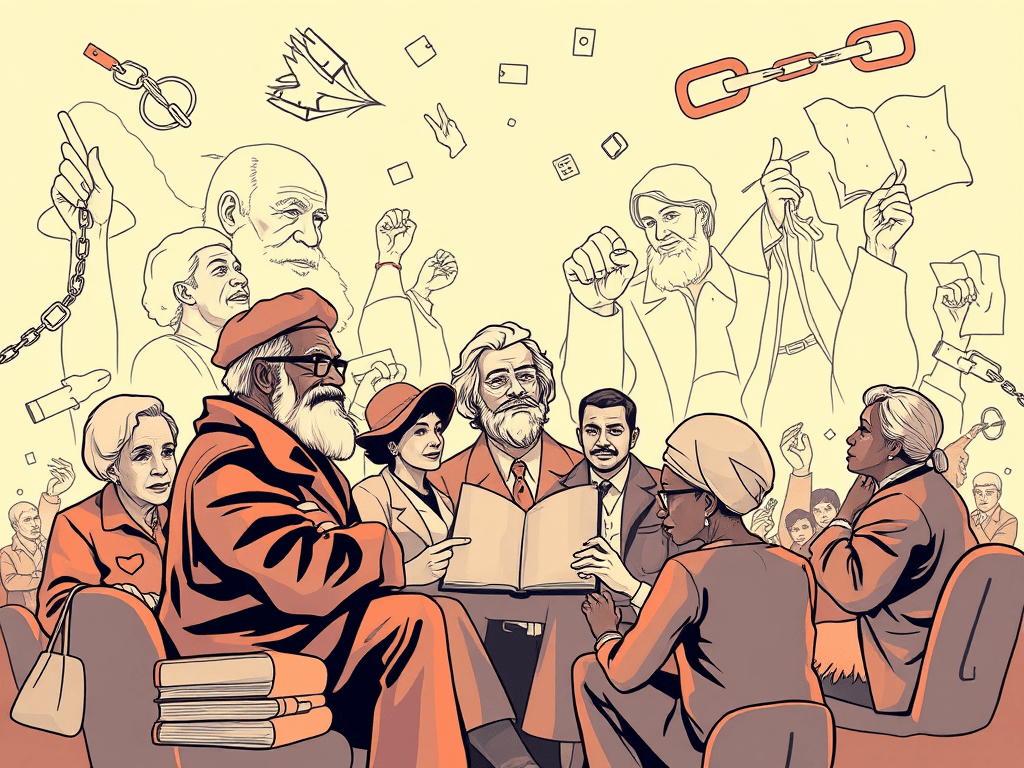
Marxist humanism draws on the early Marx, especially his 1844 “Economic and Philosophical Manuscripts,” which emphasize human nature, alienation, and emancipation. This tradition interprets Marx as a thinker of human freedom, rather than a deterministic economic scientist. In the 1960s many Western and Eastern European intellectuals rediscovered the young Marx. As Ian Angus notes, “the dominant philosophy of the Sixties was Marxist humanism or existential Marxism” – blending Marx with Hegelian and existentialist themes. Georg Lukács’s work on class consciousness and alienation (though written earlier) was widely cited, and thinkers like Erich Fromm, Herbert Marcuse and Raya Dunayevskaya explicitly grounded socialism in human liberation. Dunayevskaya, for example, insisted that Marx’s early writings give socialism its humanist content, a theory of liberation missed by pure economism.
By contrast, orthodox Marxism in the USSR and Maoist circles stressed structural and scientific Marxism. Marxist humanists arose partly in dissent from Stalinist dogma, seeking a “creative” Marxism attentive to individual and ethical dimensions. Early precursors include Karl Korsch and Lucien Goldmann (mid-20th c.), but the defining roots lie in mid-century debates. For instance, Paulo Freire’s pedagogical method explicitly wove Marx’s ideas on praxis and alienation into education: as scholars note, “the Marxist-humanist element is all pervasive in Freire’s work,” drawing on Marx’s early writings to analyze oppression. In short, Marxist humanism starts from the idea that “humanism is socialism and socialism is humanism,” stressing that society should meet human needs and dignity.
Western Europe (1970s–2000s)
In Western Europe, Marxist humanism featured strongly in the New Left and the intellectual currents around 1968. French existentialists (e.g. Jean-Paul Sartre) had earlier championed a Marxism open to human freedom. In the 1970s, student and worker movements drew on Marxist-humanist critiques of bureaucracy and alienation. Thinkers like André Gorz (Austria/France) argued that Marxism must focus on human needs beyond traditional class struggle. In Britain, the New Left (e.g. E. P. Thompson, Raymond Williams) emphasized “history from below” and human agency, critiquing determinist Marxism. They resisted Althusserian structuralism, instead highlighting workers’ experiences and moral values (Thompson called for a “humanist critique of Soviet communism”).
During the 1970s and 80s Italian Marxists like Antonio Negri (Autonomia) emphasized workers’ self-activity and the refusal of work – a kind of workerist humanism. Publications such as Telos and New Left Review circulated debates between humanist and anti-humanist positions. By the 1980s, thinkers such as Jürgen Habermas moved toward a “post-metaphysical” Marxism focused on communicative rationality and democratic ideals, blending critical theory with a legacy of humanist concern for emancipation. Environmental and anti-nuclear movements also attracted Marxist humanists; for example, Nick Stevenson (2021) argues that Herbert Marcuse’s thought links Marxism to ecological politics by reviving utopian and communal ideas of the commons. In sum, Western European Marxist-humanists typically combined a critique of capitalist exploitation with calls for a more humane society, against both capitalist and bureaucratic alternatives.
Eastern Europe (1970s–1990s)
In the Soviet bloc, Marxist humanism took on a revisionist or dissenting form. After Stalin’s death, intellectuals in countries like Poland, Czechoslovakia and Yugoslavia sought a “human face” for socialism. In Poland the so-called Budapest School (Mihály Heller, Ágnes Heller, György Márkus) re-examined Marx through existential and phenomenological lenses. Czech thinkers such as Ivan Sviták and later dissidents like Václav Havel (originally a Marxist humanist critic) also promoted a Marxism conscious of freedom and culture.
Most prominently, Yugoslavia’s Praxis School explicitly called itself Marxist humanist. Led by Mihajlo Marković, Gajo Petrović and others, the Praxis group met (1963–1974) in the “Korčula Summer School” to revive the early Marx and Hegelian Marxism. They argued for a self-managing, non-authoritarian socialism. Indeed, the Praxis journal described Marxism as fundamentally about praxis and human creativity. As historians note, the Praxis School “was a Marxist humanist philosophical movement” active in the 1960s–70s. The 1968 Prague Spring briefly appeared to realize such ideas in Czechoslovakia, but its suppression curtailed this trend.
Through the 1980s and under state socialism, Marxist humanism mostly existed underground or in samizdat journals (e.g. Kultura in Yugoslavia). By 1989–1991 the old regimes collapsed; many former Marxist humanists (e.g. Havel) turned toward liberal democracy, though they continued to invoke ideals of human dignity. The Eastern European experience showed that Marxist humanism could not easily reform existing communist states, but it laid the groundwork for post-1989 critiques of bureaucracy and market capitalism alike.
Latin America and the Global South
In Latin America, Marxist ideas mixed with anti-colonial and popular struggles. The Cuban Revolution (1959) championed culture and education as emancipatory; Fidel Castro famously declared that a lasting revolution must change human “conscience, paradigms, and values” through education and culture. Liberation theology in the 1970s fused Catholic teaching with Marxist social analysis, emphasizing the dignity and agency of the poor. In Brazil and elsewhere, pedagogues like Paulo Freire applied Marxist-humanist pedagogy: Freire’s Pedagogy of the Oppressed (1968) treats education itself as a dialogic, liberatory praxis rooted in Marxian notions of consciousness.
Intellectual debates in Latin America often mirrored Europe’s: by the 1960s–70s “various streams of Marxist thought competed for hegemony,” including humanist versus structuralist approaches. Jan Hoff observes that in this period “pro or contra Althusser” was a central question in Latin American circles. Notably, Argentine philosopher Enrique Dussel (from the 1980s on) produced a massive commentary on Marx that read him in a Third-World light. Social movements (Sandinistas in Nicaragua, guerrilla movements, union and peasant struggles) typically adopted a liberationist Marxism that valorized human agency. In 1994 the Zapatista uprising in Mexico, for example, combined Marxist critiques of neoliberalism with indigenous rights and social justice themes. Overall, Latin American Marxist-humanists insisted that anti-imperialism and economic justice must be grounded in cultural and human emancipation.
Elsewhere in the Global South, Marxist-inspired movements often adapted humanist themes. Anti-colonial leaders such as Kwame Nkrumah in Ghana and Julius Nyerere in Tanzania espoused forms of “African socialism” that emphasized communal human values (e.g. Nkrumah’s Consciencism or Nyerere’s Ujamaa), albeit within one-party states. Thinkers like Frantz Fanon (Algeria), though not strictly Marxist, deeply influenced Marxist humanists by addressing the psychology of colonialism and the need for a “New Man.” Recent scholarship even highlights a “decolonial humanism” in Fanon, noting his ethical concern with human dignity alongside his anti-colonial critique. In Asia, Marxist parties and intellectuals (in India, Indonesia, etc.) debated incorporating local traditions and caste issues into Marxist theory. Overall, Marxist humanism in the Global South stressed that class liberation must go hand in hand with cultural and post-colonial emancipation.
Humanist vs. Anti-Humanist Debates
Since the 1960s there has been an intense debate over how Marx should be interpreted. Louis Althusser’s anti-humanist thesis famously argued that Marx’s “early work” (with its notions of alienation) was ideological, while his “mature” works (Capital) constituted a scientific theory free of humanist ideology. Althusser treated “humanism” as a relic of Feuerbachian ideology. Marxist humanists rejected this break. As Doru Lung explains, humanist critics (Lukács, Dunayevskaya, Fromm, Marcuse) insisted that Marx’s early writings actually give socialism its humanist content, offering a consistent theory of liberation that structuralist readings miss. In their view, Marx’s concern for human emancipation runs through all his work, even if expressed in changing ways.
This debate persists in new form: some post-structuralists (Foucault, Derrida) dismiss classical humanism altogether, while others (e.g. Immanuel Wallerstein, Nicos Poulantzas) have tried to reconcile structuralist Marxism with normative concerns. Contemporary analytic Marxists like G. A. Cohen explicitly defend the moral core of Marx’s project. The key questions remain: To what extent is Marxism inherently about human subjectivity and values, versus objective “laws” of capitalism? Lung’s analysis captures this struggle: the very existence of separate “humanist” and “anti-humanist” discourses shows Marxism’s pluralism even today.
In practice, many activists combine both sides: they use Marxist analysis of exploitation while also emphasizing humanist goals (e.g. dignity, rights). Critics of Marxist humanism warn of a vague “human essence,” but proponents argue that without a human-centered ethics socialism loses its meaning. Thus the humanist tradition in Marxism continuously negotiates with more structural, scientific, or identity-focused approaches.
Contemporary Issues: Decolonization, Ecology, and Justice
In recent decades Marxist humanism has been reoriented around pressing global issues. Decolonization and postcolonial critique have challenged Eurocentric Marxism, insisting that emancipation must address racial and cultural oppression. Marxist humanists have responded by broadening “the human” to include formerly colonized peoples. For example, debates on Marx and race (e.g. CLR James’s The Black Jacobins and Kevin Anderson’s Marx at the Margins) highlight early Marx’s interest in anti-colonial figures like Bolívar. Some scholars argue for a decolonial humanism that finds continuity between Marxist humanism and anti-colonialism. Notably, Fanon’s legacy has been revisited: despite his critiques of humanism’s limits, recent readings emphasize the “humanist ethical spirit” in his call for new forms of collective life.
Ecology is another convergence point. Marx’s own writings on nature and agriculture have been championed by ecologists like John Bellamy Foster, who show that Marx understood alienation as estrangement not just from labor but also from nature. Foster stresses that Marxism provides “lasting and sustainable solutions to the ecological crisis,” framing capitalism as inherently anti-natural. In practice, Marxist humanists today argue for ecosocialism, combining social equality with environmental stewardship. Nick Stevenson (2021) exemplifies this trend by reinterpreting Marcuse: he links the alter-globalization and commons movements to a “radical politics fit for the twenty-first century.” In short, contemporary Marxist humanists see the environmental crisis as another form of human alienation requiring revolutionary change.
Social justice and identity movements also intersect with Marxist humanism. Feminists, anti-racists, and LGBTQ activists have sometimes critiqued “old Marxism” for ignoring gender, race, or sexuality. In response, many on the left have integrated these issues into a broader humanist Marxism. For example, socialist-feminist theorists highlight that capitalism’s exploitation is bound up with patriarchy, and they call for a feminism that is “socialist and humanist.” Cultural theorists (e.g. Stuart Hall, Angela Davis) have emphasized Marxist concepts of dignity and solidarity in struggles against racism and sexism. The Black Lives Matter and #MeToo movements, while not exclusively Marxist, often echo Marxist-humanist themes: they demand that society recognize every person’s worth and agency. In Marxist academic circles, intersectionality and class analysis are being combined to argue that liberation is incomplete unless all axes of oppression are addressed simultaneously.
Overall, Marxist humanism has shown remarkable adaptability. In a world of neoliberal globalization, ecological collapse, and renewed racial and cultural conflicts, its emphasis on human needs and emancipation remains influential. As Raya Dunayevskaya put it (writing in the 1980s), renewing the “creative mind of Marx” in each era is imperative. The legacy of Marxist humanism over the past fifty years is thus one of constant re-examination: it has both inspired revolutionary movements (from Yugoslav self-management to Latin American liberation struggles) and fueled scholarly debates on the meaning of Marx today. Despite the collapse of 20th-century state socialism, the call for a socialism that places human freedom and flourishing at its center endures through contemporary Marxist-humanist thought and activism.
 Letters from Tomis
Leave a comment