An ongoing series of reflections on Marxist economics after reading What is Marxism: An Introduction into Marxist Theory by Rob Sewell and Alan Woods. The thoughts, opinions, and any errors are mine alone.
Introduction
Karl Marx’s economic theories are fundamentally centered on the concept of class struggle. In the opening lines of The Communist Manifesto (1848), Marx and Friedrich Engels famously declared that “the history of all hitherto existing society is the history of class struggles.” This proclamation underscores the idea that societal change and economic development are driven by conflicts between social classes. Marx, a 19th-century German philosopher and economist, developed a comprehensive critique of capitalism in which class conflict plays a pivotal role. His framework—elaborated in foundational texts such as The Communist Manifesto and Das Kapital (1867)—combines a materialist view of history with an analysis of capitalist production, exposing how the tension between classes propels historical change. This essay provides a detailed overview of Marx’s economic theories with a focus on class conflict, discussing key concepts like the labor theory of value, surplus value, modes of production, and historical materialism. It also explains how class struggle is embedded in the Marxist model of the economic base and superstructure, and analyzes how class dynamics (especially between the bourgeoisie and proletariat in capitalism) drive historical change within Marx’s theoretical framework.
Marx’s Economic Theory and the Centrality of Class Conflict
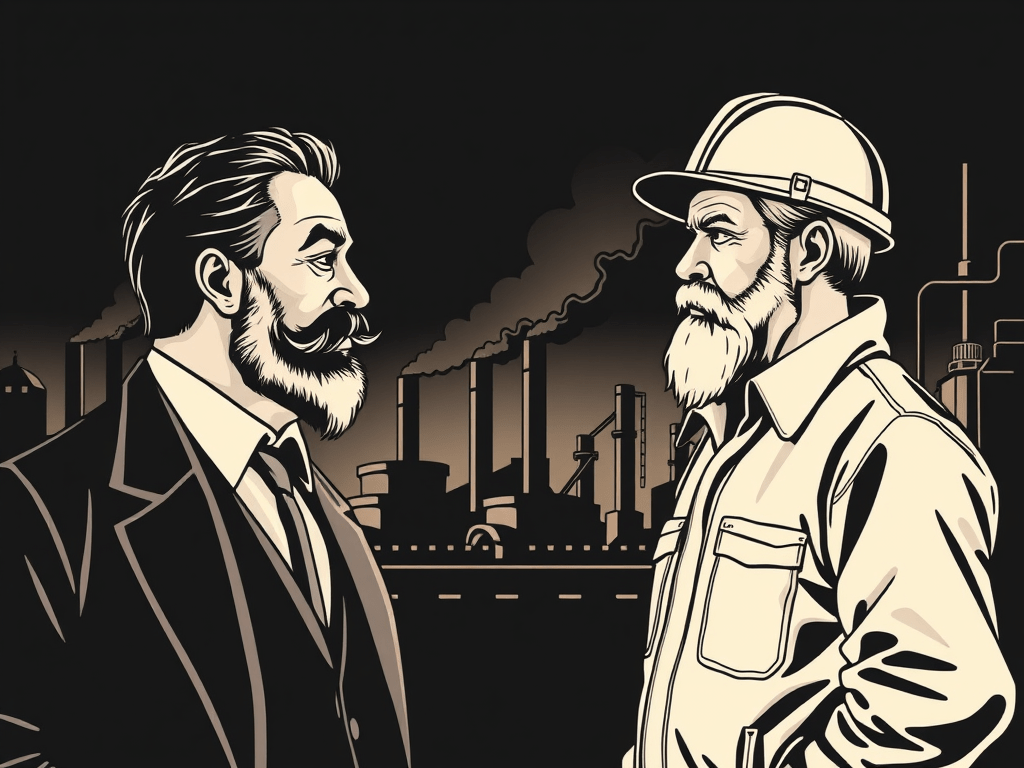
Marx’s analysis of capitalism begins with the division of society into opposing social classes and the inherent conflict between them. In Marxist economics, class is defined by one’s relationship to the means of production—essentially, the resources and tools used to produce goods. Under capitalism, society is fundamentally split into two great hostile camps: the bourgeoisie (capitalist class) and the proletariat (working class). The bourgeoisie are the owners of the means of production (factories, land, capital) and employers of wage labor, whereas the proletariat are those who own no productive property and must sell their labor power to survive. This class structure creates an antagonistic relationship: the bourgeoisie seek to maximize profits from production, and the proletariat seek higher wages and better conditions. According to Marx, the capitalist mode of production thereby pits these classes in a perpetual struggle over the fruits of labor and the distribution of economic power.
Importantly, Marx did not view class conflict as a novel feature of capitalism alone, but rather as a recurring phenomenon throughout history. Every historical epoch has been characterized by distinct classes in opposition—freeman and slave in ancient slave societies, lord and serf in feudal society, and now bourgeois and proletarian in modern capitalism. Marx’s materialist conception of history (historical materialism) posits that the economic structure of society forms the real foundation upon which a legal, political, and ideological superstructure is built. Social change occurs when the development of the productive forces comes into conflict with the existing class relations, leading to social revolution. Thus, class struggle is not an incidental byproduct of economics for Marx—it is the engine of history and the key to understanding societal evolution.
Labor Theory of Value and Surplus Value
A cornerstone of Marxist economics is the labor theory of value (LTV). Adapting ideas from classical political economists, Marx argued that the value of a commodity is fundamentally determined by the amount of socially necessary labor time required to produce it. In other words, labor is the source of economic value. This concept is crucial for Marx’s explanation of how the capitalist class derives profits and why this leads to class conflict. If labor alone creates value, then one might expect workers (the providers of labor) to receive the full value of what they produce. However, under capitalism, this is not the case. Marx introduced the concept of surplus value to explain how capitalists extract profit by appropriating a portion of the value produced by workers’ labor.
Surplus value represents the unpaid labor of the proletariat—the difference between the value a worker creates and the wages that worker receives. Marx observed that capitalists pay workers only for a part of the working day (enough to cover the workers’ own subsistence), and any additional value produced beyond that is kept by the capitalist as profit. In Das Kapital, Marx meticulously analyzed this process, showing that capital accumulation hinges on exploiting labor. The capitalists “siphon off” the surplus value produced by workers, calling it profit, and thereby amass wealth. Meanwhile, workers are not fully compensated for the value they generate, causing their relative impoverishment. This extraction of surplus value is the economic essence of exploitation in Marx’s framework: one class (the bourgeoisie) lives off the labor of another (the proletariat). The labor theory of value and the concept of surplus value thus reveal the economic basis of class conflict in capitalism. Workers, realizing that they are paid only a fraction of the value they create, have an intrinsic interest opposed to that of the capitalists who profit from their labor. This antagonism over the distribution of value underlies the class struggle in the capitalist system.
Historical Materialism and Modes of Production
Marx’s theory of historical materialism provides the broader theoretical foundation for understanding class struggle across different epochs. Historical materialism is the view that the material economic base of society (how goods are produced and how labor is organized) fundamentally determines the social, political, and intellectual life of that society. As Marx famously noted, “before men can do anything else, they must first produce the means of their subsistence” —material production is the first necessity of life, and it conditions all other aspects of society. From this standpoint, the progression of history is driven by developments in the modes of production (the overall economic systems), each of which gives rise to specific class relations and struggles.
Marx identified a sequence of major historical modes of production, each characterized by its own class structure: primitive communism (early classless tribal societies), slave society (as in the ancient Greco-Roman world, with slave-owners and slaves), feudalism (with landed nobility and serfs), and capitalism (with bourgeoisie and proletariat). In each stage, the forces of production (technology, labor, and resources) develop over time, and the relations of production (ownership and class relations) eventually become outdated constraints on further development. Crucially, Marx argued that each historical mode of production contains internal contradictions—principally the conflict of interest between the exploiting and exploited classes. For example, under feudalism the rising merchant and artisan class (early bourgeoisie) chafed against the constraints imposed by feudal lords, leading to conflict. According to Marx, these class antagonisms inevitably culminate in social revolution, wherein the old ruling class is overthrown and a new mode of production emerges . Thus, the fall of feudalism and the rise of capitalism was accomplished through the bourgeois revolution that displaced the aristocracy. In the same way, Marx predicted that the contradictions of capitalism would generate a revolutionary struggle in which the proletariat would overthrow the bourgeoisie and establish a new socialist mode of production .
Under historical materialism, class struggle is the mechanism of historical change. Marx and Engels distilled this idea in The Communist Manifesto: oppressor and oppressed classes have always stood in opposition, “a fight that each time ended, either in a revolutionary reconstitution of society at large, or in the common ruin of the contending classes.” In Marx’s view, the trajectory of history is not random or driven by ideas alone, but by material forces and class dynamics. As productive technology and economic organization evolve, old class structures become untenable and new classes rise to power through struggle. Class conflict is therefore the motive force of history, propelling society from one epoch to the next.
Economic Base and Superstructure: Embedding Class Struggle
Marxist theory describes society as consisting of an economic base and a cultural-political superstructure. The base refers to the material economy of society: the forces and relations of production (e.g. factories, resources, labor, and class relations that govern production). Upon this economic base arises a superstructure of laws, politics, and ideology—essentially, the institutions and prevailing ideas of society. Marx argued that the character of the superstructure largely reflects the interests of the dominant class that controls the base. In his 1859 work A Contribution to the Critique of Political Economy, Marx explained that the “totality of these relations of production constitutes the economic structure of society, the real foundation, on which arises a legal and political superstructure and to which correspond definite forms of social consciousness.” In simpler terms, the economy shapes the legal and political arrangements and even the way people think (social consciousness) in a given era.
Within this base-superstructure model, class struggle is embedded in multiple ways. First, the dominance of a ruling class in the economic base (ownership of the means of production) gives that class power to shape the superstructure. For example, in capitalist society the bourgeoisie’s economic power enables it to influence or control state institutions and public discourse. Marx noted that the ruling class propagates its worldview as the “ruling ideas” of the age: “The ruling ideas of every epoch… are the ideas of the ruling class.” This means that the laws, cultural norms, and dominant ideologies tend to legitimize and reinforce the position of the ruling class. In a capitalist context, ideas supporting private property, free markets, and the legitimacy of profit are promoted as natural or beneficial for all, whereas ideas that challenge the system (such as socialism) are often marginalized. Such ideology can mask the reality of exploitation, causing even the working class to accept or at least tolerate the status quo – a condition later Marxists termed false consciousness. In this way, the class struggle extends beyond the point of production into the realms of politics, law, and ideology. The superstructure becomes a field where class interests contend: the state might implement policies favoring capital or, under pressure, pass reforms favoring labor; intellectuals might challenge ruling ideas and raise class consciousness among workers.
However, the base and superstructure are not completely static or one-directional in influence. Marxism holds that changes in the base (economic crises, growth of new productive forces, etc.) will eventually lead to transformations in the superstructure—often through class struggle. When the economic base evolves (for instance, when new technology empowers a new class), tension grows between the new economic reality and the old superstructural order. Social conflict then erupts as classes fight to reshape political and legal institutions to fit the new economic base. In sum, class struggle is woven into the fabric of society: it originates in the economic base (conflict between owners and workers at the point of production) and reverberates through the superstructure (battles over laws, rights, and ideology). This holistic view explains why Marx saw the class struggle not just as an economic fight over wages, but as a broader social struggle that influences and is influenced by ideas, culture, and state power.
Class Struggle as the Engine of Historical Change
Within Marx’s theoretical framework, class dynamics drive historical change. Each significant historical transformation is the result of a clash between classes with opposing interests. The outcome of these struggles can be revolutionary (one class triumphs and inaugurates a new social order) or disastrous (“the common ruin of the contending classes” in Marx’s words) . For Marx, the rise of capitalism itself was born out of class struggle: the bourgeoisie in its ascendant phase challenged and ultimately dismantled the feudal system, overturning the old order of nobles and serfs and establishing a new capitalist order. Once in power, however, the bourgeoisie created its own antagonist—the proletariat. The development of industrial capitalism “simplified class antagonisms” down to two major classes, bourgeoisie and proletariat, directly facing each other in opposition. Marx believed that capitalism’s very advancement (the growth of industry, concentration of workers, and repeated economic crises) would foster the unity and consciousness of the working class, sharpening the class contradiction. Eventually, the proletariat would organize to overthrow the bourgeoisie, just as the bourgeoisie had overthrown the feudal aristocracy in the previous era .
It is in this sense that Marx described class struggle as the motor of history. The continuous push and pull between exploiters and exploited generates social instability and change. In Marx’s analysis, the internal tensions of capitalism make its downfall inevitable: “What the bourgeoisie, therefore, produces, above all, are its own grave-diggers. Its fall and the victory of the proletariat are equally inevitable.” This dramatic metaphor from The Communist Manifesto captures the idea that the capitalist class, through the development of industry and the exploitation of workers, inadvertently creates the conditions (a large, organized proletariat with nothing to lose) that will lead to its own overthrow. Marx predicted that a proletarian revolution would eventually establish socialism, a transitional stage, and then lead to communism, a classless society where the exploitation of labor is abolished. In a classless communist society, the dialectic of class struggle would come to an end because social relations of production would no longer be based on one class profiting at the expense of another.
While history did not unfold exactly as Marx envisioned, his theory of class struggle remains a foundational concept in understanding social change. From a Marxist perspective, major political upheavals and economic transformations are ultimately traceable to conflicts between classes – whether it was the slaves versus patricians in ancient Rome or workers versus capitalists in the modern age. Class struggle provides the explanatory thread that connects these episodes and drives the historical process forward.
The Bourgeoisie and Proletariat in Capitalist Society
Marx’s critique of political economy places special emphasis on the roles of the bourgeoisie and proletariat in capitalism. These two classes are the primary actors of class struggle in the modern era. The bourgeoisie, as defined by Marx and Engels, is the “class of modern capitalists, owners of the means of social production, and employers of wage labour.” Historically, the bourgeoisie gained prominence by leading the revolt against feudalism, revolutionizing industry, and establishing the capitalist system. Marx acknowledged the revolutionary part the bourgeoisie played in developing the forces of production and propelling social progress — for instance, by advancing technology and globalizing the economy . Under capitalism, however, the bourgeoisie’s control over production positions them as the ruling class: they not only accumulate wealth, but also wield power over political institutions (often using the state as “a committee for managing the common affairs of the whole bourgeoisie,” as Marx quipped). Their primary interest lies in expanding capital and securing profit, which leads them to extract as much labor as possible from the working class at minimum cost.
Opposite them, the proletariat is the “class of modern wage laborers who, having no means of production of their own, are reduced to selling their labour power in order to live.” The proletarians are the workers in factories, mines, and other enterprises—those who actually produce goods and services. Under capitalism, Marx observed that the proletariat has been drawn together in large workplaces and cities, which facilitates collective organization. However, workers are also subject to harsh conditions: long hours, low wages, and the degrading experience of being treated as mere cogs in the industrial machine. In Marx’s vivid description, in capitalism the worker becomes “a mere appendage of the machine” , meaning that human laborers are dehumanized and valued only for the work they can do with the machines owned by capitalists. The proletariat’s condition thus encapsulates the injustice of capitalism: workers create the wealth but receive only a small portion of it, while the owners reap the benefits.
The relationship between bourgeoisie and proletariat is inherently antagonistic. The bourgeoisie depend on exploiting the labor of the proletariat for profit, and the proletariat struggle against this exploitation, seeking better wages and working conditions and ultimately emancipation from wage-slavery. Marx believed this conflict would intensify as capitalism develops. The bourgeoisie, in pursuing profit, would continue to revolutionize production and accumulate wealth, but they would also inadvertently unify and impoverish the proletariat as a class. Over time, the proletariat would become conscious of itself as an exploited majority with common interests – developing what Marx called class consciousness. The culmination of this process would be the proletariat organizing to overthrow the bourgeoisie. In Marx’s famous formulation, the bourgeoisie “produces its own grave-diggers”: by creating a vast industrial working class and centralizing production, the bourgeoisie lays the groundwork for its own defeat. The role of the proletariat, then, is revolutionary – to end the capitalist system of class domination. The bourgeoisie’s role, conversely, is historically progressive (in its rise) but ultimately self-undermining, as its dominance generates the force that will end all class divisions.
In summary, within capitalist society the bourgeoisie and proletariat stand in direct opposition. The bourgeoisie wields economic power and seeks to maintain its dominance, while the proletariat, though initially disempowered, has the potential to become a force of revolutionary change. This dyadic class structure and the conflict between these classes form the crux of Marx’s analysis of capitalism and illustrate in concrete terms the broader theory of class struggle.
Conclusion
Class struggle is the linchpin of Marxist economic theory, providing a unifying explanation for the dynamics of capitalism and the evolution of human societies. Marx’s theoretical foundations—spanning the labor theory of value, surplus value, modes of production, and the base-superstructure model—each reinforce the idea that economic systems are built on conflicting class interests. The labor theory of value and the concept of surplus value reveal how exploitation of the working class generates profit for the capitalist class, planting the seeds of economic antagonism. The doctrine of historical materialism teaches that the material economic base (and the class relations therein) shapes society and drives historical development through class conflict. The base and superstructure framework further shows that class struggle permeates not only the factory and the marketplace, but also politics, law, and culture. Throughout history, class dynamics have been the engine of social change: new classes rise and old ones fall in a recurring pattern of conflict and revolution. In the modern capitalist era, the drama is cast in stark terms between the bourgeoisie and the proletariat, whose rivalry encapsulates the broader phenomenon of class antagonism.
Marx’s vision of economics is therefore not a neutral analysis of supply and demand, but a profoundly social theory in which economic laws are entwined with power and struggle. By highlighting class struggle, Marx provided a lens to critique the injustices of capitalism and to anticipate its possible transcendence. Whether or not one subscribes to Marx’s predictions, his insight that societal structures are borne from and transformed by class conflicts remains a powerful tool for understanding history and economics. In Marxist economics, class struggle is not only a theory of why societies change – it is a call to recognize the forces at work in our economic life and, potentially, to consciously shape the future. As Marx and Engels concluded in The Communist Manifesto, the proletarians “have nothing to lose but their chains” and a world to win, encapsulating the revolutionary ethos that the resolution of class struggle would usher in a classless society and a new chapter of human history free from exploitation.
 Letters from Tomis
Leave a comment