Unpacking the “Body Without Organs”
“Bodies without organs.” The phrase alone is enough to provoke a double-take. It sounds like a medical impossibility or perhaps the tagline of a surrealist play. In fact, it is both a poetic absurdity and a serious philosophical concept – one crafted by the avant-garde French thinkers Gilles Deleuze and Félix Guattari in their notorious work Anti-Oedipus (1972). What exactly does this cryptic notion mean? At its core, a Body Without Organs (BwO) refers to the unregulated potential of a body – any body, not necessarily even a human one – when stripped of the organizational structure that normally defines it. In plainer terms, imagine a body not as a neatly ordered organism (heart, lungs, liver all in their assigned seats), but as an open-ended field of components that can connect and interact freely, without a predetermined plan or hierarchy. Deleuze and Guattari use this strange idea to champion a vision of life and desire unshackled from conventional order. It’s a concept as fuzzy as it is radical, deliberately challenging us to rethink what a “body” and “organization” really entails.
The term “body without organs” actually predates Deleuze and Guattari. It was coined by the scandalous poet-playwright Antonin Artaud, whose 1947 radio play “To Have Done With the Judgment of God” declares: “When you will have made him a body without organs, then you will have delivered him from all his automatic reactions and restored him to his true freedom.” Artaud’s cry of defiance – free the body from its organs to free the spirit – struck a chord with Deleuze and Guattari. They adopted this provocative slogan as a kind of rallying point for their own project. Artaud viewed the organized body as a trap, a “vulnerable and repressive” structure that pins down our vitality. In one letter, he called the body nothing more than a “provisional stratification of states of life” – a temporary assemblage of actions and habits, liable to be shaken up. Deleuze and Guattari could not agree more. To them, the organized body (what we normally call the organism) is indeed a restrictive stratification, an arrangement that limits what life can do. The “Body Without Organs,” by contrast, is that same body seen as a raw potentiality: a body open to every form of expression and metamorphosis, rather than locked into a fixed mold.
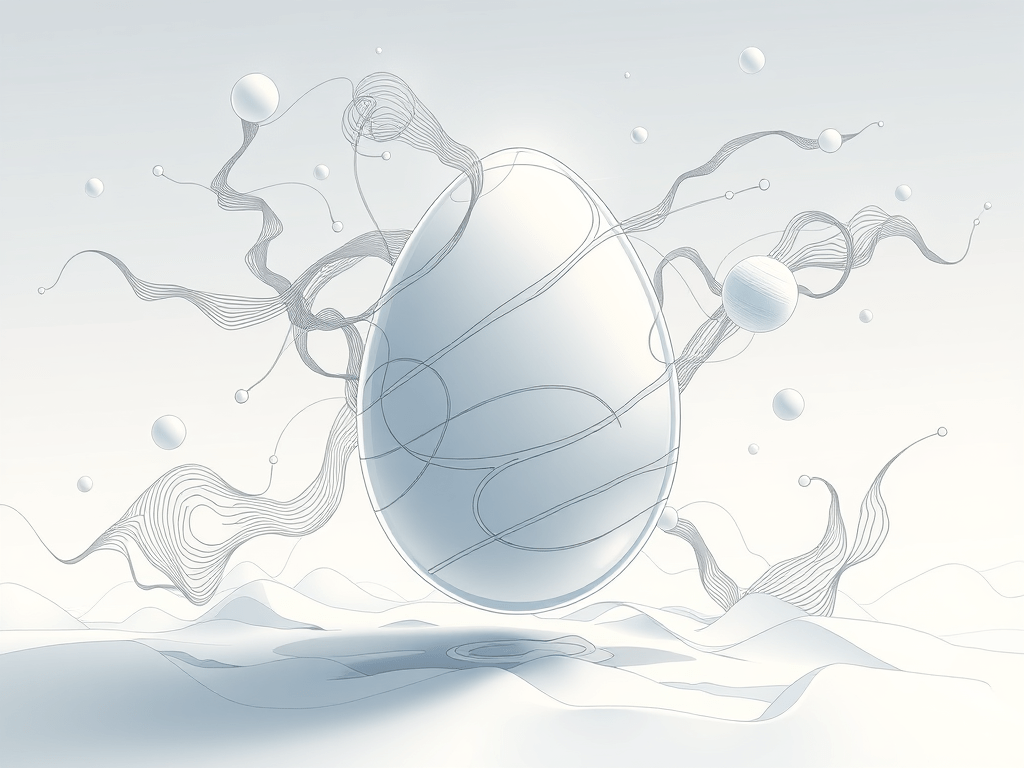
So, what does a BwO look like in practice? The authors invite us to picture an egg. Yes, an egg – that seemingly simple, featureless oval that nonetheless harbors a whole spectrum of possibilities. They describe the BwO as being like an egg “crisscrossed with axes and thresholds, with latitudes and longitudes…traversed by gradients marking the transitions and the becomings” of a life in development. Before the chick forms, the egg is a smooth space of pure intensity, not yet carved into organs. In the same way, a Body Without Organs is a smooth body – a body of continuous surfaces or flows, not yet broken into the discrete functions of an organism. It is, metaphorically, life before the blueprint, anatomy before the anatomist gets his scalpel. This is not a literal state we can observe under a microscope but a conceptual persona or condition: the body as an undivided field of desires, forces, and experiences. Deleuze and Guattari emphasize that you cannot simply will a BwO into being. It’s not a matter of murdering your organs or indulging in anarchy for its own sake. Rather, the BwO emerges when the intensity of life reaches a kind of zero-point – a state of suspended organization akin to what they poetically link to catatonic schizophrenia or even death itself . In other words, it’s a limit experience: the extreme case of a body so unstructured that it verges on dissolution. This rather morbid “zero intensity” is both a danger and, paradoxically, a wellspring of new possibilities. The Body Without Organs hovers between a harrowing void and a creative canvas, a space where either nothing happens or anything can happen.
Deleuze and Guattari’s writings portray the BwO in vivid, sometimes grotesque imagery – befitting a concept borrowed from Artaud’s theater of cruelty. “The body is never an organism,” Artaud warned, “organisms are the enemies of the body.” To make this point, our philosophers imagine the BwO reacting defensively whenever structured order tries to re-impose itself. Every time the machinery of life starts to settle into a routine – every time organs fall in line and functions get comfy – the BwO recoils as if infested by “larvae and loathsome worms” crawling to organize it. This is their flamboyant way of saying that the free, unstructured body cannot stand being pigeonholed into any one arrangement. It “presents its smooth, slippery, opaque, taut surface as a barrier” against the invading organs, “sets up a counterflow of amorphous, undifferentiated fluid” against any segmented order. The result of this tug-of-war is not total chaos but a dynamic equilibrium. Desire needs structure to get anything done, but it also needs rebellion against structure to avoid stagnation. Deleuze and Guattari thus see a productive tension between the BwO and the little machines of desire that constantly try to plug into it. The desiring-machines (their term for the myriad drives and connections that constitute our unconscious desires) ceaselessly attempt to attach to the body, to make it function in familiar ways – and the BwO just as incessantly “repels them” when they become too fixed, perceiving any stable arrangement as a kind of persecution. This apparent conflict is actually the motor of creativity: it ensures that new connections and formations are always possible once the old ones become unbearable . In short, the Body Without Organs is the constant provocation of freedom within us – that part of life which will not be pinned down by habits, identities, or codes, forcing desire to reinvent itself again and again.
Schizoanalysis: A Revolution against Oedipus
To appreciate why Deleuze and Guattari obsess over a “body” with no defined organs, we must place this concept in the context of their broader project: schizoanalysis. What is schizoanalysis? In simplest terms, it’s their proposed alternative to Freudian psychoanalysis – a kind of radical therapy and social philosophy rolled into one. If traditional psychoanalysis was about making the unconscious confess its Oedipal desires (the infamous love/hatred for Mother and Father), schizoanalysis is about liberating the unconscious from that familial straitjacket. Deleuze and Guattari were unapologetically critical of Freudian orthodoxy and its later structuralist embellishments under Jacques Lacan. In their view, by the 1970s psychoanalysis had become a kind of secular religion of the psyche, complete with its dogmatic text (Oedipus) and high priests (therapists) determined to make every patient kneel before the nuclear family drama. Anti-Oedipus was written as a gleeful heretical screed against this state of affairs – and the “body without organs” is one of its chief weapons.
In the psychoanalytic canon, desires are tamed and domesticated. A wild impulse in a child – say, aggressive or sexual energy – is theorized to get funneled into an Oedipal triangle: mummy, daddy, and me. The complex web of human desire, in Freud’s account, always seems to boil down to that familial romance (or tragedy). Deleuze and Guattari found this both implausible and pernicious. To them, forcing every desire to speak the language of Oedipus is like forcing every poem to conform to the same tired rhyme scheme – an act of violence against the richness of our psyches. Indeed, they compare orthodox psychoanalysis to a policing operation: those who refuse to internalize the Oedipal story are treated as mad or bad. “As to those who refuse to be oedipalized…the psychoanalyst is there to call the asylum or the police for help,” D&G dryly observe. The psychoanalyst, far from being a liberator of minds, becomes a deputized cop of the status quo – eager to drag the unruly subject back into the symbolic jail cell of Father, Mother, and castration anxiety. This scathing accusation reveals just how passionately our duo sought to explode the Oedipal myth.
Enter schizoanalysis and the Body Without Organs. If Freud thought our base instinct was to cling to parental figures (and dutifully develop a superego to repress any unseemly desires), Deleuze and Guattari think our base instinct is far more subversive: it is to “make yourself a body without organs,” as they famously put it – to cast off the old coordinates and find new pathways for desire. In fact, they explicitly state that “[this] body is the only practical object of schizoanalysis.” In a therapeutic context, that means the goal is not to interpret a patient’s every dream as a disguised family drama (the Freudian way), but to help the patient dismantle the restrictive organs that have been imposed on their desire and identity. Schizoanalysis would ask a person, “What is your body without organs? What would it be like if you stopped defining yourself by the organs – the roles, the narratives, the identities – that society and upbringing have attached to you?” It’s a daring, even unsettling question. Rather than guiding the patient from neurosis to normalcy (which often just means resigning to the established social order), schizoanalysis dares to guide the patient into new forms of sanity that society might label “mad.” It takes schizophrenia – not as a clinical illness to be mimicked literally, but as a metaphor for breaking open the closed circuits of the mind. In the schizophrenic break, desires detach from their usual objects and mingle in bizarre ways; language stops obeying grammatical rules and becomes glossolalic gibberish; the sense of a unified self melts into a flux of sensations. These are terrifying prospects if taken to the extreme (and Deleuze and Guattari are careful to issue warnings about literal schizophrenia and drug abuse – the goal is not to produce a catatonic wreck ). But somewhere in these extremes lies inspiration. Schizoanalysis holds that even the most “out there” expressions of desire (the babble of a psychotic, the frenzied art of an outsider) contain a revolutionary potential – a potential to escape the mind-forged manacles of tradition.
One of the key differences in this new analysis is how it understands desire itself. Freud (and virtually all of Western thought from Plato onward) framed desire as lack – you desire what you don’t have, what you feel missing. Your whole life, in this view, is an attempt to acquire some imagined completion (Freud just narrowed it to a parental surrogate or forbidden love object). Deleuze and Guattari flatly reject this model. They align themselves with philosophical mavericks like Nietzsche and Spinoza who see desire as positive force, not a negative hole . Desire doesn’t lack anything; it produces. “Desire is a machine, and the object of desire is another machine connected to it,” they write. In other words, desire is like a factory – always assembling, creating, forging connections between things. This is a profound shift: instead of viewing the psyche as a theater of longing, they view it as a workshop of experimentation. And what does this factory produce? Not shoes or sausages, but “partial objects, flows, and bodies” – the building blocks of experience. Crucially, desire in this sense produces the Body Without Organs as one of its outputs and as a space of production itself. The BwO is both the product of freeing our desiring-machines from their inhibitions and the stage on which further productive connections can form . It’s a bit like a self-expanding canvas: as you free up desire, you create a broader BwO, and on that broader surface, desire can paint even more elaborate creations.
By opposing psychoanalytic orthodoxy, Deleuze and Guattari also take a swipe at the broader structuralist tendency of their era. Freudian and Lacanian psychoanalysis was part of the structuralist movement in mid-20th-century thought – the idea that all human culture and psyche can be understood as systems of relations (structures) like language. Structuralists love ordered grids: father vs. son, signifier vs. signified, yes vs. no. The Body Without Organs is anathema to such grids. It represents a state that is “deterritorialized” and undefined, where structures dissolve into a continuum of intensities. In fact, Deleuze and Guattari often speak in the same breath of “lines of flight,” “destratification,” and the BwO – all terms pointing to an escape from fixed structure into open-ended process. While Lacan might say our desires are structured like a language (always mediated by symbols like the Name-of-the-Father, the Phallus, etc.), D&G retort that underneath those imposed symbols lies a volcanic churn of energies that owes no allegiance to the Signifier. They famously illustrate this with a political example: “It was not by means of a metaphor, even a paternal metaphor, that Hitler was able to sexually arouse the fascists…And what about the effects of money that produces more money? There are socioeconomic complexes that are also veritable complexes of the unconscious… and Oedipus and the phallus have nothing to do with this.” In other words, real desires out in the world – the horny excitement of a rally, the lust for gold in a stock market – are not all secretly about Mommy or Daddy. They are what they appear to be: direct investments of libido in political and economic fields. The traditional Freudian or structuralist would insist these are just displacements or metaphors for family romance (the Führer as father figure, the nation as mother, etc.), but Deleuze and Guattari call nonsense on that. Desire can attach itself to anything real – flags, armies, bank accounts, you name it – without needing a symbolic detour through Oedipus. This argument guts the structuralist premise that meaning always flows from a preset structure. Here, meaning (or rather affect) flows along whatever circuit it finds, unpredictably. The Body Without Organs, in this sense, is the great connector and equalizer: on the BwO, all flows are ultimately on the same plane. The desire of a fanatic cheering a dictator and the desire of a child spinning in the yard are, at base, just flows of intensity traversing bodies. Neither is “really” about an Oedipal family drama unless you force that interpretation. Schizoanalysis refuses such forced interpretations. It opts instead to map how desires move across the Body Without Organs – how they circulate, connect, and sometimes congeal into unhealthy traps (what D&G call “black holes” or re-territorializations) that must then be shaken off again.
Challenging Metaphysics and the Organized Self
Deleuze and Guattari’s concept of the Body Without Organs doesn’t stop at psychoanalysis. It fires a broadside at deeper philosophical assumptions – the kinds of metaphysical and ontological assumptions that underlie how we think about reality and the self. Western metaphysics has long been enamored with order. From Plato’s eternal Forms, to the divinely ordained cosmos of the medievals, to the rational structures sought by modern science, there runs a common belief: true being has an inherent organization. Things have essential identities; bodies have proper functions; order is natural, and disorder is a mere privation or fall. The BwO turns this venerable assumption on its head. It suggests that what we take as a stable identity or organized form is in fact a kind of after-effect – a snapshot of an ongoing process. Recall Artaud’s remark about bodies as “provisional stratifications.” Deleuze and Guattari fully embrace that: any organized body (including your own body with its organs) is just a temporary assembly of forces, a assemblage in their terminology, which could always have been assembled differently and can be disassembled. The metaphysical upshot is a shift from thinking in terms of being (static what is) to thinking in terms of becoming (dynamic what could be). The Body Without Organs is essentially a figure of becoming. It is the body defined not by its substance or design (not by any transcendent plan or “organizer”), but by its capacity to vary, to affect and be affected. In philosophical lineage, one hears echoes of Spinoza and Nietzsche here. Spinoza, the heretic rationalist of the 17th century, asked us to consider what a body can do rather than what it is. He treated the body and mind as one substance, infinitely mutable, and measured by its power to act. Deleuze (a great admirer of Spinoza) channels this directly: “the concept of the body [in BwO] inherits elements from Spinoza’s concept of substance,” defined by “cohesion through affective potential” rather than by any fixed essence or form. Likewise, Nietzsche’s view of life as will to power – an endless play of forces overcoming and transforming one another – prefigures the Brechtian drama that D&G see in desire’s workings. Nothing is static; everything is in flux, and the only “being” is becoming. The BwO enshrines this anti-essentialist ontology in one vivid image: a body that refuses to submit to the imposed order of organs, and in doing so, remains fluid and alive with possibilities.
Challenging metaphysics often goes hand in hand with challenging theology, and here our authors are unapologetic. In a striking passage, they equate the very principle of God with that of Organization – not to be blasphemous for its own sake, but to drive home the point that every imposed cosmic order (theological or otherwise) is an enemy of the BwO’s freedom. After all, in the Book of Genesis, what does God do but impose form and hierarchy on the void – separating light from dark, water from land, making creatures each with their ordained organs and purposes? To Deleuze and Guattari, this act of creation is the original stratification, the divine blueprint that justifies every authority thereafter (from the father’s authority over the family to the ruler’s over the state). Small wonder they speak of “a God at work messing it all up or strangling it by organizing it” whenever the BwO’s smooth flow is interrupted. Their atheism is implicit but profound: true life, true desire has no need for a transcendent organizer, be it God, Nature, or Reason. Instead, it operates on what they call a plane of immanence – a fancy way of saying everything happens in a single flat ontological plane where there are no higher or lower levels of being, no pre-given design, just interactions of forces. The BwO is precisely such a plane of immanence for the body and desire. It is what you get when you flatten out all the hierarchical layers and just let the chips (or organs) fall where they may.
This philosophical stance has several ramifications. Ontology without teleology: In a BwO, organs are not defined by a goal or end (telos); they are just provisional behaviors. A heart on a BwO is not a “heart” in the teleological sense (an organ whose purpose is to pump blood); it’s more like a rhythmic contraction that might serve various roles or be repurposed. If that sounds abstract, consider an example from technology: a computer can be made to simulate a “heart” pumping in a game, or a set of pulleys can imitate a heartbeat motion. The point is, organs lose their fixed meaning on the BwO – they become interchangeable functions. By challenging the sacrosanct link between organ and function, Deleuze and Guattari undermine the idea that there is a natural order of things (eye for seeing, ear for hearing, penis for penetrating, etc.). Those functions can migrate, mutate, or multiply. This is not to say they recommend literal organ transplants or chaos in physiology; rather, they are reimagining the body abstractly to see what new relationships might emerge if we aren’t bound by the usual ones. Epistemology of the unconventional: If one truly adopts the BwO perspective, knowledge itself can’t stay in neat disciplines. Psychology bleeds into political economy (why does a bank transaction give some people a thrill? D&G have an answer). Biology merges with art (the body as an experimental canvas). In a way, the BwO is a critique of reductionism in science and humanities – any approach that would reduce the mind to a set structure or society to a fixed functional system is missing the throbbing potential that underlies actual life. The BwO insists on a more holistic, albeit wildly unpredictable, view.
The ramifications for psychology are especially pointed. After Deleuze and Guattari, one cannot look at the Freudian model of the psyche – with its orderly layers of Id, Ego, Superego all laboring under the edicts of the Reality Principle and the threat of castration – in the same way. That model starts to seem like an elaborate fairy tale, a Victorian clockwork of the mind. In contrast, schizoanalysis offers a picture of the psyche as a kind of anarchic workshop. This has inspired subsequent thinkers in various fields. For instance, later forms of therapy and theory (such as certain strands of queer theory and gender theory) draw on the idea of the BwO to argue that identity (gendered, sexual, or otherwise) is not a fixed organ but a malleable field of play . If the body can be “without organs,” then surely it is without innate gender roles or any other imposed structure – all such facets can be reassembled. In the arts and literature, the BwO became a touchstone for understanding experimental art that tries to break form. And within philosophy, it bolstered the move toward process philosophy and post-structuralism: reality is constituted by dynamic processes and escapes any single overarching Structure. Even metaphysics itself isn’t spared – by suggesting that at bottom reality might be a pulsing egg of intensity, Deleuze and Guattari call into question the old dichotomy of order vs. chaos. Perhaps, they hint, what we derogatorily call “chaos” is just undiscovered order of a different kind, an order we must become willing to live in to understand.
Before we conclude, it’s worth noting that Deleuze and Guattari, despite their often celebratory tone about these wild possibilities, are not naïve about the dangers. The Body Without Organs, if mishandled, can be deadly – they concede this. A drug addict chasing the ultimate high or a schizophrenic plunging into catatonia are tragic examples of trying to become too free, too fast. These are what they term “empty” or “cancerous” BwOs, where the person strips away structure but fails to find any new empowering pattern, ending up in a kind of undifferentiated chaos or a toxic fixation. By contrast, a “full” BwO is one where the old stratifications are shed and replaced by new creative ones – a “plane of consistency” where novel connections can form without ossifying into prisons. Think of it as the difference between a successful revolution and a failed state: overthrowing the old regime is not enough; one must also harness the energies unleashed into a viable new form. In therapy or life, then, the task is delicate. The BwO is “a limit” – you approach it to break what must be broken (outworn habits, neuroses, repressive structures) but you don’t throw yourself in recklessly. This nuance is often lost on their loudest followers, but Deleuze and Guattari themselves are aware: “you have to keep enough of the organism for it to reform each dawn”, they write in their sequel A Thousand Plateaus, otherwise you truly will have “made yourself a body without organs and died.” (They wryly note that the fully unorganized body is basically a corpse – total freedom indistinguishable from total entropy.)
Conclusion: The Body Unbound – A Provocation and a Challenge
The Body Without Organs is not a notion that lends itself to gentle or tepid opinion. It is deliberately provocative, almost pugnacious, in the way it challenges authority and convention. On one level, it is a direct assault on the pieties of psychoanalysis: those Freudian and Lacanian models that reigned unopposed for much of the 20th century. Deleuze and Guattari didn’t just tweak Freud’s nose; they attempted to knock the old man flat on his back – and replace his comfortable Oedipal mother-father-child triangle with a seething web of machines and flows. In doing so, they gleefully offended the Freudian superego of their era. Hitchens, who had a known distaste for tyrannies and dogmas, might have smiled at this insurrection against what was, in essence, a psychological orthodoxy. The BwO says to Freud’s legacy: your myth of Order is the real neurosis. Desire isn’t a naughty child to be disciplined by structure; desire is an insurgent force that mocks your Oedipal throne. There is something deeply polemical in that message, something one can easily imagine Hitchens delivering in a debated tone – slicing through the pretensions of a psychoanalytic guru with a caustic bon mot.
On another level, the BwO is a more abstract (and perhaps more profound) challenge to how we conceive human existence. It asks: what are we, if not the roles and organs we’ve assumed? What remains if we strip away the stories, the labels, the “organs” of social convention and even biological necessity? The answer is not immediately comforting. Deleuze and Guattari’s answer seems to be that what remains is freedom – but a peculiar kind of freedom, one that is equal parts exhilarating and terrifying. It is the freedom Artaud spoke of in that quote about “true freedom” beyond our automatic reactions . It is freedom from ourselves as we know ourselves. This is a far cry from the nice, tidy freedoms one reads about in political theory or self-help books. It is more like the freedom a lunatic has, or a visionary, depending on how you look at it. And here we might inject a bit of Hitchensian skepticism: Is this concept perhaps too enamored of chaos? Does it risk valorizing the breakdown of meaning to such an extent that it can’t rebuild anything worthwhile? Deleuze and Guattari would retort that they do want to rebuild – just not on the old foundation. They want to rebuild life on the plane of the BwO, where new and unexpected structures can arise without solidifying into prisons.
For philosophy, this notion has been a wake-up call, a reminder that behind every neatly defined category (body, mind, society, organism) there roils a sea of uncertainty and potential. The metaphysical challenge of the BwO is to embrace that uncertainty – to affirm that the ground of being is not a rigid grid but a field of play. One could say it punctures the smug certainty of metaphysicians who treat their categories as gospel. It leaves us with a humbler, if more daunting, vision: that we must continually create the patterns of our lives rather than discovering them pre-written in nature or the unconscious. There is something profoundly democratic and anti-authoritarian in this vision. No king, priest, or psychoanalyst gets to tell the BwO how to arrange itself; no inherited dogma can capture its endless becoming. Small wonder that Anti-Oedipus was born of the late-60s zeitgeist, with its rallying cries of liberation and its suspicion of all forms of authoritarian order.
For psychology, the ramifications of BwO (and schizoanalysis generally) have been more controversial. Freud’s influence may have waned, but we have not seen Jungian analysts or CBT therapists replacing their couches with wild experiments in “making bodies without organs.” In truth, schizoanalysis remains more a philosophical provocation than a clinical method in mainstream terms. And perhaps that’s for the best – few of us would genuinely wish to undergo the kind of ordeal that a full-on BwO construction might entail (one imagines something between primal scream therapy and anarchist theater, not exactly covered by insurance). But as theoretical critique, it has done its work. It has ensured that no serious thinker can get away with facile assumptions about the universality of the Oedipus complex, or about the psyche being neatly partitioned and house-broken. It has encouraged therapists to see patients as not just products of a family history but as producers of a personal reality that might spill over those bounds. It has, in short, kept psychology on its toes, reminding it that behind the polite veneers of “normal behavior” lie forces and desires as wayward as any political revolution.
In closing, the Body Without Organs is both an intellectual dare and a poetic image. It dares us to imagine ourselves beyond the limits – beyond the structures – that we normally accept without question. It asks: What might you become if you stopped obediently performing the functions assigned to you (by biology, by society, by habit)? The answer may not be comfortable, but it just might be transformative. This concept is meant to unsettle and to spur debate. It does not apologize for flouting decorum or for sounding a bit mad. It is, in a sense, unapologetically itself.
One can certainly critique Deleuze and Guattari: their prose is infamously dense, sometimes verging on self-parody, and one might question whether the emperor has any clothes beneath the orgy of neologisms. Hitchens, ever the skeptic, would likely raise a sardonic eyebrow at phrases like “desiring-machines” and “deterritorialized intensities.” But if he looked beyond the jargon, he would find a genuinely audacious idea: that freedom runs deeper than we thought, all the way down into our anatomy and unconscious, and that much of what passes for necessity – be it the Oedipus complex or the “natural” roles of our organs – is really just imposed order that can, with courage and wit, be thrown off. In the final analysis, Bodies Without Organs stands as a challenge to think differently about everything: our bodies, our desires, our society, our very reality. It is a manifesto for the creative over the compliant, the fluid over the frozen, the unapologetically alive over the merely living. And in that sense, it is a concept that would make any iconoclast nod in vigorous approval – even if with a measure of ironic smile – at the sheer nerve of it.
 Letters from Tomis
Leave a comment