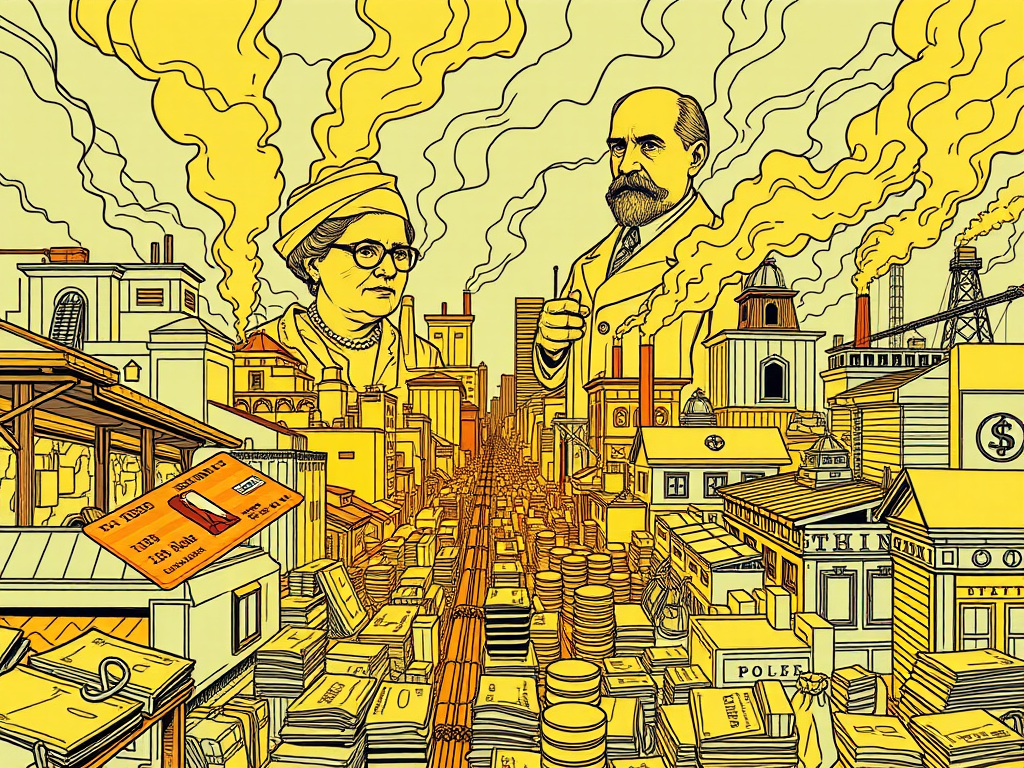
In our age of plastic cards and trillion-dollar bailouts, it often feels as if the world runs on faith and credit. A family buys groceries on a credit card; a superpower floats on a sea of treasury bonds. We moderns accept debt as a fact of life—indeed, as the grease that keeps the wheels of commerce spinning. But why was credit created in the first place? According to Marxist economics, credit was no charitable innovation or mere convenience; it was capitalism’s ingenious (and perilous) solution to its own contradictions. Let us examine this Faustian pact through the eyes of two revolutionary thinkers, Rosa Luxemburg and V. I. Lenin, and see how their century-old insights resonate in our debt-saturated contemporary world. We will find that credit has been both lifeline and noose for capitalism—at once enabling its wild global expansion and postponing its collapse, all while binding nations and individuals in financial chains.
Credit as Capital’s Lifeline and Noose: The Marxist Genesis of Credit
Karl Marx famously observed that capitalist production is laden with internal conflicts—it constantly generates more goods and profits than society can absorb, leading to crises of “overproduction”. Every few years, factories sat idle amid glutted markets and laid-off workers, threatening the system’s survival. Credit arose as a clever escape hatch from this dilemma. By extending loans, issuing paper money, and creating financial claims on future wealth, capitalists found they could sell today what the world might only pay for tomorrow. Credit expanded the market artificially, allowing business to continue as if the demand were there. Marx described this process with characteristically biting clarity: banks and markets conjure up “fictitious capital,” a paper wealth that can soar high above the real economy it supposedly represents. Through credit, inactive money or mere promises “take on a life of [their] own”, fueling new investments and purchases even when actual purchasing power is lacking. In effect, credit carries economic activity beyond the confines of what is rationally possible at that moment.
For a time, this financial alchemy works wonders. Marx noted that in a crisis, an injection of credit can “blow new life” into stricken businesses and “help sustain economic activity”. A central bank lowering interest rates or a banker extending an emergency loan can postpone bankruptcies that seemed inevitable. Credit is capitalism’s life-support, reviving the patient at the brink of collapse. But—and here the Marxist scalpel cuts deep—this remedy is purely temporary and comes at a high price. Each round of credit expansion piles up a greater mass of debt that eventually must be reckoned with. Marx called this “over-credit”: pumping up the economy on easy money only defers the crisis, ensuring that the eventual crash will be more devastating. Like an elastic band stretched farther and farther, the longer the tension builds, the sharper it snaps back. “The later the crash, the worse the outcome,” Marx warned—words chillingly confirmed by the 2008 financial meltdown, when years of debt-fueled euphoria ended in global disaster.
Thus, from a Marxist perspective, credit was created as both a lifeline and a noose for capitalism. It is the lifeline that permits production and profit to race ahead of the immediate limits of the market, keeping the machine humming. Yet it is also the noose that tightens with each new loan, each new mortgage or bond, threatening to strangle the system in an even bigger crisis down the road. This contradictory role of credit—simultaneously saving capitalism and exacerbating its instabilities—sets the stage for the insights of Luxemburg and Lenin at the dawn of the 20th century. They would witness an era when credit not only smoothed over routine crises at home, but also became a key instrument of imperial conquest and global domination.
Rosa Luxemburg: Imperialism, Accumulation, and the Credit Fix
No one was more preoccupied with capitalism’s need to find buyers for its ever-expanding output than the Polish-German revolutionary Rosa Luxemburg. Writing in The Accumulation of Capital (1913), Luxemburg tackled a vexing problem: who is left to buy all the goods once capitalists have maximized sales to their own workers and each other? Marx had shown that capital must continually accumulate—reinvest profits into producing ever more—yet workers’ wages are kept too low to purchase the surging bounty of commodities. Luxemburg’s startling answer was that capitalism survives by raiding and expanding into non-capitalist arenas. In her words, “capitalist economies can only grow… as long as there are non-capitalist territories, areas, or people” to absorb the excess goods and capital. In other words, when the domestic market is saturated, the bourgeoisie looks beyond the factory gates—to peasants, colonies, and foreign lands—to offload their commodities and plow surplus money into new ventures. This necessity gave rise to the imperialist drive, the scramble for new markets and resources across the globe.
Crucially, Luxemburg saw credit as the bridge between the capitalist core and these non-capitalist peripheries. The trouble was that those outside the capitalist world often lacked both the need and the means to buy European factory goods. A self-sufficient peasant in Africa or a craftsman in Asia had little use for Manchester textiles or Pittsburgh steel—and even if they did, they had no money to pay for them. How, then, to create a market where none existed? Enter the international loan, the seductive foreign credit that lures new regions into the web of global capitalism. Luxemburg devoted an entire chapter to “International Loans” and detailed how the great powers used debt as a weapon of expansion.
Consider Latin America in the 1820s, a case Luxemburg analyzed with relish. As soon as countries like Argentina and Brazil won independence from Spain and Portugal, British bankers rushed in to offer loans for development and modernization. Those young governments, enticed by easy credit, borrowed heavily and then spent most of the money in London, buying British manufactured goods—rails, locomotives, factory equipment, luxury wares. In effect, Britain was financing foreign purchases of its own exports, a win-win for the empire. Of course, the loans came due, with interest. When the Latin American states couldn’t pay back the first round of debts, the solution was simple: take out new loans to service the old ones, locking these nations in a cycle of dependency . It was a debt trap avant la lettre. As Luxemburg notes, these international loans became “the surest ties by which the old capitalist states maintain their influence” over the young ones, allowing the great powers to “exercise financial control and exert pressure” on their policies . In short, credit was the gentler guise of conquest. Where the gunboat could not reach, the banker’s bill did.
Historical figures knew this well. In 1824, British statesman George Canning exulted in the new imperial reality: “Spanish America is free; and if we do not mismanage our affairs sadly, she is English.” His confidence was not misplaced. A British traveler in the 1830s, marveling at how thoroughly British goods had inundated even remote areas, described a gaucho on the Argentine pampas: “Take his whole equipment… and what is there not of raw hide that is not British? If his wife has a gown, ten to one it is made at Manchester… the camp-kettle… the knife, his poncho, spurs, bit, all are imported [from] England.” The entire material culture of that Argentine cowboy had been quietly colonized by British industry. And this was achieved without a single Redcoat or formal colony in Argentina—it was done through trade and credit. As one historian put it, Britain had turned these nations into de facto economic colonies “simply by ‘clipping coupons’,” that is, by lending money and collecting interest.
Luxemburg incisively observed that military force, while always lurking in the background, was often unnecessary to imperialism: “Great Britain did not need to resort to military conquest… It used two very effective economic weapons: international credit and forcing these newly independent states to discard protectionism.” Debt and free trade, imposed via diplomacy or the occasional gunboat ultimatum, would do the job of subjugation. A public loan to a cash-strapped government to build a railroad or canal would come with strings attached—perhaps a contract for a British construction firm, or a clause that British manufacturers get preferential access to the local market. In this way every loan was a Trojan horse, smuggling in economic domination. From Egypt to China, from Turkey to Mexico, Luxemburg showed how foreign credit paved the way for foreign control, making the financiers of Paris and London the new high priests of power.
Yet, true to her Marxist rigor, Luxemburg also saw the limits and contradictions of this credit-fueled imperialism. Non-capitalist territories could be plundered and prodded into the money economy, but they could not be relied upon to indefinitely consume the excess output of the industrialized world. After all, a colony or semi-colony saddled with debt and flooded with imports would sooner or later run into bankruptcy or rebellion. Each new market seized—each new loan made—only hastened the exhaustion of the remaining “outside” areas capitalism could penetrate. In Luxemburg’s view, by 1900 the world was nearly carved up: once every last nook of Africa, Asia, or Latin America was integrated, what then? She foresaw that capitalism, having created a truly global market through credit and conquest, would face one final insurmountable barrier: there would be no one left to absorb its surplus. At that point, the system would burst asunder under the weight of its own excess. The frenzied imperialism of her day, with financiers stretching railroads across continents and government ministers waging small wars for foreign investments, was, in her eyes, the death throes of a system desperately forestalling its demise. To paraphrase a stark choice she made famous, humanity would soon face “socialism or barbarism”—either a new cooperative economic order beyond capitalism, or a collapse into war and ruin as the old order outlived its viability.
Lenin: Finance Capital and the Empire of Debt
Where Luxemburg emphasized the markets for output in imperial expansion, Vladimir Lenin concentrated on the flipside: the glut of capital itself seeking profitable investment. Writing a few years after Luxemburg, in the midst of World War I, Lenin’s Imperialism, the Highest Stage of Capitalism (1916) portrays a world dominated not by competitive free enterprise, but by vast monopolies and giant banks—a finance aristocracy bestriding the globe. Credit was the scaffolding upon which this new edifice of monopoly capitalism rose. Small banks and local creditors had given way to a handful of colossal banks that centralized the wealth of nations. By pooling the deposits of millions and funneling them into industry, these banks had become incredibly powerful. “The principal function of banks,” Lenin explained, is to “transform inactive money capital into active capital” —in other words, to take the idle savings of individuals and make them available to big business as loans and investments. As banking advanced and became ever more concentrated, a few large banks held sway over almost all available capital. They turned into “powerful monopolies having at their command almost the whole of the money capital” of the country . This new financial oligarchy could direct resources on a massive scale, picking winners and losers in the economy, and tying the fortunes of industry to the whims of finance.
Lenin argued that by the early 20th century, industrial capital and bank capital had effectively merged into a single intertwined entity he called “finance capital.” Industrial corporations depended on big loans and stock offerings underwritten by banks; banks in turn took major ownership stakes in industrial firms. The result was a tight-knit elite of bankers and industrialists—often the same people wearing different hats—who dominated entire national economies. With domestic markets relatively mature, these finance capitalists found themselves with more capital than they could profitably reinvest at home. By 1900, countries like Britain, France, and Germany had amassed huge surplus pools of capital. If they tried to use this capital to raise workers’ wages substantially or develop domestic agriculture (to increase home demand), it would have eaten into their profits. And, as Lenin drily noted, “if capitalism did these things it would not be capitalism”. Keeping workers relatively impoverished was part of the model; thus the home market remained limited by design. The only solution was to send the excess capital abroad.
This is the crux of Lenin’s theory: imperialism is driven by the export of capital. In the old days, under free-market capitalism, exporting goods was paramount (England shipping cotton cloth to India, for example). In the new epoch of monopoly capitalism, exporting capital (money, machinery, loans) became the dominant tendency . **The richest capitalist countries—“overripe” with accumulated wealth—began pouring investments and loans into less-developed regions, where profits were higher. Why higher? Because in colonial or peripheral economies, wages were very low, land and resources were cheap, and local competitors were few. A British financier could lend money to build railways in South America or to start a mining venture in Africa and reap a much fatter return than he could by investing the same money in Britain’s saturated, high-cost market.
By this means, London, Paris, Berlin, and New York transformed vast swathes of Asia, Africa, and the Americas into investment frontiers. The people of those lands had little say in the matter. Capital came in under the protection of imperial flags and armies, when necessary, and whole economies were reshaped to serve foreign investors. Mines, plantations, ports, and railroads sprang up, not primarily to develop the local society, but to extract wealth for export. The lending countries grew rich from the interest and dividends flowing back to their banks and bondholders. Lenin vividly described this system as “the financial strangulation of the overwhelming majority of the world by a handful of ‘advanced’ countries.” A few imperial powers had essentially enslaved entire nations through debt and investment, drawing a continuous stream of tribute from their labor. In a mordant turn of phrase, Lenin said the capitalists of these wealthy nations could now “plunder the whole world simply by ‘clipping coupons’.” Picture a lordly rentier, sitting in his London club and clipping interest coupons off his bonds from Argentina or India; he need not ever visit a factory or a mine—the sweat of distant workers, leveraged through loans, would pay for his gentlemanly luxuries. This, Lenin argued, was the true face of modern imperialism: not just flags on a map, but a global network of financial exploitation.
Like Luxemburg, Lenin saw imperialism as a desperate attempt to prop up profitability in the capitalist core. Each new foreign loan or investment outlet was a pressure release valve for the system’s surplus capital. However, it came with its own fateful contradictions. Imperialism intensified rivalries between the great powers as they jockeyed for the best investments and spheres of influence. It is no accident, Lenin observed, that the age of massive capital export was also the age of colonial partitions and world war. Moreover, while imperialism brought windfalls to the bourgeoisie, it did precious little to solve the plight of workers. True, a slice of the spoils was sometimes used to bribe a segment of the working class into complacency—Lenin controversially argued that a “labor aristocracy” in the West was being pampered with crumbs from imperialist superprofits. But those crumbs could not feed everyone. Even as bankers grew fat off foreign ventures, ordinary workers still faced low wages and periodic layoffs. In effect, credit expansion abroad allowed the system to delay its reckoning at home, but it did not prevent it forever. The more the capitalist economy became global and entangled in debt, the more a crisis anywhere could cascade everywhere. By the early 1900s, a financial panic in New York could spark a credit crisis in Europe; a revolution in a debtor country could send shockwaves through the balance sheets of its lenders. Lenin’s capitalism was a ticking time bomb: heavily leveraged, ferociously competitive, and prone to violent eruptions (be they crashes or wars) as the contradictions heightened.
Debt-Driven Capitalism and the Delayed Crisis: From Lenin’s Time to Today
Fast forward to the present and the spectacle we face: a capitalism that has “matured” into an almost pure debt-driven system, oscillating between credit binge and credit crisis with manic regularity. The trends that Luxemburg and Lenin identified have, if anything, intensified. After World War II, the imperial powers (led by the United States) fashioned a new global financial order—institutions like the IMF and World Bank took over the job of managing international credit flows, often with the same old imperial logic. Under the banner of “development” and “modernization,” billions were lent to newly independent countries in the Global South. With a cruel irony Luxemburg would recognize, much of this money cycled right back to the rich countries in the form of contracts for Western firms or interest payments to Western banks. By the 1980s, many developing nations found themselves mired in a debt crisis: they had to spend a huge share of their budgets just to service loans, even as their people endured austerity at the behest of international creditors. The “financial strangulation” Lenin spoke of is alive and well today—consider that in 2023, developing countries spent a record $1.4 trillion just to service foreign debt, a burden that has skyrocketed with rising global interest rates. Entire regions are effectively paying tribute to global finance, caught in what some call a new debt colonialism. When the poorest countries spend more on interest to wealthy creditors than on education or healthcare for their own citizens, we see the empire of debt in its most naked form.
Meanwhile, within the advanced capitalist countries, the credit system has permeated everyday life to an extent that might astound even Marx. Consumer credit — virtually nonexistent in Marx’s day — became the engine of the postwar boom. In America, for instance, wages stagnated after the 1970s even as the economy kept growing and corporate profits soared. How was social stability maintained amid this glaring disconnect? The answer: through easy credit that masked the stagnation. By the 1990s and 2000s, ordinary workers were compensating for flat paychecks by borrowing on an unprecedented scale: credit cards, auto loans, student loans, mortgages with little money down, and so on. As one economic analysis tartly noted, “Americans’ ‘raises’ since 1970 have come in the form of risky unsecured debt. Banks are loaning workers money so companies don’t have to pay them more.” Instead of bosses raising wages to boost workers’ buying power, banks extended credit to fill the gap – profiting nicely from the interest, of course. This ingenious trick kept consumer demand alive, even as real earnings went nowhere. It was as if the capitalist system said to workers: “We won’t pay you enough to afford the products you make, but we’ll lend you the difference (and then some), so you can keep shopping.” For a while, this debt-fueled consumerism created an illusion of prosperity. Suburban homes filled up with new gadgets and gizmos – all on installment plans and credit terms. The middle class lifestyle itself became a sort of leveraged buyout, teetering on the edge of insolvency whenever the next bill came due.
By the early 21st century, the levels of debt in the system reached stratospheric heights. Governments joined the borrowing binge too, often to paper over economic troubles or finance wars without angering taxpayers. The result: year after year, the world broke new records for indebtedness. Just before the 2008 crash, global debt (public and private combined) had swollen to dizzying proportions, with banks inventing exotic new instruments to spread and multiply credit—“securitizing” mortgages into collateralized debt obligations, and other such arcana—creating a vast castle in the air. Then came the fall. The U.S. subprime mortgage bubble burst, toppling Lehman Brothers and nearly the entire financial system. Trillions of dollars in fictitious capital were vaporized virtually overnight. It was the moment of truth Marx had foretold: the day when the debts can’t be rolled over, when the “fictitious” values evaporate and reveal the underlying reality of overproduction and underpayment. In 2008, the reality was that millions of American families could never realistically repay the loans they had been given to buy homes at inflated prices, and banks, in turn, could not collect on the complex chains of IOUs built atop those mortgages. The credit system imploded, and with it went jobs, savings, and stability across the world. Only massive state intervention—on a truly unprecedented scale—stopped the bleeding.
In the aftermath, governments and central banks in the U.S. and Europe did something that reads like a vindication of Marx’s analysis: they pumped the system full of even more credit to revive it. Interest rates were slashed to zero, and central banks embarked on “quantitative easing”, a fancy term for printing money to buy up financial assets. The intent was to reflate the burst bubble, to get credit flowing again at all costs. It worked, in the narrow sense: markets rose back up, banks became profitable again, and consumers were lured into taking on new loans as memories of the crash faded. But this “solution” essentially set the stage for the next crisis, just as Marx would predict. By 2020, global debt hit a staggering 256% of world GDP, the highest peacetime level ever recorded . The world had literally borrowed its way out of the last disaster – only to accumulate a new mountain of debt even larger than the last. When the COVID-19 pandemic struck, instead of fundamentally changing course, the response was more of the same: governments took on enormous debts to shield corporations and maintain incomes, and central banks backstopped markets with limitless credit. Necessary? Arguably, yes, to avert immediate collapse. Sustainable? Not in the least. We now live under what can be called “the dictatorship of debt”: every major economic decision — raising interest rates, funding social programs, regulating banks — is haunted by the specter of the debt load and the volatile credit markets. Our leaders, whatever their rhetoric, remain captives to the imperative of keeping credit cheap and abundant, lest the house of cards come crashing down.
If this sounds like a gilded Ponzi scheme, that’s because it has become one. Credit, the great stabilizer, has turned into a dangerously addictive substance for global capitalism. Each fix postpones the crash at the cost of inflating a bigger bubble. As Marx put it, the credit system allows capitalism to “over-reach” itself, to go beyond its natural limits. But just as Icarus’ flight was followed by a fall, there is a point where the wax and feathers of finance melt under the sun of reality. We saw a preview in 2008. We caught another glimpse in 2020 when pandemic disruptions nearly triggered a financial heart attack. And even now, tremors run through the system (a bank failure here, a debt default by a nation there) warning that the edifice is unstable. The Marxist theorists of a century ago would not be surprised. Luxemburg would nod grimly at the “expanded reproduction” on display: a global market vastly larger (on paper) than the underlying productive economy can support. Lenin would instantly recognize the imperial character of today’s capital flows: wealthy nations still “plunder the whole world” by leveraging debt and interest payments, while inside those nations the working masses are kept docile with credit cards in lieu of pay raises. Both would point out that these strategies, while marvelously effective in the short run, cannot go on indefinitely.
Conclusion: The Credit Question — Capitalism’s Last Refuge and Final Folly
Let us sharpen the irony to a fine point: credit was created to save capitalism from itself, yet may end up being the very thing that destroys it. Rosa Luxemburg and Lenin, each in their own way, exposed how credit lubricates the engine of accumulation when it would otherwise seize up. It is the “get out of jail free” card of the bourgeoisie: when workers can’t buy the goods, lend them money; when factories overproduce, finance new buyers abroad; when profits wane, chase returns in far-flung markets funded by loans; when a downturn hits, spur it away with a flood of liquidity. This credit system has deferred the capitalist day of judgment time and again, giving the illusion that the contradictions can be indefinitely managed. But as every debt-ridden family or nation eventually learns, there comes a day when the bills must be paid. Marxists argue that for the global capitalist system, that day is drawing nearer. The edifice creaks under the weight of unsustainable claims on the future. Credit has become a colossal superstition: a faith that we can consume today and somehow, someone else will pay tomorrow.
Bankers and politicians genuflect before the “Almighty Market” while frantically printing money and extending credit to stave off its wrath. It is a spectacle of high farce and low cunning. The Marxist analysis, especially via Luxemburg and Lenin, lets us see the structure behind this farce. We see that credit was not a deus ex machina descending from the heavens of economic theory; it was a human invention tailored to an historical problem: how to keep profit growing when real economy stagnates or saturates. Credit’s creation was rooted in class interests and empire: it served to maintain the power and profit of the few by manipulating the constraints of the market and the fates of nations. It has proven remarkably potent in doing so — up to a point.
In the end, one is left with the uncomfortable truth that credit is a double-edged sword with which capitalism has been playing a very long game of chicken. On one edge, it staves off collapse by drawing ever more people and resources into the cash nexus, by mortgaging the future to prop up the present. On the other edge, it stockpiles catastrophe in the form of ballooning debts, impoverished borrowers, and moral hazard, making the eventual reckoning more terrible. The Marxist tradition teaches that no system can live on IOUs forever. For now, the global economy soldiers on, kicking the can down the road with each new credit injection, each new bailout, each new emerging market to exploit. But like a patient kept alive on transfusions and drugs, one wonders what true health remains — and what happens when the medicine finally runs out. The creed of modern capitalism is that debt will set you free. Rosa Luxemburg and Lenin would reply that this creed is a folly, and that those chained to it—be they wage earners or whole nations—are not free at all, but merely free to borrow until the trap closes.
 Letters from Tomis
Leave a comment