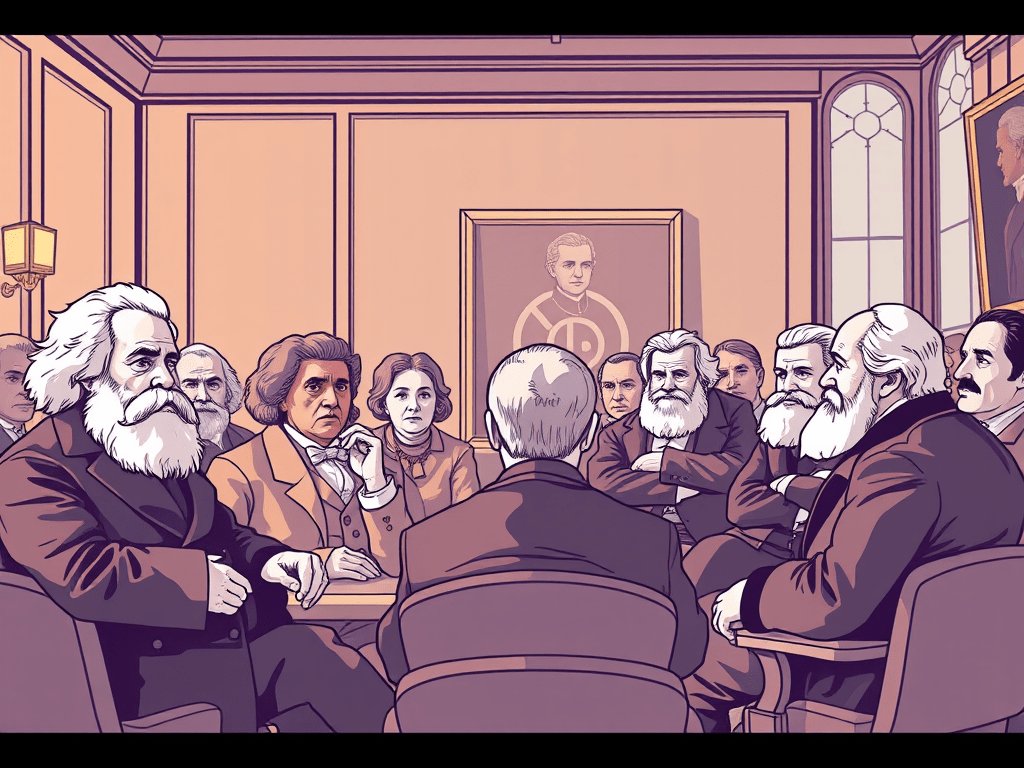
Lecture
This is a lecture on the beginnings of the socialist movement, exploring its historical roots in the wake of the Industrial Revolution and the profound social changes it triggered. The discussion will delve into key figures and philosophies that shaped early socialist thought, illustrating how these ideas emerged as a response to the exploitation of the working class and the growing disparities in wealth. By analyzing various movements and the socio-political contexts of the time, we can better understand the foundational principles that continue to influence modern socialist ideologies.
Lecture Outline
I. Introduction
• Definition and significance of the First International
• Overview of socialism and labor movements in the mid-19th century
• The International Workingmen’s Association (IWA) as a crucial development in the history of socialism
⸻
II. Historical Context and Formation
• The Industrial Revolution and Class Struggles
• Growth of industrial capitalism and the proletariat
• Exploitation of workers and poor labor conditions
• Rise of socialist and anarchist ideas as a response
• The Role of 1848 Revolutions
• Widespread revolts across Europe, driven by demands for democracy, workers’ rights, and national unification
• The revolutions’ failures and their impact on socialist movements
• Foundation of the First International (1864)
• Meeting in London at St. Martin’s Hall, organized by British and French trade unionists
• Karl Marx’s key role in drafting the Inaugural Address and defining the International’s objectives
• The structure and membership, including various socialist, anarchist, and labor groups
⸻
III. Ideological Diversity and Internal Struggles
• Key Factions and Thinkers
• Karl Marx: Advocated scientific socialism, class struggle, and workers’ revolution
• Mikhail Bakunin: Represented the anarchist faction, emphasizing direct action and the abolition of the state
• Pierre-Joseph Proudhon: Early socialist who supported mutualism and workers’ cooperatives
• Marx vs. Bakunin: The Central Dispute
• Marx’s belief in a transitional dictatorship of the proletariat vs. Bakunin’s advocacy for immediate abolition of the state
• Conflicts over leadership, organizational structure, and the use of political action
• Expulsion of Bakunin and his supporters at the 1872 Hague Congress
⸻
IV. Activities and Impact of the First International
• Workers’ Solidarity and Strikes
• Supported labor movements and strikes across Europe
• Helped coordinate international worker efforts, including in France, Germany, and Britain
• Paris Commune of 1871
• Influence of the International in the revolutionary government of Paris
• Brutal repression by the French state and its effects on socialist movements
• Marx’s analysis of the Commune as the “dictatorship of the proletariat”
• Challenges and Decline
• Increased state repression, particularly in Germany and France
• The split between Marxist and anarchist factions
• The International’s relocation to New York in 1872 and its eventual dissolution in 1876
⸻
V. Legacy and Influence
• Influence on Later Socialist Movements
• Formation of the Second International in 1889, more structured and focused on parliamentary socialism
• Influence on trade unionism and workers’ movements in Europe and beyond
• The ideological divide between anarchism and Marxism continuing into the 20th century
• The First International as a Model for Global Worker Organization
• Set a precedent for international labor cooperation
• Inspired later efforts such as the Communist International (Comintern)
⸻
VI. Conclusion
• The First International as a landmark in socialist and labor history
• The importance of its debates in shaping modern socialist thought
• The relevance of its struggles in today’s global labor movements
⸻
Bibliography
Primary Sources
• Marx, Karl. The Civil War in France (1871).
• Marx, Karl. Inaugural Address of the International Workingmen’s Association (1864).
• Bakunin, Mikhail. Statism and Anarchy (1873).
• Proudhon, Pierre-Joseph. What is Property? (1840).
Secondary Sources
• Cole, G. D. H. A History of Socialist Thought, Volume 2: Marxism and Anarchism 1850-1890. Macmillan, 1954.
• Draper, Hal. Karl Marx’s Theory of Revolution, Vol. II: The Politics of Social Classes. Monthly Review Press, 1978.
• Stekloff, G. M. History of the First International. Martin Lawrence, 1928.
• Nettl, J. P. Rosa Luxemburg. Oxford University Press, 1966. (Discusses the continuation of First International ideas)
• Thomas, Paul. Karl Marx and the Anarchists. Routledge, 1980.
 Letters from Tomis
Leave a comment