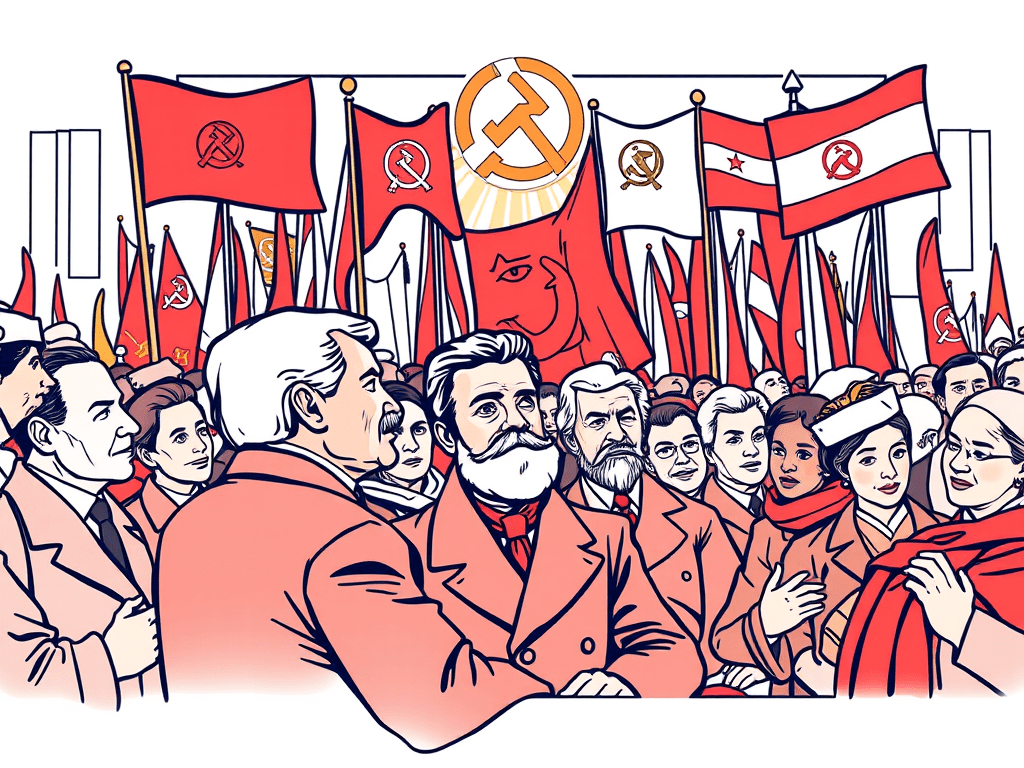
Lecture
Here is a lecture I created a while back on the history of the Second International. Use as you will…
Introduction
The Second International (1889–1916) was an organization of socialist and labor parties that sought to coordinate efforts for the advancement of socialism on an international scale. Founded in response to the growing industrial proletariat and the rise of Marxist and socialist movements, the Second International played a crucial role in shaping socialist thought, fostering international solidarity, and influencing later socialist organizations. This lecture will explore the origins, development, ideological conflicts, achievements, and decline of the Second International.
⸻
1. Origins of the Second International
A. Background: The First International (1864–1876)
Before the Second International, the First International (International Workingmen’s Association) was established in 1864 to unite working-class movements across different nations. However, internal ideological disputes—especially between Karl Marx’s followers and anarchists led by Mikhail Bakunin—led to its dissolution in 1876.
B. Revival of Socialist Internationalism
By the late 19th century, industrial capitalism had expanded, and labor movements had gained strength, particularly in Germany, France, and Britain. With Marxism becoming a dominant socialist ideology and labor unions growing in size, there was a need for a new international organization to coordinate socialist activities.
C. The Paris Congress of 1889
On July 14, 1889—coinciding with the centennial of the French Revolution—delegates from socialist and labor parties across Europe gathered in Paris to establish the Second International. The congress was dominated by Marxist-oriented parties, particularly the German Social Democratic Party (SPD), which had become the largest socialist party in Europe.
⸻
2. Structure and Ideology
A. Organizational Structure
Unlike the First International, which had a centralized leadership, the Second International functioned as a loose federation of socialist and labor parties. It held congresses every few years where delegates discussed strategy, policies, and international cooperation.
B. Dominant Ideologies
1. Marxism – Most parties in the Second International adhered to Marxist principles, advocating for class struggle, the abolition of capitalism, and the establishment of socialism through political means.
2. Revisionism – Some socialist leaders, like Eduard Bernstein, argued that socialism could be achieved gradually through democratic reforms rather than revolutionary means.
3. Revolutionary Socialism – Leaders such as Rosa Luxemburg and Lenin rejected revisionism and insisted on the necessity of revolutionary action to overthrow capitalism.
4. Syndicalism and Trade Unionism – Some factions, particularly in France and Italy, emphasized direct action, including strikes and general uprisings, as the primary means of achieving socialism.
⸻
3. Key Achievements and Activities
A. The Fight for the Eight-Hour Workday
One of the major early successes of the Second International was its advocacy for the eight-hour workday. The organization called for workers worldwide to hold demonstrations on May 1, 1890, leading to the establishment of May Day as an international day of labor solidarity.
B. Anti-War and Anti-Militarism Efforts
The Second International condemned imperialism and militarism, calling for workers to resist war. At several congresses, socialist parties pledged to oppose capitalist wars, advocating for international solidarity among workers.
C. Women’s Rights and Socialism
The Second International supported women’s rights, particularly in the context of labor and suffrage. The efforts of socialist feminists such as Clara Zetkin contributed to the establishment of International Women’s Day on March 8.
D. Opposition to Colonialism and Imperialism
Many within the Second International denounced colonialism and argued that imperialism was a byproduct of capitalism. However, socialist parties in some imperialist nations, like Britain and France, had divisions over supporting colonial policies.
⸻
4. Challenges and Internal Conflicts
A. The Reform vs. Revolution Debate
The rise of revisionism, especially Eduard Bernstein’s ideas, sparked fierce debates. Bernstein argued that capitalism was evolving to accommodate workers’ demands through reforms and democracy, making revolution unnecessary. In contrast, radicals like Karl Kautsky, Rosa Luxemburg, and Lenin opposed this view, insisting on the need for class struggle.
B. Nationalism vs. Internationalism
Although the Second International promoted international solidarity, many socialist parties prioritized national interests. This contradiction became particularly evident in the lead-up to World War I.
C. The Problem of Imperialism
While some socialists condemned imperialism outright, others in the Second International hesitated to fully oppose their own nations’ colonial policies. This inconsistency weakened the organization’s ability to present a united front.
⸻
5. The Collapse of the Second International (1914–1916)
A. The Outbreak of World War I
In 1914, the Second International faced its greatest test: the outbreak of World War I. Despite previous resolutions condemning war, most socialist parties—including the German SPD and the French Socialist Party—supported their respective national governments and voted for war credits. This was seen as a betrayal of socialist internationalism.
B. The Zimmerwald Conference (1915)
A minority of anti-war socialists, including Lenin and Rosa Luxemburg, held the Zimmerwald Conference in 1915, condemning the war and calling for revolutionary opposition. However, they lacked sufficient influence to prevent the collapse of the Second International.
C. The Final Break (1916)
By 1916, the Second International had effectively ceased to function as a united organization. The divisions between pro-war socialists, reformists, and revolutionary Marxists had become irreconcilable.
⸻
6. Legacy and Successor Organizations
A. The Third International (Comintern, 1919)
In 1919, Lenin and the Bolsheviks founded the Third International (Communist International, or Comintern), which explicitly rejected reformism and sought to promote global proletarian revolution. This marked a decisive split between communist and social-democratic movements.
B. The Socialist International (1923-Present)
After World War I, reformist socialist parties reorganized into the Labour and Socialist International (1923–1940), which later evolved into the modern Socialist International (1951–present), representing social-democratic parties worldwide.
⸻
Conclusion
The Second International played a crucial role in the development of socialism, influencing labor rights, women’s rights, and anti-war activism. However, internal ideological divisions and the failure to maintain international solidarity during World War I led to its downfall. Despite its collapse, its legacy endured in the form of later socialist and communist movements that shaped the 20th century.
 Letters from Tomis
Leave a comment