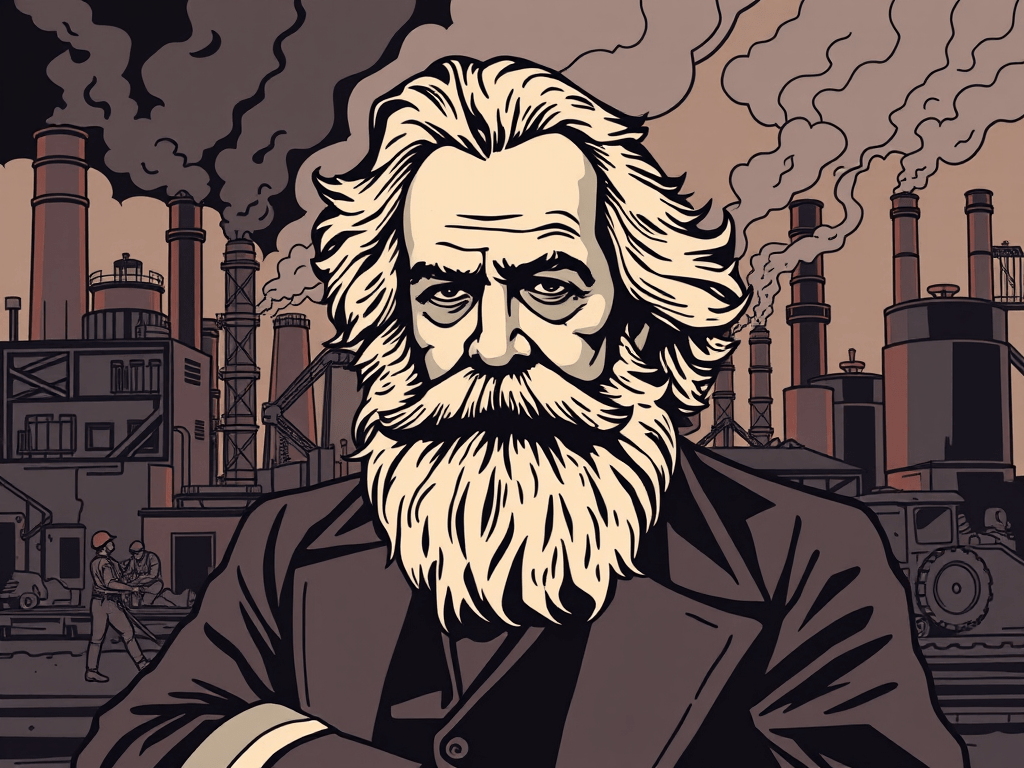
An ongoing series of reflections of my thoughts on historical materialism after reading What is Marxism: An Introduction into Marxist Theory by Rob Sewell and Alan Woods. The thoughts, opinions, and any errors are mine alone.
In the vast tapestry of human societies, few concepts have been as pivotal—and as persistently misunderstood—as that of “class.” Within the Marxist framework, class is not merely a descriptor of economic status or social stratification; it is the very engine of historical development, the crucible within which the dramas of human progress and conflict are forged.
Karl Marx, the progenitor of this analytical lens, eschewed simplistic categorizations based on income or lifestyle. Instead, he rooted his definition of class in one’s relationship to the means of production—the tools, land, factories, and resources essential for creating goods and services. In this schema, society bifurcates primarily into two antagonistic groups: the bourgeoisie, who own the means of production, and the proletariat, who, devoid of such ownership, are compelled to sell their labor to survive.
This dichotomy is not a mere academic construct but a dynamic relationship fraught with tension and exploitation. The bourgeoisie, in their pursuit of profit, extract surplus value from the labor of the proletariat—value that exceeds the compensation workers receive, thereby generating capital accumulation for the owners. This exploitative relationship is the bedrock of capitalist economies and, according to Marx, the source of inherent class conflict.
Yet, Marx’s conception of class transcends economic transactions; it encompasses consciousness and collective identity. He distinguished between a “class in itself” (Klasse an sich)—a group sharing common economic conditions—and a “class for itself” (Klasse für sich)—a group that becomes aware of its shared interests and potential power. This awakening, this transition from a passive economic category to an active political force, is the catalyst for revolutionary change.
Critics often accuse Marx of economic determinism, alleging that he reduces the rich tapestry of human experience to mere financial interactions. Such critiques, however, overlook the profundity of Marx’s analysis. He recognized that economic structures shape, but do not solely define, human relations. The superstructure of society—its politics, culture, and ideology—is both a product of and a reinforcement for the underlying economic base. Thus, class struggle manifests not only in factory floors and picket lines but also in parliaments, churches, and schools.
In contemporary discourse, the term “working class” has been diluted, often employed as a catch-all phrase devoid of analytical precision. Politicians and pundits wield it to evoke empathy or solidarity, yet seldom grapple with its Marxist implications. To Marx, the working class is not an identity to be claimed but a position within a system of production—a position marked by exploitation and endowed with the revolutionary potential to overthrow the existing order.
Understanding Marx’s definition of class is not an exercise in ideological nostalgia but a vital tool for deciphering the complexities of modern capitalism. As economic inequalities widen and labor becomes increasingly precarious, the relevance of class analysis resurfaces with renewed urgency. Marx invites us to see beyond the illusions of meritocracy and individualism, urging a recognition of the collective forces that shape our destinies.
In essence, class, through the Marxist lens, is the heartbeat of societal evolution. It is the struggle between those who control the means of production and those who labor within them that propels history forward, often through convulsions of conflict and revolution. To grasp this is to hold a key to understanding the past, critiquing the present, and envisioning a future where the emancipation of the proletariat leads to the liberation of all humanity.
 Letters from Tomis
Leave a comment