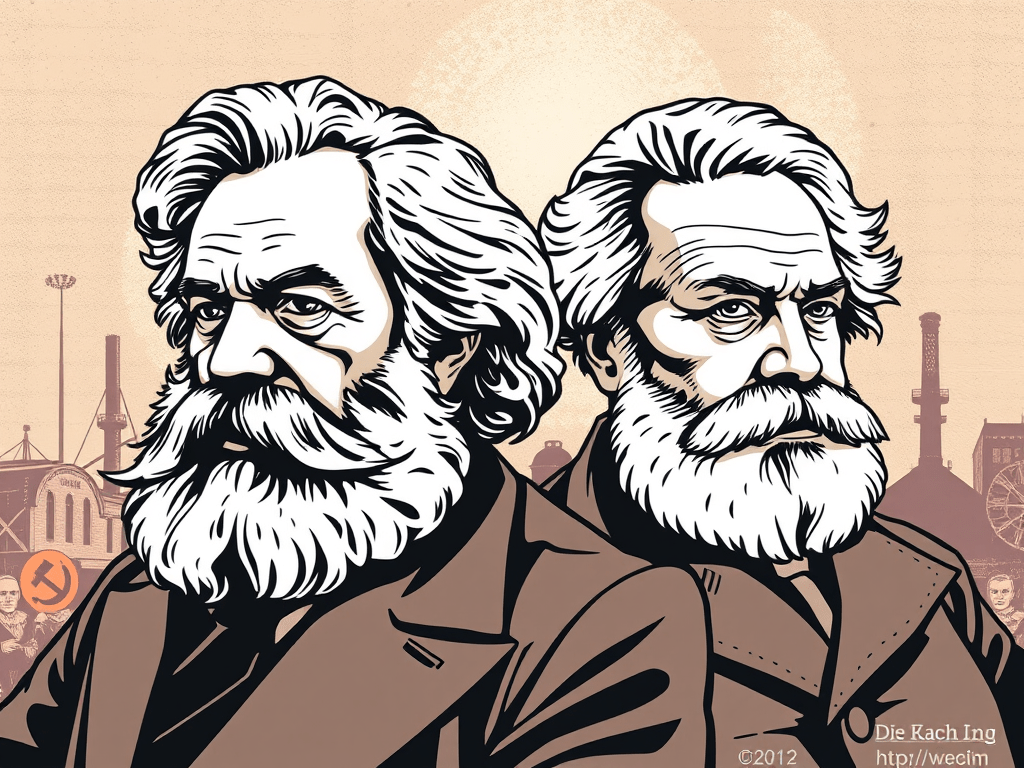
Sixteenth in a series of reflections on my thoughts after reading What is Marxism: An Introduction into Marxist Theory by Rob Sewell and Alan Woods. The thoughts, opinions, and any errors are mine alone.
It is a curious thing, is it not, that so much ink has been spilled on account of two men, Karl Marx and Friedrich Engels, who dared to transmute the abstractions of philosophy into the urgent grammar of revolution. Marx and Engels, whose partnership rivaled in intensity and output that of the most enduring collaborations, reshaped not just political thought but also the way humanity perceives itself. Yet to confine their contribution to mere “philosophy” is to diminish them. It was precisely their revolt against philosophy in its ivory-tower form—the Hegelian word-games and scholastic detours—that marked their signal achievement. They sought to marry thought to action, to render ideas combustible, and in so doing, they aimed to rewrite the history of human suffering.
Marx and Engels were, first and foremost, materialists. This commitment places them squarely in the tradition of Enlightenment thinkers who sought to explain the world in terms of observable, earthly forces rather than celestial diktats. But their materialism was dynamic rather than static. To them, society was not a collection of inert atoms but a swirling vortex of productive forces and relations. Borrowing from Hegel’s dialectics—but turning it on its head, as Marx cheekily put it—they argued that history was propelled by contradictions between the means of production and the social relations they engendered. Here lies their first great philosophical contribution: the idea that history has a logic, a direction, but one that is rooted in economic realities rather than metaphysical inevitabilities.
Marx and Engels rejected the “utopian socialism” of their contemporaries, which relied on moral exhortation and airy dreams of universal brotherhood. Instead, they grounded their vision in what they saw as the inexorable workings of capitalism itself. Capitalism, they argued, was a revolutionary force—it tore down feudal hierarchies, unleashed the productive potential of humanity, and knit the globe together in a web of commerce. But, as they so memorably put it in The Communist Manifesto, capitalism also sowed the seeds of its own destruction. The exploitation of labor, the concentration of wealth, and the cyclical crises endemic to the system would inevitably lead to its collapse and replacement by socialism. Whether one agrees with this prognosis or not—and history has certainly not been kind to some of its predictions—it must be admitted that Marx and Engels transformed the very terms of debate. They gave us a framework for analyzing power, exploitation, and class struggle that remains, if not definitive, then certainly indispensable.
Their second major philosophical innovation was their theory of ideology. In The German Ideology, they argued that the ruling ideas of any epoch are those of the ruling class. This insight, so simple yet so profound, undermines the pretense of “neutrality” in philosophy, law, and culture. Ideology, for Marx and Engels, is not merely a set of ideas but a veil that obscures the material interests underlying them. It is the false consciousness that allows the worker to accept his chains as natural, the citizen to regard the state as impartial, and the philosopher to mistake abstractions for eternal truths. In this, Marx and Engels inaugurated a mode of critique that would echo through the ages, from the Frankfurt School to postmodernism. It is hard to imagine a Michel Foucault or a Noam Chomsky without the foundation they laid.
Marx and Engels were not perfect, prescient prophets, nor were they saints. They were, instead, relentless critics of the status quo, determined to expose the hidden structures of power and exploitation that undergird society. Their philosophy is not a roadmap to utopia but a set of tools for understanding and challenging the world as it is. And if they were wrong about some things—about the capacity of human beings to transcend their baser instincts—they were right about this: that the philosophers have hitherto only interpreted the world, but the point is to change it.
It is a sentiment that should make us uneasy, as all profound truths do. For it leaves us not with the comfort of certainty but with the burden of responsibility. Marx and Engels may have given us the means to see the world more clearly, but the task of transforming it remains unfinished, as urgent and fraught as ever. And that, perhaps, is their most enduring gift to philosophy: not a doctrine, but a challenge.
 Letters from Tomis
Leave a comment