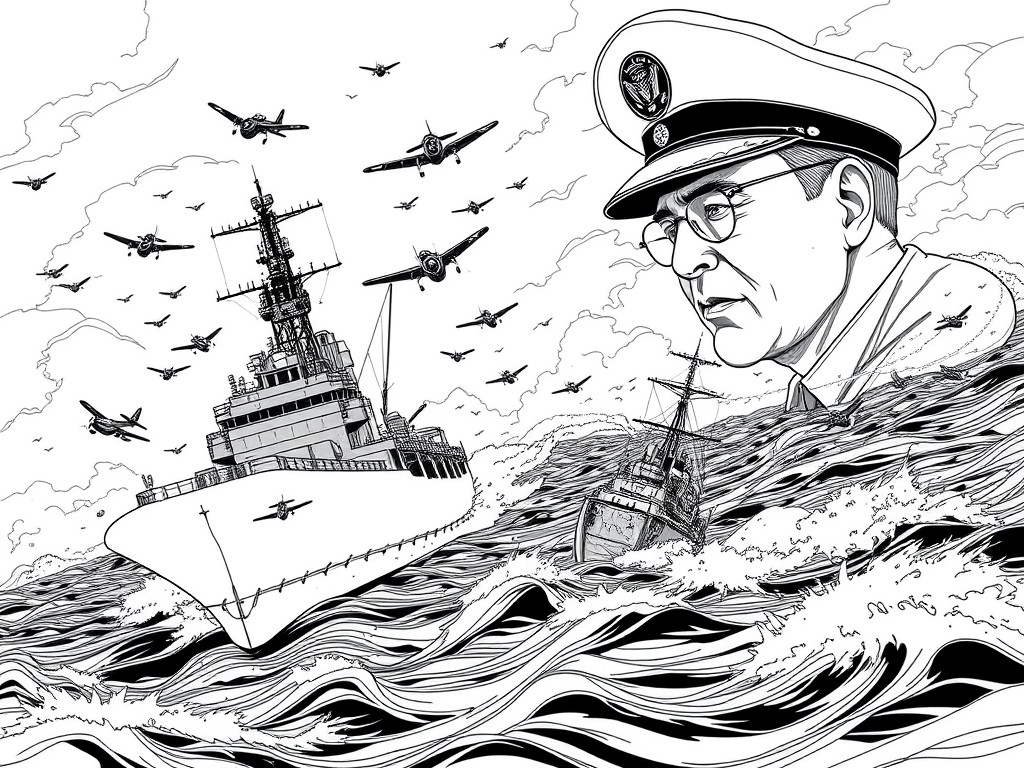
Toll, Ian W. The Conquering Tide: War in the Pacific Islands, 1942–1944. W.W. Norton & Company, 2015.
Ian W. Toll’s The Conquering Tide: War in the Pacific Islands, 1942–1944 occupies a distinctive position in contemporary naval and military historiography. As the second volume of Toll’s Pacific War Trilogy, it bears the weight of narrative transition: the U.S. Navy and Marine Corps have survived Midway and the chaotic bloodletting of early 1942, yet they have not yet entered the climactic firestorms of 1944–45. This middle volume could easily have become a bridge-text, a mere connective tissue between the dramatic opening and the final apocalyptic crescendo of the war. Instead, The Conquering Tide emerges as the trilogy’s dramatic centerpiece — a sweeping, meticulously researched, and thematically rich study of the Allied Pacific counteroffensive in all its operational, environmental, and human complexity.
In roughly 700 pages, Toll chronicles the transformation of the Pacific War from a defensive struggle to an expansive, multidimensional campaign of encirclement, attrition, and amphibious advance. He explores, with equal ease, the minutiae of logistics, the vast strategic shifts of 1943–44, the personalities of commanders, and the brutal realities endured by common soldiers and sailors. Yet the achievement of The Conquering Tide is more than narrative comprehensiveness; it is a synthesis of compelling storytelling, historiographical rigor, and a deeply humane engagement with the lived experience of total war.
This essay critically evaluates Toll’s contribution on four analytic fronts:
1. Narrative methodology and historiographical intervention
2. Operational and strategic analysis
3. Representation of combatants and human experience
4. Limitations and areas of historiographical tension
I. Narrative Methodology: Synthesis as Method
Toll writes in the tradition of Samuel Eliot Morison, John Keegan, and Paul Fussell, combining literary narrative with archival empiricism. His method is neither strictly microhistorical nor wholly panoramic; instead, it is a tapestry woven from hundreds of individual threads, each representing a diary entry, a letter, a combat report, or a postwar interview. For this reason, Toll’s narrative defies simple categorization. It is both an operational history of the Pacific War and a socio-cultural history of the American and Japanese militaries.
Blending the Operational and the Intimate
The opening chapters, describing the grinding attrition of the Guadalcanal campaign and the expanding American logistical footprint, exemplify this hybrid narrative. Toll shifts fluidly between:
• the high-command deliberations of Nimitz, Halsey, and Yamamoto
• the bureaucratic struggle to synchronize U.S. shipyards, air production, and fuel logistics
• and the desperate testimonies of Marines huddled on rain-soaked ridges or sailors trapped inside burning steel compartments
This technique allows Toll to highlight the central insight of much modern military scholarship: war is not shaped by operational decisions alone but also by systems, supply lines, morale, weather, terrain, and chance.
Toll’s prose is vivid without sacrificing analytic clarity. Particularly memorable is his description of the Central Pacific’s coral atolls as “rings of bone in a blue infinity,” an image that recurs symbolically in later chapters. This stylistic consistency gives the work a literary character unusual in contemporary naval histories, enhancing its accessibility without diminishing its scholarly credibility.
Historiographical Positioning
Toll situates himself implicitly against two historiographical tendencies:
1. The triumphalist, technocratic American narrative, which exaggerates U.S. superiority in doctrine and equipment.
2. The culturalist Japanese-soldier-as-fanatic narrative, which reduces Japanese behavior to essentialized stereotypes.
While Toll does not explicitly argue with these traditions, his choices of evidence, structure, and tone undermine both. His inclusion of Japanese planning failures, morale debates, and interservice rivalries, mirrored against American uncertainties, produces a more balanced tableau of human institutions struggling in the face of overwhelming logistical and geographic obstacles.
II. Operational and Strategic Analysis: Recasting the Island-Hopping Narrative
One of Toll’s central contributions is the reframing of the island-hopping campaign. Rather than presenting it as a predetermined sequence of amphibious conquests — the model that dominated mid-century American historiography — Toll portrays it as a contested improvisation, shaped by interservice rivalry, political constraints, and the stubborn realities of distance.
Logistics as Destiny
Toll frequently emphasizes a theme central to modern strategic studies: logistics precede strategy. The U.S. victory in the mid-war period was not simply the result of naval aviation or codebreaking, but also of industrial mobilization:
• the steel flowing from Pittsburgh
• the aircraft engines from continental factories
• the convoys of fuel oil stretching thousands of miles
• the evolution of amphibious doctrine and specialized craft
Toll describes this colossal logistical machine with a novelist’s attention to texture. Shipyards “hammered and hissed like titanic organs,” while the 1943 shipbuilding schedule “was itself an operational weapon.” The metaphor is apt: the United States did not merely fight — it manufactured the conditions for victory.
The Solomons and New Guinea: A War of Small Edges
In chronicling the Solomon Islands and New Guinea, Toll demonstrates that Allied progress was frequently incremental, not dramatic. Battles like Kolombangara, Vella Gulf, and Cape Gloucester were obscure to the American public at the time and remain so today. Yet Toll argues convincingly that these engagements collectively eroded Japanese naval and air power and strained Japanese supply lines to their breaking point.
He interprets these mid-war campaigns not as sideshows but as the learning ground for integrated naval-air-amphibious doctrine. The “struggle for small edges,” as one might call it, becomes the book’s conceptual core — a framing aligned with contemporary strategic theory, which emphasizes cumulative advantage rather than decisive battle.
The Marianas: A Strategic Decisive Point
The book culminates in the 1944 seizure of Saipan, Tinian, and Guam — operations Toll elevates to their proper strategic significance. He rightly stresses that the capture of the Marianas placed Japan within range of the B-29 bomber, transforming the Pacific War from a naval contest to a strategic air war.
Toll’s lengthy narrative of the Battle of the Philippine Sea (“The Great Marianas Turkey Shoot”) is one of the book’s strongest sections. His analysis refuses oversimplification: the U.S. tactical victory was overwhelming, but Toll emphasizes the Japanese pilots’ courage amid near-certain death and highlights the systemic failures in Japanese training pipelines and aircraft production.
III. Representations of Combatants and the Human Experience of War
Toll is at his best when chronicling the human dimension of combat. His portrayal of Pacific warfare is neither heroic nor cynical, but tragic — a mode reminiscent of John Dower’s War Without Mercy and E.B. Sledge’s With the Old Breed.
American Combatants: Endurance Over Heroism
American Marines and soldiers in Toll’s narrative are not mythic warriors but exhausted young men navigating:
• jungle rot
• malarial fevers
• logistical shortages
• leadership uncertainties
• and the psychological weight of a war seemingly without end
Toll resists the romanticized Marine Corps iconography prevalent in postwar Hollywood. Instead, he presents the Marines’ effectiveness as emerging from discipline, training, and a powerful support network — not intrinsic superiority.
Japanese Combatants: A Nuanced Portrayal
A major historiographical strength of The Conquering Tide lies in its representation of Japanese servicemen. Toll avoids caricature by:
• portraying Japanese morale debates
• explaining the cultural and institutional roots of gyokusai (honorable death) doctrine
• and illustrating the systemic failures that trapped many Japanese garrisons in hopeless positions
The treatment of Japanese defenders on Tarawa, Saipan, and Biak is particularly affecting. Toll shows that fanatic resistance was not merely ideological zeal but often a rational response to the collapse of Japan’s logistical ability to support evacuation or resupply.
Civilians in the Crossfire
Toll also foregrounds the fate of Pacific Islanders and Japanese civilians. His treatment of the Saipan civilian suicides — one of the most tragic episodes of 1944 — is sober, compassionate, and free of sensationalism. He situates the suicides within a framework of propaganda, fear, and the collapse of Japanese authority, rather than reducing them to spectacle.
IV. Limitations, Silences, and Tensions
Despite its enormous strengths, The Conquering Tide is not without limitations.
A U.S.-Centered Narrative
While Toll includes substantial attention to Japanese strategy and experience, the work remains structurally American-centric. Allied (non-U.S.) contributions — particularly those of Australian forces in New Guinea — appear intermittently, and often only as context for American operations. Given the book’s scope, this imbalance is understandable but worth noting.
Underrepresentation of Indigenous Pacific Experiences
Pacific Islanders appear frequently in anecdotal or observational roles but seldom as full historical subjects. Toll illuminates the devastation of war on native populations, yet he does not explore in depth:
• indigenous war labor
• the long-term ecological consequences
• or the political transformations experienced across Micronesia, Melanesia, and Polynesia
This gap is increasingly visible given the scholarship of scholars such as Epeli Hau‘ofa, Robert Kiste, and Geoffrey White.
Limited Engagement with Broader Historiography
Toll’s narrative is comprehensive, but his analytic engagement with academic historiography is often implicit rather than explicit. Readers familiar with debates about military culture, operational learning, or modernization theory may wish for more direct dialogue with works by Williamson Murray, Richard Overy, or H.P. Willmott.
Compression of the Southwest Pacific
The New Guinea campaigns — crucial arenas of strategic development — receive less depth than the Central Pacific thrust. Toll acknowledges the complexity of MacArthur’s command but does not explore the full political dimensions of Army–Navy rivalry, an omission that narrows the analytical scope.
Conclusion: A Monument of Modern Naval Historiography
Despite its limitations, The Conquering Tide stands as a monumental achievement in twenty-first-century military history. Toll succeeds in crafting a narrative that is at once operationally rigorous and emotionally resonant. He demonstrates that the Pacific War was shaped not by technological determinism or heroic myth, but by:
• industrial capacity
• organizational learning
• human endurance
• environmental hardship
• political contingency
• and the grinding attrition of men, machines, and morale
His contribution to interpreting the Pacific War’s middle period is indispensable. For graduate students, policy analysts, and military professionals, The Conquering Tide provides not only a rich empirical narrative but also a cautionary meditation on the cost of global conflict — a reminder that modern industrial war is fundamentally a war of systems, fought by humans who bear the consequences in their bodies and memories.
As a middle volume of a trilogy, its achievement is extraordinary; as a standalone work, it is one of the finest modern histories of the Pacific War.
 Letters from Tomis
Leave a comment