Book Review
Zola, Émile. The Dream (Le Rêve). Translated by Ernest Alfred Vizetelly, Oxford University Press, 1998.
Émile Zola’s Le Rêve (The Dream, 1888) occupies an intriguing and often misunderstood position within the Rougon-Macquart cycle. Written after the naturalistic vigor of L’Assommoir (1877) and Germinal (1885), this sixteenth installment seems, at first glance, a retreat into ethereal sentimentality and religious idealism. Yet beneath its delicate surface lies a continuation of Zola’s deterministic vision, refracted through the lens of Catholic mysticism and bourgeois morality. The Dream thus operates as a counterpoint within the Rougon-Macquart series—a text that complicates rather than abandons Zola’s naturalism, engaging with the ideological contradictions between faith, heredity, and desire.
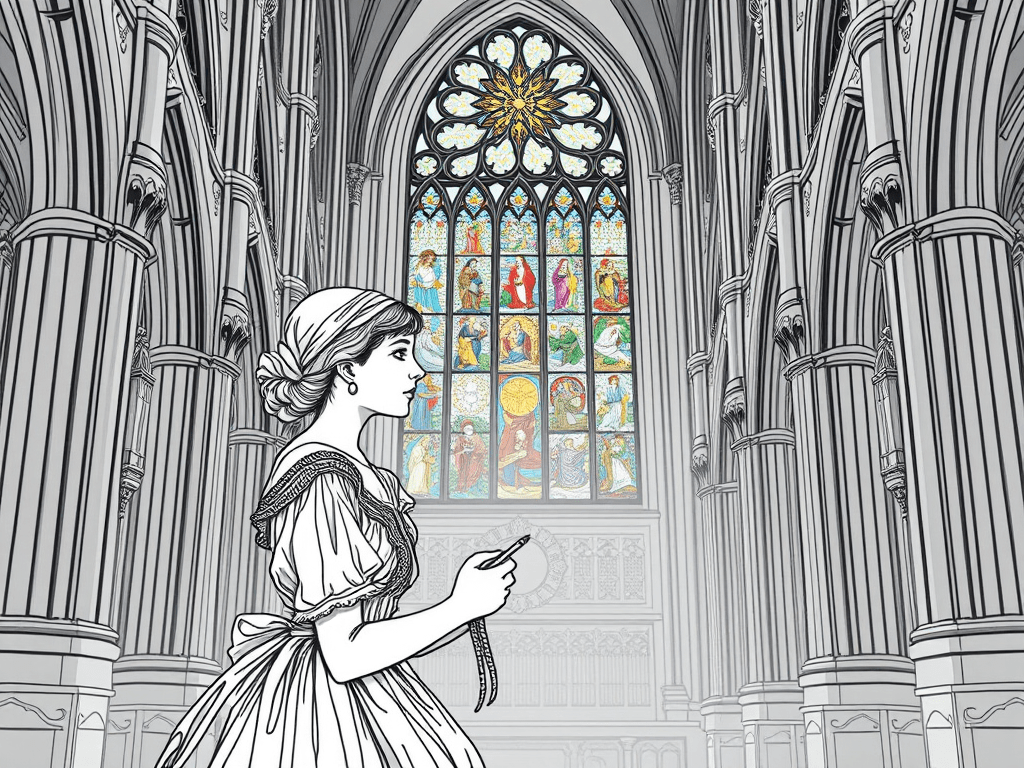
The novel centers on Angélique, an orphaned embroiderer adopted by the devout Hubert family, who falls in love with Félicien, a young nobleman and son of a bishop. Their love story unfolds within the shadow of the Gothic cathedral of Beaumont, an architectural symbol of spiritual aspiration and repression. On the surface, Zola’s treatment of Angélique appears to renounce the sociological realism that defined his earlier works. The prose, suffused with symbolism and hagiographic imagery, departs from the industrial or urban settings that anchored his critique of capitalist society. However, this aesthetic transformation conceals an underlying determinism. Angélique’s dream of purity and transcendence is a pathological outgrowth of her heredity as a Rougon-Macquart—her neurosis and religiosity serve as sublimations of the same biological and social forces that produce vice and degeneration elsewhere in the series.
Critically, The Dream reveals Zola’s ambivalence toward the ideological reach of naturalism itself. The novel’s title foregrounds illusion as both aesthetic and epistemological problem. Zola’s scientific method, when applied to the domain of faith and sentiment, exposes the instability of positivist materialism in the face of metaphysical yearning. Angélique’s ecstatic death, occurring precisely at the moment her “dream” of union with Félicien is realized, literalizes the collapse of idealism under the weight of determinism. The novel thus enacts a dialectic between scientific observation and spiritual transcendence, positioning Zola’s project within the broader fin-de-siècle crisis of faith and reason.
Moreover, The Dream functions as a critique of patriarchal control and clerical authority. The cathedral, described with exquisite architectural precision, operates as both sanctuary and prison. Félicien’s father, the Bishop of Beaumont, embodies institutional repression—his opposition to their marriage is motivated not by theology but by class and decorum. Angélique’s sanctification at the novel’s end, achieved through death rather than social liberation, exposes the tragic limits imposed on women by both religion and patriarchy. Zola’s seeming idealism thus carries an ironic edge: divine grace becomes indistinguishable from social annihilation.
From a stylistic perspective, The Dream marks Zola’s experiment with what might be termed “symbolic naturalism.” The prose oscillates between empirical precision and lyrical transcendence, uniting medieval imagery with modern determinism. The embroidered vestments and stained-glass windows mirror Zola’s narrative craft—each detail contributing to an aesthetic of enclosure that mirrors Angélique’s psychic world. In this sense, The Dream anticipates later modernist explorations of interiority and mysticism, from Huysmans to Proust.
In sum, The Dream should not be dismissed as an anomalous or sentimental deviation within Zola’s oeuvre. Rather, it crystallizes the contradictions inherent in the naturalist project—the tension between scientific determinism and the irrepressible human yearning for transcendence. Through Angélique’s tragic idealism, Zola dramatizes the collapse of faith, class, and gender into a single aesthetic vision of doomed perfection. The novel remains, therefore, a haunting meditation on the limits of realism and the persistence of the dream within the machinery of modernity.
 Letters from Tomis
Leave a comment