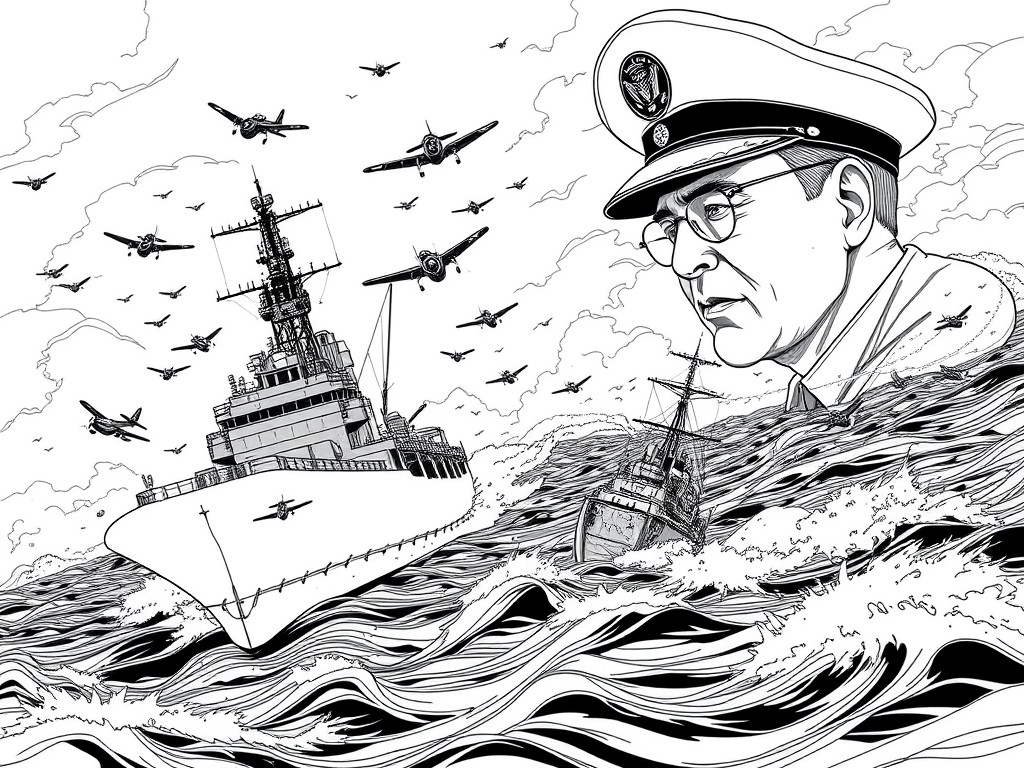
Book Review
Toll, Ian W. Pacific Crucible: War at Sea in the Pacific, 1941–1942. W. W. Norton & Company, 2011.
Ian W. Toll’s Pacific Crucible inaugurates his Pacific War trilogy with a sweeping, analytically grounded narrative of the conflict’s first act—from the shock of Pearl Harbor through the inflection points at the Coral Sea and Midway and the early months around Guadalcanal. The book’s signal achievement lies in its synthesis: Toll fuses operational history, biography of high command, technological change, and the political economy of mobilization into a coherent account that is at once readable and historiographically conversant.
Methodologically, Toll pursues a narrative strategy that privileges decision-making under uncertainty. Admiral Yamamoto, Chester Nimitz, William Halsey, and Joseph Rochefort emerge not as deterministic agents of victory or defeat but as improvisers in a fog of intelligence gaps, logistical constraints, and doctrinal half-lives. Toll’s treatment of codebreaking—Station HYPO’s labor and the contested status of Rochefort—exemplifies this approach: intelligence is neither an omniscient deus ex machina nor a mere footnote to matériel superiority. Instead, it appears as probabilistic advantage, unevenly perceived and politically mediated. The payoff is interpretive clarity about why Midway was both contingent and overdetermined: contingent in its execution (decks caught mid-rearmament, search arcs missed, timing luck), yet increasingly overdetermined by the strategic misalignment produced by Japan’s “decisive battle” (kantei kessen) doctrine and the United States’ accelerating industrial mobilization.
Toll’s command of the operational literature is evident, particularly in his reconstruction of carrier warfare’s rapid maturation. He tracks the U.S. Navy’s doctrinal learning curve—from prewar Mahanian preferences for battle lines to the emergent grammar of task force operations, deck-load strikes, and combat information centers. The analysis of Coral Sea avoids teleology: rather than a mere prelude to Midway, it is read as a crucible in which both sides tested the parameters of offense, scouting, and air group coordination. Similarly, Toll’s Midway narrative accommodates both “Shattered Sword”–style insights into Japanese deck and ordnance cycles and the more traditional focus on command intent, without lapsing into technical minutiae that would unmoor general readers. For scholars, this balance will seem judicious if sometimes conservative; for graduate students, it models how to integrate technical debates into a larger strategic story.
The book’s structural intelligence rests on its alternating scale. Toll frequently zooms out to the war’s political economy (the mobilization state, shipbuilding schedules, training pipelines) and then back in to cockpit-level decision points. These transitions do analytic work: they demonstrate how macro-level asymmetries—oil, industrial capacity, pilot replacement—translated into micro-level tempo advantages at sea. The portrait of Japan’s early-war virtuosity—adept aircrews, night fighting, torpedoes—sits beside a sober audit of its brittle replacement system and doctrinal rigidity. Conversely, the United States’ early deficits in pilot quality and sortie coordination are contextualized within an institutional ecology that could absorb loss and scale learning. Toll thus resists both triumphalism and fatalism, offering a dynamic model of adaptation.
Toll is also attentive to culture and morale without succumbing to essentialism. Vignettes on training regimes, shipboard life, and the moral shock of Pearl Harbor supply texture while illuminating operational outcomes: high-risk aggressiveness in Japanese strike doctrine, American tolerance for tactical loss in pursuit of strategic patience. His account of the Roosevelt administration’s narrative shaping—crafting a political language for a naval-air war in a continental democracy—adds an underappreciated layer to the story of resource mobilization.
If the book has limitations, they are largely the by-products of its chosen scope. The emphasis on the U.S.–Japan dyad and on carrier warfare leaves allied perspectives (Australian, Dutch, British Eastern Fleet) comparatively thin, and the Chinese theater is necessarily peripheral. Social histories of the home fronts appear episodically rather than systematically; Pacific Islanders’ experiences and labor, for instance, surface mostly when directly relevant to base construction or reconnaissance. On the Japanese side, although Toll draws on a range of secondary scholarship and translated sources, the narrative’s center of gravity remains within Anglophone debates; specialists may wish for deeper engagement with Japanese-language operational studies and postwar doctrinal critiques. Finally, Toll’s gift for character portraiture occasionally recenters Great-Man vantage points at the expense of staff processes, though he is generally careful to show the bureaucratic and inter-service frictions—Navy-Army rivalry in Tokyo, and U.S. Navy debates over carrier concentration—that shaped outcomes.
Historiographically, Pacific Crucible sits in fruitful conversation with John Lundstrom on early carrier air combat, Parshall and Tully on Midway, H. P. Willmott and Ronald Spector on grand strategy, Peattie and Evans on the Imperial Japanese Navy, and Richard Frank on Guadalcanal. Toll’s distinctive contribution is not a revisionist thesis so much as a re-presentation of the 1941–42 arc that integrates those specialist literatures into a narrative with explanatory bite. His maps are clear, his apparatus solid, and his prose frequently luminous without romanticizing combat. The result is a work that can anchor a graduate seminar on the Pacific naval war’s opening year while remaining accessible enough to assign alongside more technical monographs.
Pedagogically, the book is especially valuable for modeling causal reasoning in military history. Toll demonstrates how to track mechanisms across levels—how industrial policy shapes training pipelines; how training regimes produce tactical doctrine; how doctrine interacts with intelligence and geography to generate operational opportunity. Students can mine the text for case-comparisons (e.g., Japanese scouting failures at Midway versus U.S. search doctrine; Coral Sea’s reciprocal attrition versus Midway’s asymmetric strike timing) and for evaluating counterfactuals without overreaching. In this sense, Pacific Crucible is not only a narrative of what happened but a study in how complex organizations learn—or fail to learn—in war.
In sum, Pacific Crucible earns its place among the essential accounts of the Pacific War’s opening phase. It is a capacious synthesis that rewards expert readers with judicious engagement of specialist debates while providing a clear analytic through-line for newcomers. Its chief virtues—narrative clarity, multilevel analysis, and respect for contingency—more than compensate for the inevitable tradeoffs of scope. As an entry point into the Pacific War’s maritime revolution and as a model of historically informed strategic analysis, Toll’s volume is superb.
 Letters from Tomis
Leave a comment