Introduction
In April 1914, a brutal confrontation between striking coal miners and armed forces of capital unfolded in the small community of Ludlow, Colorado. The event, later known as the Ludlow Massacre, has since stood as one of the bloodiest episodes in American labor history. From a Marxist perspective, the massacre was far more than a local tragedy; it was a vivid illustration of class struggle in its most naked form. On one side stood the coal miners and their families – largely immigrant workers living in dire conditions – united in a fight for basic rights and dignity. Opposing them were the mine owners, backed by the apparatus of the capitalist state and private gunmen, determined to crush the workers’ strike to protect profits. This essay examines the Ludlow Massacre through a Marxist lens, analyzing the event as a manifestation of capitalist exploitation and class conflict. It will highlight the solidarity and resistance shown by the workers in the face of oppression and draw parallels between this historical struggle and modern socialist movements. In doing so, we can better understand how the themes of labor conditions, union suppression, and capitalist opposition at Ludlow echo in contemporary society, reinforcing the enduring relevance of class struggle.
Historical Context: Coal, Capital, and Labor in Early 20th Century America
By the early 20th century, coal mining was a cornerstone of American industrial capitalism – and one of its most exploitative industries. In southern Colorado, vast coal deposits were controlled by powerful corporations such as Colorado Fuel and Iron Company (CF&I), a firm partially owned by the Rockefeller family. Thousands of miners, many of them recent immigrants from Europe and Mexico, toiled in these mines under dangerous conditions. The workdays were gruelingly long, often 10 to 12 hours or more, and miners were paid low wages that barely sustained their families. Employers routinely found ways to extract extra labor without compensation: miners received no pay for so-called “dead work” – tasks like clearing rubble, laying track, and shoring up tunnels to make the mines operable. Pay was often calculated by the weight of coal mined, but companies manipulated the scales or used larger ton measurements to cheat workers of their due. In addition, the coal operators imposed a pervasive control over miners’ lives through company towns.
In these company towns, the mine owners provided housing and services – but at a price. Families lived in company-owned houses which were often shabbily built and lacked basic comforts. Rent and the cost of living were effectively deducted from miners’ wages, since many had to shop at company stores and send their children to company-run schools. In some cases, miners were paid in scrip (a form of company-issued currency), usable only at the company store, preventing them from seeking cheaper goods elsewhere. This economic bondage meant that even the meager wages miners earned found their way back into the owners’ coffers. Medical care came from company doctors, and leisure was limited by the oversight of company agents. Such a system created a captive workforce and maximized the operators’ profits, but it bred enormous resentment. The miners understood that they were producing great wealth – especially for absentee industrialists like John D. Rockefeller Jr. – while they themselves lived in poverty, debt, and peril. Conditions in the mines were notoriously dangerous; accidents, explosions, and chronic illness like black lung disease were commonplace, with little effort by companies to improve safety. Every element of this scenario reflects what Karl Marx identified as the exploitation of labor: the workers’ surplus value was being extracted to enrich the owners, and any expenditure that could ensure workers’ well-being (higher pay, safety measures, decent housing) was minimized to preserve profit.
The miners’ plight did not go unchallenged. Across Colorado and the broader United States, the early 1900s were a time of rising labor consciousness and organization. The United Mine Workers of America (UMWA) was actively recruiting and mobilizing coal miners to demand better conditions. Years of smaller strikes and grievances set the stage for a larger confrontation. By 1913, discontent in the Colorado coalfields had reached a boiling point. The UMWA drew up a list of demands aimed at addressing the most egregious abuses. Among the key demands were: official recognition of the union as the miners’ bargaining representative; an eight-hour workday (enforcement of an existing state law that was widely ignored by the companies); payment for dead work and honest weight measurements for coal (to prevent the company from cheating workers by weight manipulation); a living wage and the right to shop at stores of their choice (ending the monopoly of company stores and scrip system); the freedom to choose their own housing and doctors (rather than being forced into company housing and medical care); and importantly, the abolition of the company guard system – the private armies of security hired by the companies to police and intimidate the workforce. These demands struck at both the economic exploitation (wages, hours, safety) and the feudal-like control that the companies exerted over miners’ lives.
The coal operators flatly rejected the miners’ petition. In September 1913, the UMWA called a strike, and thousands of miners in southern Colorado walked off the job. The miners and their families were immediately evicted from the company-owned houses in which they lived – a common tactic by employers in that era to punish and break strikes. In response, the union arranged a makeshift solution: tent colonies. Hundreds of canvas tents were erected on open land just outside the company property, leased or loaned by sympathetic landowners and union supporters. One of the largest of these tent camps was at Ludlow, an area near several mines. Roughly 1,200 people – miners, their wives, children, and other relatives – settled into the Ludlow tent colony, bracing for what they knew could be a long and bitter struggle. Despite the primitive conditions (winter in the Rockies is harsh, and families huddled around cast-iron stoves in canvas tents), the strikers maintained high morale, sustained by a spirit of solidarity. They organized themselves with a camp committee, held daily meetings, and even dug cellars beneath the tents both as storage and as shelters in case of gunfire. These arrangements reflected an acute awareness that violence was looming. Indeed, the mining companies wasted no time in escalating their efforts to break the strike.
The Ludlow Massacre: Class Conflict Erupts in Violence
From the outset of the strike, it was clear that the coal companies – representing the capitalist class in this conflict – were prepared to use force and coercion to crush the workers’ movement. They employed the Baldwin-Felts Detective Agency, a notorious private security outfit infamous for strike-breaking, to harass the strikers. Baldwin-Felts agents, essentially private mercenaries on the company payroll, prowled the perimeter of the tent camps. They trained searchlights on the tents at night, denying families rest, and sporadically sprayed the camps with gunfire. These attacks were not random accidents but deliberate acts of intimidation; several strikers and family members were wounded or killed in the weeks and months before the final massacre. The companies even had an armored car – ominously nicknamed the “Death Special” by the miners – which was outfitted with a machine gun and driven around the camp boundaries to terrorize the inhabitants. This private war on the strikers demonstrated a fundamental tenet of Marxist analysis: the capitalist class will not hesitate to marshal superior violence to maintain its dominance. The coal owners, far from negotiating over the workers’ legitimate grievances, treated the strike as an insurrection to be bloodily put down.
Tensions continued to mount through the autumn of 1913 and into the spring of 1914. Local law enforcement, under the sway of the mine operators, deputized company loyalists and strikebreakers, essentially expanding the ranks of armed anti-union forces. Isolated gunfights and skirmishes occurred as some strikers armed themselves in self-defense. In October 1913, Colorado’s governor, Elias Ammons, responding to the unrest (and doubtless pressured by the powerful mine owners), called in the Colorado National Guard to occupy the strike zone. Initially, the presence of the state militia brought a tense calm; many miners hoped the Guard would be a neutral peacekeeper. However, any pretense of neutrality soon evaporated. The National Guard officers openly sided with the companies. Many guardsmen were themselves locals reliant on the mining company for income, or had been given incentives by the company. Discipline in the Guard units deteriorated over time as funding for their deployment ran low, leading some guardsmen to drift away and be replaced by new hires – often the very Baldwin-Felts agents and company gunmen who had been harassing the camps. In effect, the National Guard deployment became indistinguishable from the company’s private army. This convergence of state power and private capital’s interests is a textbook example of the Marxist assertion that the state functions as an instrument of class rule. In Ludlow, the state militia was used to enforce the will of the mine owners against the working class.
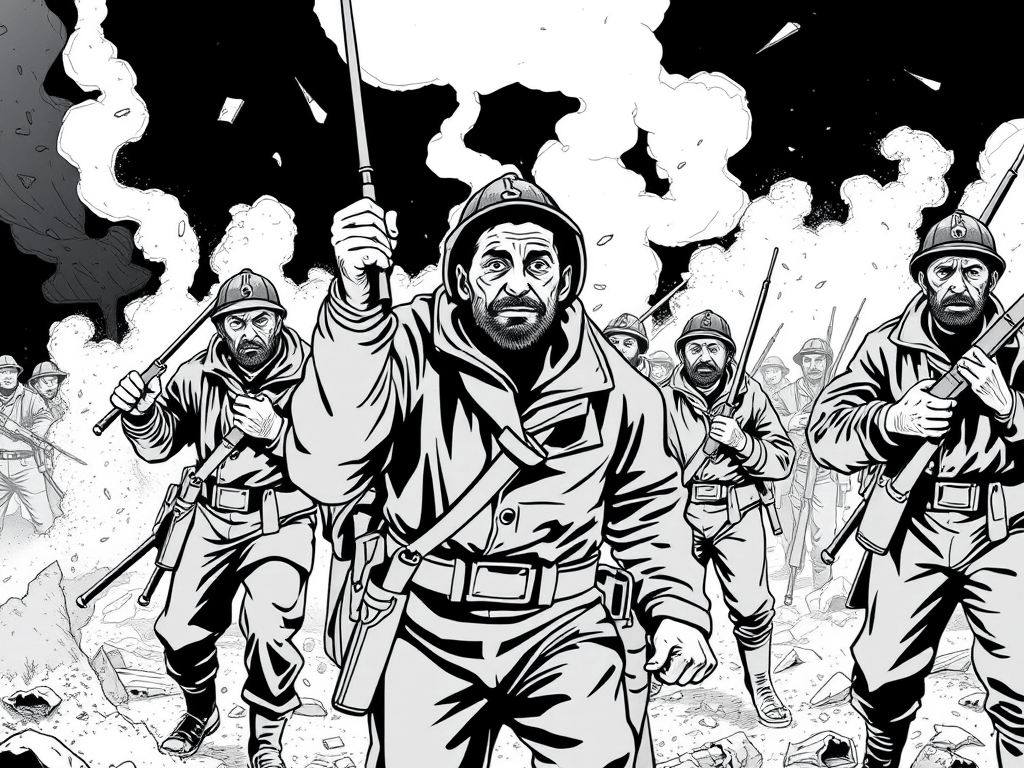
On the morning of April 20, 1914, the long-brewing conflict exploded into an all-out assault that would forever mark Ludlow in history. It was the Orthodox Christian Easter Monday, and many of the striking families (which included a significant number of Greek and other immigrant Orthodox) were in a somber mood following holiday gatherings the day before. An altercation earlier that day – some accounts say a militia officer tried to rough up a striker’s wife, others that shots were exchanged between nervous sentries – ignited a pitched battle between the strikers and the National Guard. The militia had positioned machine guns on a ridge overlooking the tent colony. Once fighting broke out, the troops began raking the camp with continuous gunfire. Panicked, the unarmed families – women, children, the elderly – dived for cover. As bullets tore through canvas, many sought refuge in the shallow pits dug beneath their tents. These makeshift cellars, which the miners had prepared anticipating exactly such an attack, became both shelters and, tragically, tombs.
The firefight raged for hours. A few armed miners tried to return fire to defend the camp, but they were vastly outgunned and outnumbered by the militia. By late afternoon, as the tent colony smoldered from incendiary bullets and overturned stoves, the strikers began to run low on ammunition and scattered to the hills, many fleeing to save their lives and regroup later. With most adult males driven off, the soldiers moved in. They doused tents with kerosene and set them ablaze systematically, to ensure the strikers had nowhere to return. Entire families’ possessions and shelter were put to the torch in an act of punitive destruction. In the chaos, dozens of people were caught in the crossfire or trapped. A horrific discovery came after the smoke cleared: under one tent, in a hole that became known as the “death pit,” the charred bodies of two women and eleven children were found huddled together. They had suffocated to death, hiding from the gunfire as the tent above them was set on fire. This gruesome finding shocked the nation and became the enduring symbol of the Ludlow Massacre – innocent women and children, victims of a war between capital and labor.
In total, the Ludlow Massacre claimed numerous lives, with estimates around two dozen killed that day (most of them miners’ family members), and many more wounded. Among the dead was Louis Tikas, the main labor organizer and leader of the Ludlow strikers. Tikas, a Greek immigrant who had become a respected union organizer, had reportedly spent the day coordinating the evacuation of women and children from the danger. As the camp fell, Tikas and a couple of fellow union men were captured by the militia. Rather than being treated as prisoners of war or arrested, they were brutally executed. Eyewitness accounts later revealed that a National Guard lieutenant bludgeoned Tikas with a rifle butt and then shot him in the back. The soldiers left his body, alongside others, sprawled in the open as if to send a warning to any who would dare challenge the coal companies. Indeed, in the immediate aftermath, the militia and company agents prevented even the Red Cross from entering the camp for days, and allowed the bodies of the slain (including Tikas) to lie exposed by the railroad tracks. This gory display was meant to terrorize the surviving miners and any other workers passing through the area – a stark message of class retribution.
From a Marxist standpoint, the massacre at Ludlow lays bare the violence inherent in the capitalist system’s maintenance of power. Here were workers asserting what they believed were fair and just demands – an end to blatant exploitation and a plea for basic human dignity – and they were met with bullets and fire. The bourgeoisie, represented by Rockefeller’s CF&I and its allies, effectively used both private mercenaries and state military forces to defend their property and profits. The Colorado National Guard, ostensibly an instrument of the people’s government, acted essentially as a private security force for capital, illustrating how the state and capital interests were intertwined. In Marxist theory, the state is often characterized as the “executive committee” of the ruling class, and the actions of the Colorado authorities lend credence to that idea. Not only were no militia members or company officials ever held accountable for the massacre, but the Governor of Colorado and even President Woodrow Wilson’s administration largely sided with the operators’ narrative that the strike was a lawless uprising. Ludlow’s bloodbath underscores that when pushed to choose between the lives of workers and the sanctity of private capital, the powers that be in a capitalist society chose the latter. This willingness to resort to extreme force to break the union is a dramatic example of class struggle at its most extreme.
Capitalist Exploitation and the Dynamics of Class Struggle
To fully analyze Ludlow as an instance of class struggle, it is crucial to articulate the underlying economic and social dynamics from a Marxist perspective. At its core, the conflict sprang from the exploitation of labor by capital – in this case, the extraction of coal by miners for the profit of industrialists. According to Marxist theory, capitalists gain profit by paying workers less than the value of what the workers produce. This surplus value, captured by the owners, is the source of profit, and increasing profit often means increasing the rate of exploitation. In Colorado’s coal mines, increasing exploitation took many forms: extending working hours, cutting pay rates, charging workers for their own essential equipment and housing, and neglecting safety to reduce overhead costs. The miners’ strike was a direct challenge to these practices – a collective action aimed at reclaiming some of the value of their labor and securing humane working conditions.
The united demands of the miners essentially sought to limit the power of capital to exploit. Calling for an eight-hour day and fair pay meant the owners could not simply lengthen hours or manipulate pay scales at will. Demanding union recognition and the right to free association threatened the owners’ unilateral control by giving workers a collective voice. Perhaps most significantly, the insistence on ending the company guard system and company towns was a bid to dismantle the semi-feudal hold employers had over every aspect of workers’ lives. These demands, modest as they might seem (after all, the miners were not calling for ownership of the mines or an end to private property – they were pleading for basic fairness within the system), were perceived by the coal operators as an existential threat. Why? Because any concession to worker organization or rights sets a precedent that could empower labor further and reduce the supremacy of capital. In the logic of class struggle, the employers understood that capitulating to the union could encourage more militant demands in the future, potentially eroding their profits and authority. Thus, they resolved to fight the strike ruthlessly, even at great human cost.
Marxist analysis also emphasizes how ruling classes use ideological and coercive apparatuses to maintain control. At Ludlow, the coercive side was plain: guns, militias, jails, and firings. But one can also observe attempts at ideology and division. The mining companies, for example, often tried to exploit ethnic tensions among the workers – the Ludlow strikers were a diverse lot, including Greeks, Italians, Slavs, Mexicans, African Americans, and native-born Anglos. In many industries, bosses used divide-and-rule tactics, pitting one ethnic group against another or using language barriers to sow mistrust among workers. The UMWA’s success at Ludlow was in fostering a sense of class solidarity that transcended these differences. Union meetings and materials were translated into multiple languages, and shared hardship built fellowship among the miners. The fact that the miners stuck together despite these differences would have been alarming to the owners. Indeed, some of the professional strikebreakers hired were themselves often from particular ethnic or racial groups thought to be antagonistic to the strikers, or simply men desperate for any work, in order to break the unity of the strike. The company also used propaganda – for instance, newspapers controlled by mine interests painted the strikers as radical anarchists or violent troublemakers, hoping to sway public opinion against them. In Marxist terms, this is an example of the bourgeois narrative attempting to justify repression of workers by branding them as criminals or subversives. Despite all this, the prevailing public sentiment after the massacre turned against the company once the scale of the bloodshed (especially the killing of children) became known. This shift highlights another aspect of class struggle: while the ruling class holds great power, it can be challenged when the brutality of the system is exposed, sharpening the consciousness of broader layers of society about injustice.
In the aftermath of the massacre, even though the miners had suffered a horrific blow, the class struggle did not simply end – it transformed. News of the Ludlow Massacre sent shockwaves through the working class across Colorado and the entire nation. In Denver, the state capital, outraged citizens and workers held mass demonstrations condemning the governor and the Rockefellers. The labor movement used the Ludlow story to rally support, with newspapers sympathetic to labor and socialist groups publicizing the atrocities committed. Notably, prominent social reformers and socialist leaders of the time decried the massacre as emblematic of capitalism’s moral bankruptcy. For example, labor activist Mary “Mother” Jones, who had been involved in organizing miners in Colorado, helped spread the rallying cry of “Remember Ludlow!” This slogan became an invocation against injustice, much as “Remember Haymarket” or “Remember Homestead” had been watchwords linking labor struggles of earlier years. In Marxist historical analysis, such episodes of severe repression can sometimes become turning points that heighten class consciousness — the awareness by workers of themselves as a class with shared interests opposed to those of the capitalists. Ludlow served as a harsh lesson in the necessity of worker solidarity and the realities of class power in America.
Solidarity and Resistance: The Working-Class Response
One of the most striking aspects of the Ludlow events is the tenacity and solidarity exhibited by the miners and their families — both during the strike and in its fiery aftermath. Despite facing extreme hardships, the strikers maintained a cooperative community in the tent colony for months. Women in the camp played essential roles, sustaining families and also participating in the strike. They ran tent kitchens, sewed banners, and some even took part in picketing and warning off strikebreakers. Children, too, contributed in their own ways, perhaps by helping with errands or simply by enduring the difficult living conditions without breaking the morale of their parents. The very decision to move into tents rather than accept defeat and return to work was itself a profound act of resistance. It symbolized a collective refusal to be cowed by the company’s control of housing and livelihoods. In essence, the workers created a self-contained community of resistance at Ludlow, one built on mutual aid and a shared vision of justice. For Marxists, this kind of unity is the seed of a broader class consciousness – the recognition that they were not just individuals at the mercy of an employer, but part of a unified class of working people fighting for each other.
After the massacre on April 20, 1914, the immediate response from the surviving miners and the wider working-class community was nothing short of insurrectionary. Rather than scattering in fear, miners across the region took up arms. News of the slaughter at Ludlow spread rapidly by telegraph, word of mouth, and through union networks. Outrage propelled miners from other camps, some miles away, to join the fight. In the days following the massacre, thousands of miners joined an armed rebellion across southern Colorado, determined to exact justice and prevent further attacks on their families. They targeted the coal mines – the physical strongholds of the companies – attacking mine guards, destroying equipment, and even occupying some mining towns. This episode, often called the Colorado Coalfield War, lasted approximately ten days and saw pitched battles between organized groups of miners and militias or company guards along a 200-mile front. The miners, many of them military veterans or immigrants with experience in conflicts abroad, formed companies of their own, some flying red flags or banners declaring workers’ control of the mines. Their rallying cries of “Remember Ludlow!” and “Burn the bastards out!” echoed the anger and grief they carried.
Strikingly, even as the miners took on the methods of warfare, they often maintained a moral high ground in contrast to their oppressors. In one confrontation, a group of miners overran a mine and captured several mine managers and their families. The mine owners’ families, including women and children, hid in a pit (ironically mirroring the miners’ families at Ludlow). Yet the vengeful workers did not inflict on them the kind of harm that had been dealt to the Ludlow women and children; the captives were released unharmed after the miners had destroyed company property. Such discipline demonstrated that the miners’ fight was not with innocents but with the armed agents of the capitalist class. Additionally, solidarity came from beyond the immediate circle of miners. Railroad workers, for instance, refused orders to transport militia troops or coal trains needed by the companies. Other trade unionists in Colorado – from building trades to factory workers – raised funds and even sent volunteers to assist the striking miners. Women’s groups, like the wives of union men in Denver and the United Garment Workers’ Union women, organized relief and protested the violence. Even some National Guard soldiers sympathized: reports emerged of a number of militiamen who, upon learning they might be commanded to shoot at miners and their families again, simply laid down their arms or refused to go.
This extraordinary level of working-class solidarity underscores a Marxist point: when class consciousness is strong, workers begin to see an injury to one as an injury to all, crossing the boundaries of trade, ethnicity, and locality. For those tumultuous ten days after Ludlow, it almost appeared as if a nascent workers’ revolution might erupt in Colorado. The state’s authorities, unable to quickly contain the miners’ uprising, appealed to the federal government. President Woodrow Wilson eventually sent U.S. Army troops to the region. Unlike the state militia, these federal soldiers were not directly under Colorado’s political or company influence, and their orders were to disarm both sides to stop the bloodshed. By early May 1914, the Army had suppressed the fighting: the miners, unwilling to battle U.S. regulars, laid down many of their arms, and the coal companies halted their private war for the moment. The strike itself, however, continued in a stalemate for months longer. Ultimately, by the end of 1914, the strike was called off without the UMWA winning recognition or most of its immediate demands. Hundreds of strikers were blacklisted (denied re-employment in the mines) and many of the union’s leaders were arrested or driven out of the region.
On the surface, it appeared a bitter defeat for the miners. But from a broader historical perspective, the Ludlow Massacre and the ensuing resistance left an indelible legacy. The sacrifices of the Ludlow miners became a powerful narrative for the labor movement nationwide. Investigations and public inquiries were launched; even the U.S. Congress held hearings in 1914 to examine labor conditions in the Colorado mines, bringing national attention to the miners’ grievances. The revelations – of families shot and burned alive, of miners living under quasi-serfdom to the company – garnered widespread sympathy for the cause of labor. In subsequent years, modest reforms followed. Colorado passed some improvements in its labor laws, and nationally the momentum for an eight-hour workday and stricter child labor laws built, partly galvanized by Ludlow. John D. Rockefeller Jr., eager to repair his public image after being excoriated as a mass-murdering tycoon, introduced a form of company union and slight wage increases in his mines, hoping to stave off further unrest. Though these measures fell far short of the strikers’ original goals and were designed to undercut real independent unionism, they were evidence that the ruling class had been forced to respond to worker unrest in some way. In Marxist terms, this is a case where the ruling class, frightened by the intensity of class struggle, made limited concessions to stabilize the system.
Just as importantly, the memory of Ludlow became a rallying point in worker education and socialist organizing. Labor organizers in the following decades cited Ludlow as proof of the need for unions and for workers to stand together. The United Mine Workers erected a monument at the site of the massacre to honor the fallen, ensuring that future generations would remember Ludlow not just as a tragedy, but as an example of workers’ courage and the high price of resistance. The site became almost sacred ground for the labor movement, a reminder of both the brutality of unchecked capital and the heroism of those who dared confront it.
Parallels in Modern Labor Struggles and Socialist Movements
While the Ludlow Massacre took place over a century ago in a specific industrial context, its themes of class struggle, labor rights, and capitalist opposition resonate strongly with contemporary issues and socialist movements worldwide. The modes of conflict have evolved – open gun battles between workers and private militias are rarer in today’s advanced industrial nations – yet the underlying struggles between labor and capital persist. A Marxist analysis sees a continuum from events like Ludlow to modern conflicts over workers’ rights, albeit often in different guises.
Firstly, consider labor conditions and exploitation in today’s global economy. Capitalism has by no means outgrown its tendency to prioritize profit over worker welfare. In fact, the relentless pursuit of lower labor costs and higher returns has driven many corporations to seek out the weakest labor protections and most vulnerable workforces. The result is that some of the grim conditions that American miners faced in 1914 have been exported to other parts of the world. In developing countries, sweatshops and mines often operate with minimal safety and poverty-level wages, eerily reminiscent of the early 20th century U.S. scenario. For example, the persistence of deadly industrial accidents – such as collapses of garment factories or frequent coal mine explosions in countries like China and Bangladesh – shows that the lessons of Ludlow are still being written in blood elsewhere. Workers in those situations face a similar calculus: risk death daily for a pittance, while the fruits of their labor flow to distant corporations and wealthy investors.
Even within advanced economies, new forms of exploitation have arisen. The rise of the “gig economy” and precarious employment means many workers lack basic job security, benefits, or the right to unionize. One could argue that the fragmentation of labor and use of contract workers in, say, an Amazon warehouse or an Uber driver pool, is a modern strategy to undermine worker solidarity – not entirely unlike how early 20th century companies used divided ethnic camps or company towns to keep workers dependent and weak. The specifics differ, but the effect is to maximize profit and minimize workers’ ability to collectively bargain, which remains a constant in capitalist strategy.
The theme of union suppression also continues in modern times, albeit often through legal and psychological means rather than outright massacres. After the 1930s in America (with New Deal reforms and stronger labor laws), blatant violent crackdowns on strikes became less publicly acceptable. However, companies still employ a vast repertoire of tactics to prevent or bust unions: hiring expensive “union avoidance” consultants, running aggressive anti-union propaganda campaigns among employees, firing or retaliating against key organizers (illegally, but often with little consequence), and exploiting legal loopholes to delay union elections or contract negotiations. The spirit of capitalist opposition to organized labor is as strong as ever. One need only look at the intense resistance major corporations have displayed toward recent unionization efforts. For instance, when warehouse workers at Amazon or baristas at Starbucks have attempted to unionize in recent years, those companies have responded with tactics ranging from mandatory anti-union meetings (to instill fear that a union would lead to job losses or closures) to outright firings of union leaders and litigating to stall union recognition. Although no machine guns are involved, the underlying power play – the desire of the capitalist to keep labor dividual and compliant – is the same that drove Rockefeller’s CF&I to refuse the UMWA in 1914.
The role of the state in labor disputes remains a crucial question, just as it was in Ludlow. Modern governments typically don’t deploy troops to shoot down strikers in democratic nations, but they often provide more subtle support to capital. Police are frequently used to break picket lines and arrest strikers who might block business operations. Courts issue injunctions that limit picketing or order strikers back to work under threat of fines and imprisonment (for example, the use of anti-strike injunctions has a long history, and even in recent times courts have sometimes banned strikes or large-scale protests deemed disruptive to commerce). Politically, many governments pass legislation that undermines union power – such as “right-to-work” laws in many U.S. states which aim to weaken union funding, or restrictions on public sector strikes. These are modern echoes of the militia intervention at Ludlow: the apparatus of the state aligning, even if under the cover of law and order, with the interests of property and profit over those of workers.
Modern socialist movements and leftist organizations explicitly draw connections between past struggles like Ludlow and today’s fight for a more equitable society. A central tenet of Marxist and socialist thought is that the emancipation of the working class must be achieved by the working class themselves. The story of Ludlow – downtrodden workers banding together to confront a mighty corporation and state power – serves as both inspiration and caution. It inspires by showing that ordinary people can challenge injustice and that solidarity can shake the foundations of power. Indeed, many contemporary socialists point to labor history as proof that any rights and comforts workers enjoy today (the eight-hour day, safety standards, the right to organize) were won through such fierce struggles, not benevolently granted by capital. The cautionary side of Ludlow’s legacy is that the ruling class will often react with extreme measures to defend its privilege, and that gains can be rolled back or co-opted if the movement is not sustained.
One concrete parallel in recent history is the 2012 Marikana massacre in South Africa, where police opened fire on striking miners, killing dozens. Though separated by nearly a century and a continent apart, observers noted the chilling similarity to Ludlow: impoverished mine workers striking for better pay and conditions, met with lethal state violence defending the mining company’s interests. The Marikana incident has been cited by socialists and labor activists as evidence that brutal class conflict is not a relic of the past, but an ongoing reality wherever workers challenge the entrenched power of capital. It reinforces the Marxist view that the state, even in a post-colonial democracy like South Africa, often serves the interests of domestic and international capital at the expense of its most vulnerable citizens.
In the United States, the resurgence of interest in socialism and labor organizing in the 21st century has also kept Ludlow’s spirit alive. Organizations such as the Democratic Socialists of America, and figures like Senator Bernie Sanders, frequently remind the public of the country’s rich labor history – including tragedies like Ludlow – to argue for stronger protections for workers today. The push for a higher minimum wage, universal healthcare, and labor law reforms are framed as continuing the struggle of workers for basic rights and dignity that past generations fought for. When young workers at an e-commerce giant or a fast-food chain consider unionizing, they may not explicitly invoke Ludlow, but they are part of the same continuum of class struggle, facing a powerful corporation that may not use bullets anymore but certainly uses power and money to resist change.
Finally, the connection between historical struggles and modern socialist thought is evident in how these memories are preserved and taught. Socialist historians and educators use events like the Ludlow Massacre as case studies in the analysis of capitalism. Ludlow is taught not just as a lamentable episode of violence, but as a stark example of the lengths to which capital will go to prevent workers from achieving collective power – and conversely, the depths of courage workers can reach when they stand together. The lesson drawn is that meaningful change in the plight of workers requires collective action and often confrontation with the existing power structure. Many of the goals of today’s socialist and labor movements – whether it be curbing corporate power, achieving democratic control in the workplace, or simply ensuring safe working conditions and a living wage – can trace intellectual lineage to the same grievances the Ludlow miners articulated in 1914. The methods may shift with time and context, but the essence of the fight remains about who controls the fruits of labor and how society values the lives of those who do the work.
Conclusion
The Ludlow Massacre of 1914 stands as a somber chapter in the annals of class struggle, a moment when the fundamental conflict between labor and capital was laid bare in gunfire and flames. Through a Marxist perspective, Ludlow is more than a historical incident; it is a prism revealing the harsh dynamics of capitalist exploitation and the valor of working-class resistance. The miners and families who perished in Ludlow did not die in vain, for their story became a clarion call that echoed through subsequent generations of labor activists and socialists. Their demands for fairness and their willingness to stand up to a vastly more powerful foe underscore the timeless struggle of the working class to attain justice. The massacre exemplified how the capitalist class, when pushed, could dispense with all pretenses of humane governance and unleash raw violence to maintain its rule – a reality Marxist theory grimly predicts in class conflicts. At the same time, the solidarity exhibited by the Ludlow strikers – across ethnic lines, across communities, even extending to sympathetic allies in other industries – demonstrated the potential strength of worker unity, a key ingredient in any challenge to the status quo.
Connecting Ludlow to the present, we see that while overt lethal force against workers in the U.S. has receded into history, the underlying battle between exploiters and exploited continues in boardrooms, warehouses, factories, and fields across the world. Modern socialist movements rightly view events like the Ludlow Massacre as both inspiration and warning in their critique of capitalism. The parallels in contemporary labor struggles – whether it is a fight for a union, a protest against unsafe work, or a campaign for living wages – all hark back to the essential issues raised at Ludlow. Who benefits from the wealth created by labor? How far will those in power go to preserve their dominance? And how can ordinary people band together to demand a more just, equitable world?
In formally analyzing Ludlow, we affirm that the massacre was not an aberration of a bygone era but a concentrated example of class struggle that is relevant to understanding present injustices. The miners’ bravery and sacrifice highlight that progress for workers has historically come not from the benevolence of the powerful, but from the collective action and resistance of the oppressed. It reminds us that rights and safety standards in workplaces were often written in the blood of martyrs like those at Ludlow. As today’s socialists and labor activists continue the fight for a society that values people over profit, the legacy of Ludlow serves as a rallying memory – a testament to both the brutal costs of unchecked capitalism and the enduring power of working-class solidarity. In remembering Ludlow, we not only honor those who fell, but we also sharpen our resolve to pursue a world in which such tragedies need never happen again – a world where, in Marxist vision, the workers themselves hold power and the cycles of exploitation and violence can finally be broken.
 Letters from Tomis
Leave a comment