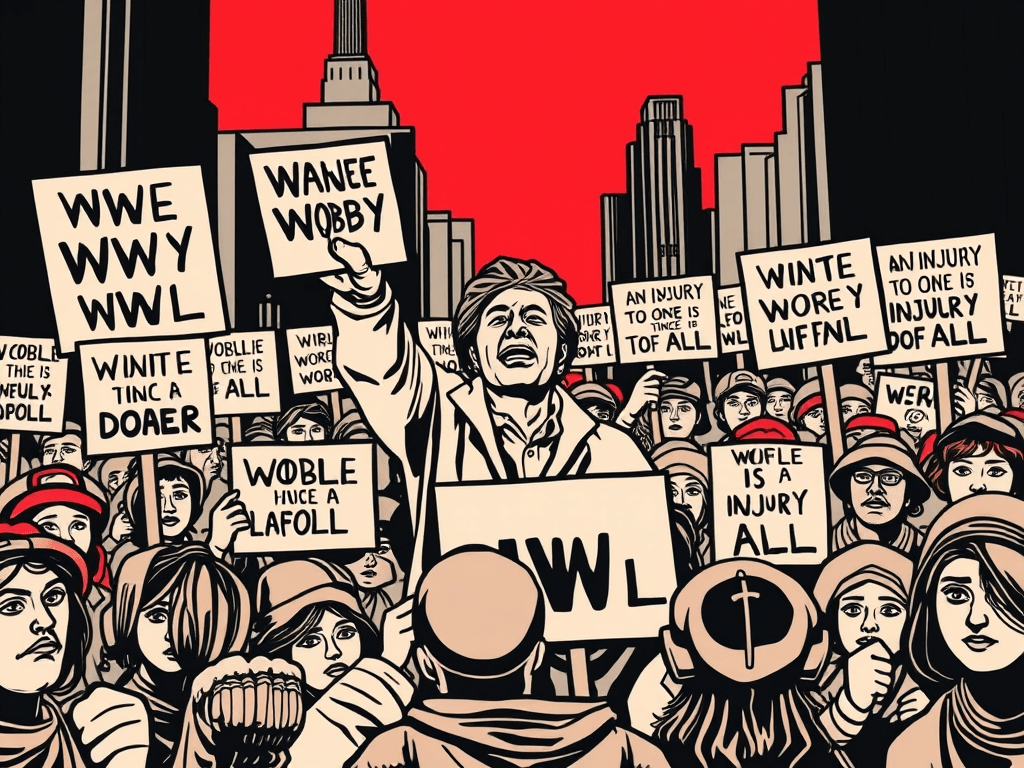
Introduction
In the annals of American labor, the birth of the Congress of Industrial Organizations (CIO) is often painted as an inevitable triumph of worker solidarity and New Deal benevolence. This sanitized tableau conveniently forgets the actual midwives of that triumph: a motley assembly of radical organizers, Marxists and Musteites, who galvanized the mass of unorganized workers with fiery conviction. From the depths of the Great Depression through World War II, it was these militant left-wing organizers – frequently maligned as “reds” – who did the thankless work of building industrial unions. One might observe that the CIO’s rise owed more to the courage of heretics than the wisdom of high priests. Indeed, without the communists and radical pacifists at the barricades, the CIO might have remained a footnote rather than a force. This essay revisits 1930–1945 polemically, celebrating how Muste’s disciples and Communist militants infused the labor movement with unprecedented daring and principle, and contrasting their achievements with the reactionary hostility they faced both from old-line labor leaders and the American state.
The Gathering Storm: Radical Roots of the CIO (1930–1935)
The early 1930s brought economic collapse and with it a wave of worker militancy that traditional labor leaders were utterly unprepared (and often unwilling) to harness. The American Federation of Labor (AFL), dominated by craft-union mandarins allergic to change, had long shunned the vast majority of industrial workers as “unorganizable” rabble. As unemployment soared and hunger stalked the land, it was left to radicals outside the AFL mainstream to channel workers’ anger into action. Communist organizers set up Unemployed Councils and led hunger marches; independent socialists like A. J. Muste formed Unemployed Leagues across the industrial Midwest. These Musteites and other leftists not only demanded relief, they drilled a simple lesson into the downtrodden: collective action could win tangible gains even in desperate times. Nowhere was this clearer than in the dramatic labor upheavals of 1934, which served as the CIO’s prelude.
Three great strikes in 1934 – in Toledo, Minneapolis, and San Francisco – exploded onto the scene, each powered by radical leadership, and together they jolted the American labor movement awake. In Toledo, Ohio, Muste’s followers in the American Workers Party (AWP) joined forces with local socialists and communists to support an Auto-Lite factory strike. Toledo was a stronghold of Muste’s radical Unemployed Leagues, and the Musteites “rapidly mobilized large numbers of unemployed workers to reinforce the picket lines,” even in defiance of court injunctions. When police and National Guardsmen attempted to break the strike – at one point shooting into a mass of thousands and killing two picketers – the protesters stood firm. The result was a rare victory: the company yielded to mediation, granting a 22% wage increase and recognizing the union in part. In Minneapolis, it was Trotskyist militants of the Communist League (later Socialist Workers Party) who organized Teamsters Local 574. They led strikes that turned the city into a virtual war zone; pitched battles in the streets against armed police and deputized company thugs ended with the employers’ “Citizen’s Alliance” in retreat and the workers in control of their union. And on the West Coast, a longshoremen’s strike led by communist Harry Bridges shut down the ports of San Francisco and sparked a citywide general strike, proving that even conservative AFL unions could be shaken into militancy by radical example. Each of these strikes was victorious against long odds – an almost unthinkable achievement in that era – and each was led by precisely the sort of radical organizers whom respectable labor leaders regarded as pariahs. As one labor historian notes, these “victorious strikes…with militant leadership” were the catalyst for the emergence of the CIO.
It is worth stressing how isolated the AFL old guard was at this moment. While Muste’s cadres and communist agitators were busy stopping bullets and organizing sit-ins, AFL President William Green and his circle remained largely passive – if not hostile – to industrial organizing. AFL unions had been losing members throughout the Depression, yet the federation responded with only timid half-measures. It authorized a few token “federal” unions for unskilled workers, but swiftly dissolved many of them for fear of upsetting craft union jurisdictions. Such timidity bordered on the farcical: the very year that Toledo’s jobless crowds were surrounding factories and Minneapolis truck drivers were routing armed police, AFL leaders were expelling militants and snubbing mass production workers. Small wonder, then, that a group of farsighted labor chiefs led by John L. Lewis of the Mine Workers concluded that the old federation was hopeless. Lewis – a hulking, pugnacious figure with a Shakespearean growl – had the strategic sense to see that unless labor organized the steel mills, auto plants, and factories, it would remain fatally weak. At the AFL’s 1935 convention, when Lewis and craft-union diehards openly clashed over organizing industrial workers, the dispute literally came to blows: Lewis ended an exchange of insults by slugging an AFL rival, an act of violence (and theater) that cemented his image as a man willing to fight for workers’ right. Shortly thereafter, he and other pro-industrial union leaders formed the Committee (later Congress) for Industrial Organization within the AFL, signaling the birth of what would become the CIO.
Musteites, Communists, and the New Unionism (1935–1938)
If the idea of the CIO was conceived by Lewis and a few allies, the execution fell largely to the radicals. Lewis was a pragmatic unionist – hardly a leftist himself – but he had few qualms about deploying militant organizers to build his new federation. As the CIO’s organizing drives got underway in 1936, hundreds of seasoned labor cadres flocked to the cause. Many of them were members of Communist and socialist groups; many had cut their teeth in the brutal strikes and campaigns of the early ’30s. Lewis, with a cynic’s wit, welcomed their talent while dismissing concerns about their politics. “Who gets the bird, the hunter or the dog?” he quipped when asked about the reds on his staff. The meaning was clear: so long as these organizers helped bag new members, Lewis didn’t mind who their friends in Moscow might be. This devil’s bargain (or perhaps marriage of convenience) between hard-boiled union leaders and radical activists defined the CIO’s early years.
The scale of radical involvement was substantial. The Communist Party USA, which had its largest-ever membership in the late 1930s, eagerly threw itself into CIO organizing. Dozens of Communists took staff positions in fledgling CIO unions. By one estimate from CP chairman William Z. Foster, at least 60 of the 200 full-time organizers in the 1936–37 steel industry drive were Party member. And that was just steel – across other industries, hundreds more communists and left-wing socialists went onto the CIO payroll as the federation’s “shock troops.” Even some of A. J. Muste’s disciples, those radical pacifists-turned-Marxists who had proven their mettle in 1934, took part despite Muste himself bowing out of the movement by 1936. The result was that by the late 1930s the CIO “included many communists” in its midst and had a reputation for militancy well beyond that of the old AFL. The new industrial unions pioneered bold tactics – most famously the sit-down strike – that would have been unthinkable without the impatience and daring of these left-wing organizers. It is no exaggeration to say the CIO’s dramatic growth in this period was fueled by radical energy: as one account notes, “because of their success, the CIO grew rapidly,” riding on the coattails of militant actions like sit-downs.
Of course, this alliance was never without tensions. Many CIO leaders were leery of the far left, even as they relied on it. Deals were struck to keep the peace. The Socialist Party, not to be outdone by its communist rivals, also sent its members into CIO organizing drives. For a brief moment, former Wobblies, Musteites, Trotskyists, Socialists, and Communists all rubbed shoulders under the CIO tent, united by the practical goal of unionizing the unorganized. The Popular Front ethos of the day – a broad anti-fascist cooperation – also encouraged radicals to work with liberals and moderates. Still, the communists in particular had to walk on eggshells. Lewis and his colleagues, like CIO Vice-President Philip Murray, made sure to keep ultimate control in their own hands, giving the radicals enough leash to be useful but yanking them back whenever they grew too bold. If a communist organizer agitated a bit too publicly about Marx or class struggle, he’d quietly be dismissed. Victorious campaigns were often followed by reassignments – successful left-wing organizers would be packed off to the next city before they could build a personal following in the local union. As a result, the CIO of the late ’30s was a paradox: driven at the base by leftist fervor, but moderated at the top by leaders who were wary of that same fervor.
Even with these internal frictions, the achievements of this radical-infused CIO were historic. In the space of a few years, millions of industrial workers who had never known a union card now had representation and collective bargaining rights. Factories that had been bastions of the open shop fell like dominos to CIO drives. To appreciate the magnitude of this transformation, we can examine two key battleground industries: auto and steel.
Radical Triumph in Auto: The Flint Sit-Down Strike
Nowhere did the new unionism display more audacity than in the auto industry. The United Automobile Workers (UAW), a CIO affiliate, was initially a small, scrappy union with just a few thousand members. But it had an invaluable asset: a core of left-wing activists – some socialist, some communist, some Musteite – determined to take on the most powerful corporation in the world: General Motors. In late 1936, these UAW militants launched what can only be described as an industrial insurrection. Rather than a conventional strike (where workers picket outside and risk being replaced by scabs), they pioneered the sit-down strike: workers stayed inside the plant, physically occupying the factories and halting all production. This tactic had been percolating in labor circles (some credit French workers or the IWW for inspiring it), but in America it was adopted with particular zeal by radicals who understood that conventional strikes often spelled defeat. By seizing the factory, workers presented both management and authorities with a fait accompli – any attempt to dislodge them risked destroying the company’s own property. It was bold, illegal, and profoundly effective.
The decisive trial of the sit-down strategy came at Flint, Michigan in the winter of 1936–37. UAW organizers targeted GM’s nerve center – the Flint complex – and in late December occupied key plants. They kept their plans secret to evade company spies, and once inside, established a regimented system to hold the factories. They even fended off an assault by police and company guards using fire hoses and hurled auto parts, in what came to be known as the “Battle of Bulls’ Run.” Michigan’s Governor, Frank Murphy, to his credit, refused GM’s demands to send in troops to massacre the sit-downers; instead he pressured both sides to negotiate. After a tense 44 days, GM blinked: in February 1937 it agreed to recognize the UAW as the bargaining agent for its workers. It was an astonishing victory over an industrial titan. Importantly, while John L. Lewis helped broker the final deal, the on-the-ground leadership in Flint came from the workers themselves – many of whom were influenced by radical ideas. Socialists like Walter Reuther (who, despite later anti-communist credentials, was at that time working closely with communists) and communists like Henry Kraus and Wyndham Mortimer all played parts in mobilizing the rank and file. Notably, when a more conservative UAW president (Homer Martin) later tried to purge the Communist faction, he even expelled the Reuther brothers for having cooperated with communists – a short-lived ouster that the union’s rank-and-file reversed the next year. The episode underscored that the UAW’s early successes were inextricably linked to radical activism; any attempt to excise the leftists in 1937 would have crippled the union’s fighting capacity.
Fresh from Flint, the UAW quickly organized Chrysler and smaller automakers without needing major strikes – now that the dam had broken, workers flocked to join. However, one company remained stubbornly anti-union: Ford Motor Company. Henry Ford, an avowed reactionary and notorious anti-Semite, loathed unions with a passion and maintained a private police force (the Ford Service Department, led by the brutish Harry Bennett) to intimidate and attack union sympathizers. Ford’s plants were like armed camps where spies and gangsters made sure “union talk” was silenced with fists or worse. In May 1937, as the UAW began an organizing push at Ford’s giant River Rouge complex, Bennett’s thugs brutally beat UAW organizers Walter Reuther and Richard Frankensteen on an overpass in broad daylight – the infamous “Battle of the Overpass.” Photographs of the bloodied Reuther went nationwide, creating a public relations disaster for Ford. Yet such was Ford’s intransigence that it took four more years and the pressures of wartime production for the Ford Motor Company to finally sign a union contract in 1941. The lesson in auto was clear: where workers, led by radicals, mustered extraordinary unity and bold tactics, they prevailed even against giants; but the forces of reaction – whether corporate or criminal – would stop at nothing to resist. The UAW’s birth was thus a triumph of militant organizing over corporate feudalism, and it vividly demonstrated the positive contribution of left-wing ideas: without the sit-down strike (a tactic denounced by conservatives as anarchy), the CIO’s victory in auto might never have happened.
Storming Steel: Reds Organize the Unorganizable
If Detroit’s assembly lines tested the mettle of CIO organizers, the steel mills were an even greater crucible. The steel industry in the 1930s was considered nearly impregnable to unionization. U.S. Steel (the largest firm) and the so-called “Little Steel” companies had long crushed unions through brute force – hiring private armies, fomenting ethnic divisions among workers, and wielding political influence to call in police or troops at the first hint of labor unrest. It was an industry where company spies and company-sponsored “welfare” unions kept workers cowed. The AFL had disastrously failed to unionize steel in 1919, when a national steel strike (led in part by William Z. Foster) was broken by Red Scare hysteria and violence. Many thought a genuine steel union was a fool’s dream. But the CIO’s radicals saw an opportunity to finish what past struggles had begun.
John L. Lewis had a personal interest in organizing steel – coal miners (his base) supplied the steel mills, and their wages depended in part on the fortunes of steelworkers. In 1936 he created the Steel Workers Organizing Committee (SWOC) and appointed Philip Murray (a close associate, politically moderate) as its chairman. But crucially, Lewis flooded SWOC with experienced organizers, “many [of whom] were his past political opponents or radicals drawn from the Communist-led unions that had attempted to organize the industry earlier in the 1930s.” In other words, he brought in the very communists and leftists who had been agitating in steel towns for years. One can almost imagine the grim satisfaction of William Z. Foster – now a top Communist leader – seeing his old plans dusted off and implemented. (Foster’s 1920s endeavor, the Trade Union Educational League, had laid groundwork among steel workers, and many of his proteges were now SWOC staff.) The communists lent SWOC their organizing expertise and their commitment to interracial unionism: unlike the AFL, which mostly excluded Black workers, the CIO (reflecting left-wing influence) made real efforts to organize Black steelworkers on an equal basis. Foster himself was a pioneer in demanding Black equality within the labor movement, a stance that helped the CIO break racial barriers in heavy industry.
The CIO’s steel campaign achieved a stunning breakthrough in March 1937 when U.S. Steel – the largest and historically most anti-union company – agreed to recognize the union without a strike. This was a top-down victory: rather than a militant plant-by-plant uprising as in Flint, Lewis secured a peace with U.S. Steel’s management by convincing them that a strike would be costly and futile (pointing to the chaos GM had endured in Flint). U.S. Steel’s chairman, Myron Taylor, chose to appear enlightened (and perhaps avoid broken windows and occupied mills) by signing a contract granting modest wage increases and a grievance process. It was a pragmatic business decision facilitated by the credible threat of militant action. That threat was made real by SWOC’s army of organizers, whose ranks – as noted – were rich with communists. Indeed, Communist Party leader Eugene Dennis famously quipped that Lewis “surrendered” to labor’s left wing by chartering SWOC as a quasi-autonomous entity, since SWOC’s actual field operations were so heavily run by reds. Lewis’s cynical bon mot about hunters and dogs was a direct reference to this arrangement – he knew who was doing the hunting (the radical organizers) and who would ultimately claim the bird (Lewis and mainstream labor).
If U.S. Steel was a bloodless victory, the real test came with the smaller steel firms – Republic Steel, Bethlehem Steel, Youngstown Sheet & Tube, etc. These “Little Steel” companies refused to follow U.S. Steel’s lead and vehemently resisted unionization. In May 1937, steelworkers struck at several Little Steel plants to demand their basic right to a union. What followed was some of the most bitter violence of the decade. In Chicago, a peaceful mass picnic and march by strikers at Republic Steel turned into the Memorial Day Massacre when city police suddenly opened fire on the crowd. Ten unarmed strikers were shot dead in cold blood, and dozens more were wounded or clubbed in the aftermath. Among the killed were not only union men but supporters – even women in the crowd were beaten. The police later concocted a story that they were faced with a “Communist mob” insurrection, a claim utterly unsupported by evidence. The Memorial Day Massacre stands as a gruesome reminder of what the CIO was up against: reactionary forces in law enforcement and local government that would rather shoot workers in the back than allow them to organize. It was, as the Chicago History Museum records, “one of the most deadly in US labor history,” with no one held accountable for the slaughter.
Elsewhere in the Little Steel strike, battles raged in Ohio and Pennsylvania. Police and company goons attacked picket lines; airplanes were even used to drop supplies to besieged workers in one Ohio mill under strike, as if it were a wartime siege. Despite the valor of the workers and the support of communists who often led strike committees, the Little Steel strike of 1937 ended in a partial defeat – the companies held out until the pressure of war production eventually forced them to accept unions by 1941. Yet even in this setback, the positive role of the CIO’s radicals was evident: they brought the fight as far as it could go, exposing to the nation the brutal lengths to which industrial barons and their police enablers would go to block unionization. A Senate investigation (the La Follette Civil Liberties Committee) later revealed how Republic Steel stockpiled tear gas, guns, and even launched an anti-union propaganda campaign to paint the CIO as communist traitors, all with tacit approval from local authorities. Without the communist and left-wing organizers keeping the flame of resistance alive, those mills might never have unionized at all. In fact, by 1942 contracts were finally won, vindicating years of effort. The steel story thus shows both the indispensable contribution of radical organizers (who bore the brunt of the early battles) and the ferocity of the reaction they provoked.
Reactionaries Strike Back: Red-Baiting and Repression
At every stage of this tumultuous journey, the forces of reaction lurked in the wings, ready to pounce. The success of the CIO – achieved on the shoulders of leftist militants – triggered profound anxiety among established power brokers. Within the labor movement, the AFL leadership reacted with a mix of outrage and fear. By 1936, the AFL expelled the CIO unions outright for “dual unionism,” effectively declaring war on Lewis’s faction. AFL stalwarts like William Green and crafts-union barons such as carpenters’ leader William Hutcheson (whom Lewis had decked in that famous altercation) painted the CIO as a rogue operation teeming with communists and anarchists. This was not entirely wrong – the CIO did teem with communists – but the AFL’s motivation was hardly ideological purity; it was the threat to their own power. Nonetheless, the red-baiting started early. AFL publications and allies spread propaganda that the CIO was a Trojan horse for Bolshevism, that John L. Lewis was in bed with Stalin. The irony that the AFL itself was doing precious little to organize the working class was not lost on astute observers. Even Franklin D. Roosevelt, supposedly labor’s friend, kept the CIO at arm’s length initially, wary of its radical tinge, while welcoming AFL support. Yet the CIO’s ranks swelled with millions of workers, proving that average workers cared more about bread-and-butter gains than red-baiting smears.
Within the CIO, as we’ve seen, moderate leaders tried to manage the influence of the radicals but also valued their contributions. By 1939–1940, however, global events strained this marriage of convenience. The Communist Party’s line, dictated by Moscow, zigzagged with the Nazi-Soviet Pact of 1939 – suddenly communists went from supporting Roosevelt’s preparedness to denouncing the war as imperialist (until Hitler invaded the USSR in 1941, when they changed again to fervent patriotism). These contortions made even the most patient CIO allies of the communists begin to lose trust. John L. Lewis himself broke politically with many on the left in 1940: he opposed FDR’s third term and resigned as CIO president in 1941. Still, during World War II the CIO and the communists maintained a public unity for the war effort. The Party, to demonstrate its loyalty, imposed a no-strike pledge, effectively tamping down labor militancy to help Roosevelt win the war. This self-imposed moderation by communists showed their commitment to the nation, but it also had the perverse effect of reducing the very pressure that had built the CIO. One might note that the communists in American unions thus proved more patriotic than many capitalists – while unions froze wages and pledged not to strike, some corporations continued reaping profits. But benevolence did not buy the left enduring gratitude.
As the war drew to a close in 1945, reactionaries both in government and within labor prepared to settle scores. The U.S. Congress had already planted the seeds with the Dies Committee (House Un-American Activities) back in 1938: it proclaimed that no fewer than 280 CIO staff members were Communist Party members, a statistic trotted out to smear the entire organization as subversive. This was a classic guilt-by-association tactic – imagine damning the achievements of a union of millions because a few hundred organizers carried a Party card. Yet such was the hysteria to come. With the dawn of the Cold War, anti-communism became a tidal wave that would wash over the CIO. By the late 1940s (just outside our time frame), CIO leaders purged nearly all communist influence, even expelling 11 left-led unions in 1949, effectively amputating some of the most progressive segments of the labor movement. But during 1930–1945, it is important to emphasize, those left-led unions and organizers were still integral to CIO’s strength. In fact, when a premature attempt was made in 1938 by UAW president Homer Martin to purge communists from the auto union, it backfired spectacularly – Martin was deposed and the expelled left-leaning leaders (including Walter Reuther) reinstated. The CIO rank-and-file in those years often respected the communists as dedicated fighters for workers’ interests, even if they didn’t share their politics.
On the government side, repression was usually more stick than carrot. We have already recounted the brutal police violence at the Memorial Day Massacre. That was no anomaly – police and National Guard interventions in strikes were common. What changed with the CIO era was that labor sometimes had sympathetic voices in high office (e.g. pro-labor governors like Michigan’s Murphy, or senators like Robert La Follette Jr. investigating repression). Still, local authorities like the notorious Mayor Frank Hague of Jersey City – a Democrat boss, no less – outright banned CIO rallies and had organizers arrested for distributing leaflets, claiming “I am the law” in his domain. The CIO took Hague to court, and in 1939 the Supreme Court (in Hague v. CIO) affirmed the CIO’s right to free assembly. That victory underscored how reactionary forces in the state were so egregious that even the courts (hardly radical institutions) had to rein them in to uphold basic constitutional rights. Meanwhile, the FBI under J. Edgar Hoover surveilled communist organizers continuously, laying the groundwork for the witch-hunts to come.
Thus, the reactionaries in both labor and government saw to it that the CIO’s radical edge would be blunted as soon as practicable. They tolerated the “reddish” tint of industrial unionism only as long as fascism loomed and production was paramount. The moment the crises of Depression and war eased, the knives came out for the left. Yet, and this is crucial, none of that retroactive hostility can erase the accomplishments that Muste’s acolytes and communist militants achieved in the CIO’s formative years. The American working class was organized on a scale and with a zeal never seen before, precisely because these radicals were present at the creation. The reactionaries may have won the last chapters of this story (by purging the communists and reasserting bureaucratic control), but they could not have even written the opening chapters without the radicals’ ink.
Conclusion
In examining the CIO’s early history, one cannot help but apply a similar lens: The comforting national myth is that enlightened New Dealers and upright union statesmen uplifted America’s workers. The truth is rather more uncomfortable (for some) and more inspiring (for others): it was the radicals, the ones vilified as traitors and agitators, who struck the sparks that lit labor’s flame. A. J. Muste’s indefatigable idealists, who marched armies of unemployed into battle, and William Z. Foster’s communist cadres, who never wavered in the mills and mines, proved to be the backbone and brain of an insurgent labor movement. They forged industrial unions where company gunmen and racist hiring had long kept workers divided and docile. They popularized tactics of direct action – sit-downs, mass pickets, flying picket squads – that gave workers new leverage on the shop floor. They insisted that all workers, black or white, native or immigrant, skilled or unskilled, belonged side by side in the same fighting organization – a principle anathema to the old AFL but essential to CIO’s success. When the CIO broke through, winning union recognition in autos and steel and beyond, it validated the radicals’ vision that only bold industrial unionism could wrest power from America’s captains of industry.
None of this is to claim the radicals were saints or to deny others their due. John L. Lewis’s cunning and oratorical thunder, for instance, were vital; without his shrewd leadership, the CIO might have floundered or been crushed. Rank-and-file workers by the millions showed bravery and solidarity that didn’t require any -ism besides a sense of justice. And yet, to omit the role of the Musteites and communists is to lobotomize the history. It would be as if one praised a novel while stripping out the most dynamic characters. We should distrust any history that heaps laurels on the comfortable while excising the contributions of the uncomfortable. The Musteites and the communists were decidedly uncomfortable to the powers that be – they preached a radical gospel of worker emancipation that challenged not only factory bosses but also the cozy relationship between mainstream union leaders and the status quo. That very willingness to challenge and confront made them effective. Reactionaries in Congress and the AFL might have denounced these militants as a cancer, but in truth they were the cure for a moribund labor movement.
By 1945, the CIO had become a powerhouse, a legitimate voice for labor in the corridors of power and a key part of the New Deal coalition. The groundwork for that was laid in the barricades of 1934, the occupied plants of 1937, and countless lesser-known struggles where radicals toiled. The ensuing Cold War would all but write these radicals out of the official story, turning them into un-persons or demons. But as we sift through the record, the evidence is plain: without them, the CIO’s dramatic rise would not have succeeded. The positive contributions of Muste’s disciples and Communist militants to the CIO are not a matter of sentimental leftist nostalgia; they are attested by hard facts and contemporary testimony. Even adversaries grudgingly acknowledged it – the House Dies Committee’s alarm over “280 Communist CIO organizers” is in an odd way a compliment to how integral the reds had become. John L. Lewis’s wry admission about the “hunter” and the “dog” is likewise an unintentional homage to the red organizers who fetched the bird for him. These radicals organized the unorganized, braved the bullets and batons, and built the locals that became the backbone of industrial unions.
In summing up this epoch, one cannot do better than to highlight the supreme irony: the United States of America, bastion of capitalism, saw its working class elevated to dignity in the 1930s by the very “reds” that the nation would soon persecute. The 1930–1945 history of the CIO is thus a testament to how social progress often owes a debt to its ideological outsiders. The Musteites and Communist militants proved that radicalism was not a foreign contagion but a powerful indigenous force for democracy in the workplace. They helped turn “industrial unionism” from a slogan into a living reality for millions. That legacy – however occluded by later events. In the end, the CIO’s radical founders did not ask for gratitude; they only asked that the workers of America stand up. And stand up they did, reshaping the nation in the process. History may be written by the victors, but in this case the victors stood on the shoulders of giants they would later disavow. Recognizing those giants is not only a matter of historical justice, it is a reminder that progress emerges not from polite consensus but from the relentless pressure of righteous troublemakers. The CIO had plenty of those – and we have them to thank for a union movement that, for a time, gave American workers a fair share of the American promise.
 Letters from Tomis
Leave a comment