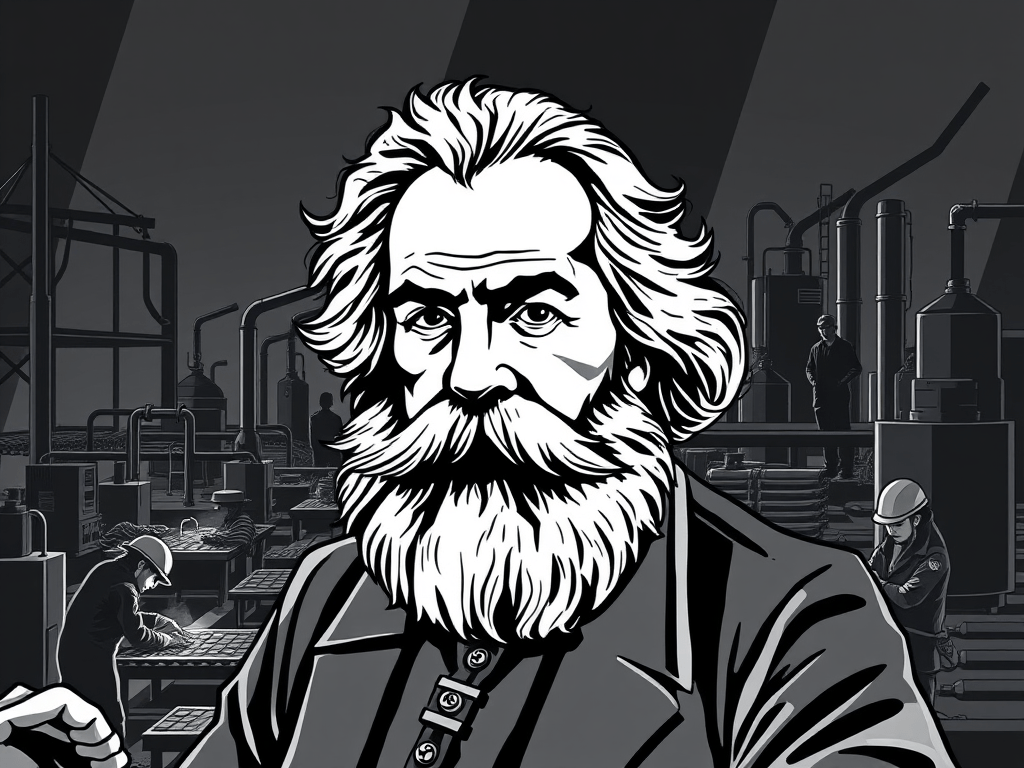
An ongoing series of reflections on Marxist economics after reading What is Marxism: An Introduction into Marxist Theory by Rob Sewell and Alan Woods. The thoughts, opinions, and any errors are mine alone.
One must engage Marxist economic theory not merely as a scholarly curiosity but as a scalpel that cuts to the very marrow of capitalist society’s recurring ailments. Marx’s penetrating analysis, never one to settle for facile explanations, locates the fundamental cause of capitalist crises not in transient mismanagement nor superficial financial malpractice, but in the systemic contradictions at capitalism’s very heart—the conflict between the social character of production and the private appropriation of profit.
At the center of Marxist economics is the concept of surplus value, the source of capitalist profit derived from the labor of workers. Workers produce commodities whose value exceeds their wages—the difference siphoned away as profit by the owners of capital. Yet capitalism, by its very nature, incessantly expands production, pushing technological advances to lower the cost of commodities, thereby intensifying competition and inevitably reducing the rate of profit over time. This “tendency of the rate of profit to fall,” as Marx so aptly phrased it, is capitalism’s Achilles’ heel, forcing ever more aggressive strategies to maintain profitability: wage suppression, lengthening working hours, and relentless mechanization.
It is precisely this relentless accumulation, paradoxically driven by capital’s insatiable thirst for profit, that lays the groundwork for its periodic crises. While individual capitalists strive rationally for personal enrichment, collectively their actions result in overproduction and underconsumption—too many goods chasing too few buyers. Marx eloquently described this phenomenon as a crisis of realization, where capitalists find themselves with commodities they cannot profitably sell, not due to scarcity or need, but because the exploited masses simply lack the purchasing power to absorb the glut produced by their own labor.
Capitalist crises thus appear with grim inevitability. Each boom, marked by optimism and speculative investment, sows the seeds of its own demise by exacerbating income disparities, concentrating wealth and reducing consumption power among the masses whose labor fuels the system. Marx argued with prescient clarity that crises were not aberrations but essential features of capitalism’s internal logic—storms to clear away inefficiencies, yes, but storms that repeatedly devastate the lives of workers and destabilize societies.
Moreover, capitalism’s crises grow progressively deeper and more destructive. The very tools used by capitalists to escape crisis—financialization, credit expansion, and speculative investments—merely postpone the inevitable, amplifying the scale of eventual collapse. Recent history offers abundant evidence, from the Great Depression of the 1930s to the financial crisis of 2008, each revealing that the capitalist system, left to its devices, does not spontaneously stabilize but moves cyclically toward chaos.
Thus, in Marxist economics, the fundamental cause of capitalist crises lies in capitalism’s internal contradiction between collective production and private appropriation. As Marx forewarned, and as history recurrently demonstrates, the capitalist mode of production is inherently crisis-prone, a system whose periodic convulsions are not mere anomalies, but symptoms of structural instability. Until society transcends this contradiction—moving towards a mode of production where socialized labor matches socialized ownership—the capitalist world remains fated, as Marx famously stated, to recurrent bouts of “epidemic overproduction,” each crisis more damaging than the last, each recovery more tenuous and fleeting.
 Letters from Tomis
Leave a comment